Gutters and flashings
Five advantages of steel external window sills
In brief
A steel external window sill should be considered as part of a complete detail, not just a sheet of metal. The building owner and the trade should check whether the light form, dimensional fit and consistent colour go hand in hand with a slope, stable support and ends that drain water away from the façade. The article discusses five advantages of this solution, but also shows the limits of their operation: the sheet is not a platform or a universal shelf, and its durability depends on the coating, installation and later care. The choice of variant should take these dependencies into account.
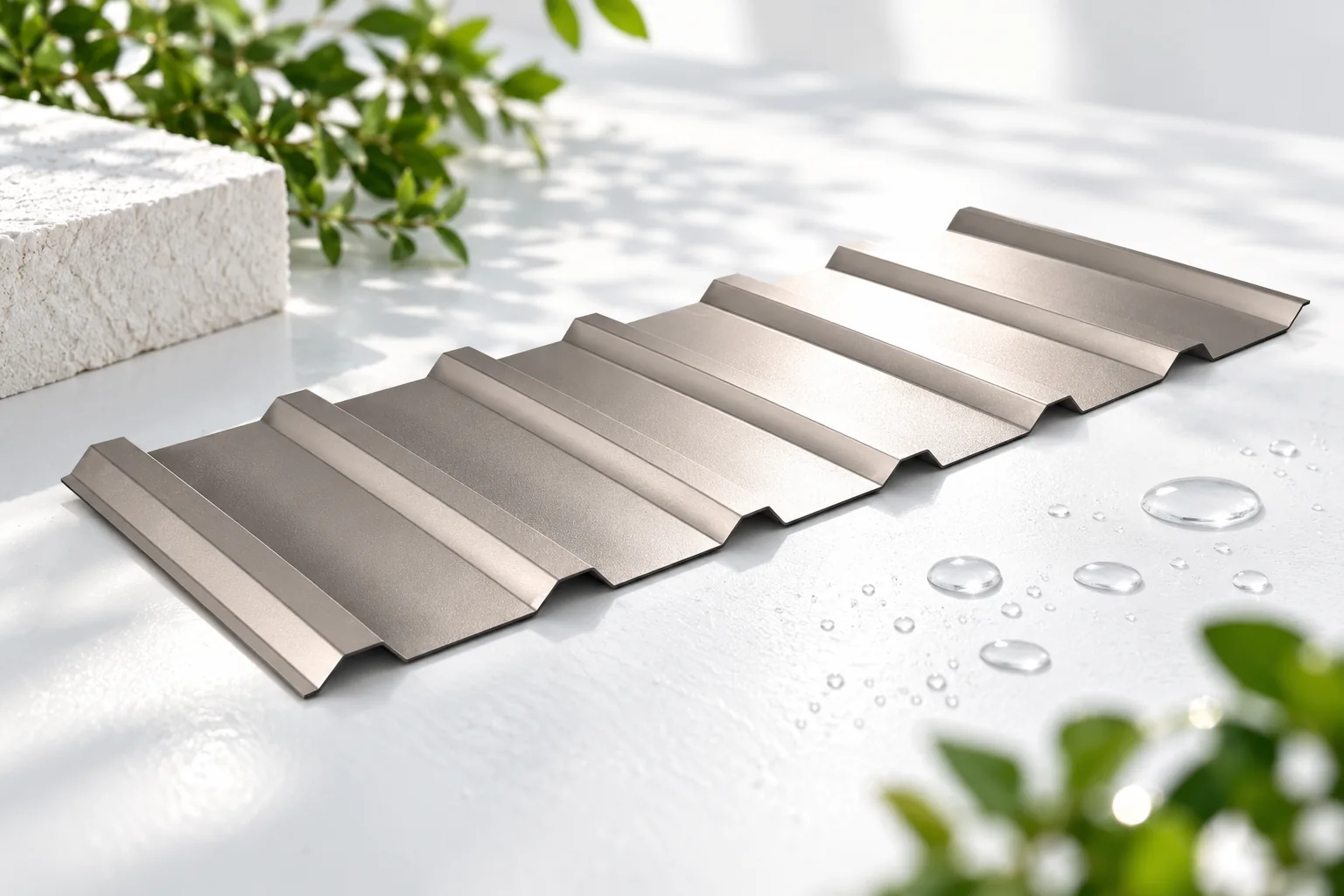
1. Low weight makes work at the window easier
A sheet-metal element is light compared with a solid mineral sill of similar dimensions. This makes transport and positioning at the opening easier. This matters especially when modernising a façade where access is limited. Low weight does not mean, however, that proper support and fixing can be omitted.
The sill should remain stable during use and under weather exposure. A wide element may require a particular bearing solution. It is not a platform for working at the window nor a universal shelf for heavy objects. Its suitability results from its purpose and method of installation, not from the mere fact that it is made of steel.
2. Dimensions can be adapted to the façade
The sheet can be prepared in a length and width to suit the specific opening and wall thickness. This allows the correct projection beyond the finished face to be maintained. This is useful when insulating, when the old sill becomes too short. The measurement must take into account all layers that are yet to be installed.
Side terminations, the joint under the window and allowance for thermal movement must also be planned. It is not enough to measure the width of the recess and order exactly the same length. The element should not be rigidly wedged between the reveals. The dimensioning details should correspond to the chosen installation system.
3. A slim edge tidies the appearance
A steel sill forms a relatively delicate line under the window. It can work well with a plain façade, metal flashings and dark joinery. The shape of the front edge is not, however, only of visual importance. It should help detach water droplets from the surface and direct them away from the wall.
It is worth assessing the detail from a greater distance and in relation to the whole frame. Too large or too small a projection changes the proportions. The dimension should not be chosen solely to make the sill less visible. Water running down the façade will quickly cancel out the aesthetic effect through streaks and dirt.

4. The colour can be coordinated with the roof and flashings
The available finishes allow you to match the sill to other metal elements. A consistent shade can bring the roof, gutters and frames together into an orderly whole. It is best to compare actual samples in daylight. A colour name or number does not show differences in gloss and texture between different surfaces.
A dark sill can clearly emphasise the window, while one close to the render creates a calmer detail. There is no single correct combination for all buildings. It is worth maintaining consistency across the whole façade, however. Choosing a single sample in isolation from the frame and render may give a different effect than expected after installation.
5. A smooth surface makes cleaning easier
Typical soiling is easy to remove from a correctly executed surface using a method suited to the coating. The slope helps drain water away, and the absence of places that trap deposits limits the build-up of dirt. The sill still requires periodic cleaning. The material’s resistance does not mean that dried-on contamination can be removed with any product.
The coating must be protected from abrasion and aggressive chemicals. Sharp tools can damage the protective layer. If a scratch appears, the method of repair depends on its extent and the type of finish. The entire surface should not be painted over with an arbitrary paint just to hide minor local damage.
What must correct installation ensure?
The sill should direct water outwards, remain stable and work together with the window. The connection must not block the drainage openings of the joinery. The sides must limit the penetration of water into the reveal. Continuity of insulation under the frame is also important. The metal element alone does not solve the entire thermal detail.
Thermal movement requires appropriate clearances and terminations. A rigid press-fit between sections of render can cause stress. Fixing materials are selected to suit the system and the substrate. It is not worth treating a single foam or adhesive as a universal method for every width and every type of window. The correct solution should be agreed before the façade is executed.
How do you check the sill at acceptance?
Assess the slope, projection, stability and condition of the coating. Check the terminations and the connection under the window. Water should leave the front edge beyond the face of the wall. It is also worth making sure that the protective film was removed at the appropriate time. Leaving it on in the sun for a long time can make it harder to remove later.
Keep the dimensional data and information about the finish. In the event of a repair, it will be easier to select a matching element. A steel sill is a good solution when its advantages result from a complete detail. Buying a lightweight, aesthetically pleasing sheet metal alone will not ensure tightness or correct water drainage.
7 branches. Materials closer to your project.