Roof coverings
Specifying a protective coating for sheet metal exposed to the weather
In brief
Describe the conditions on both faces of the sheet before choosing a finish. Outside, note whether the site is coastal, close to heavy traffic or other pollution, or surrounded by dense vegetation. How long does the surface stay wet? Inside, check for condensation and consider what the building is used for. The two faces may need different protection. Give the person specifying the coating these details so they can confirm where the proposed product can be used. Colour and warranty length alone tell you little about its suitability for that exposure.
How to describe the surroundings before choosing a coating?
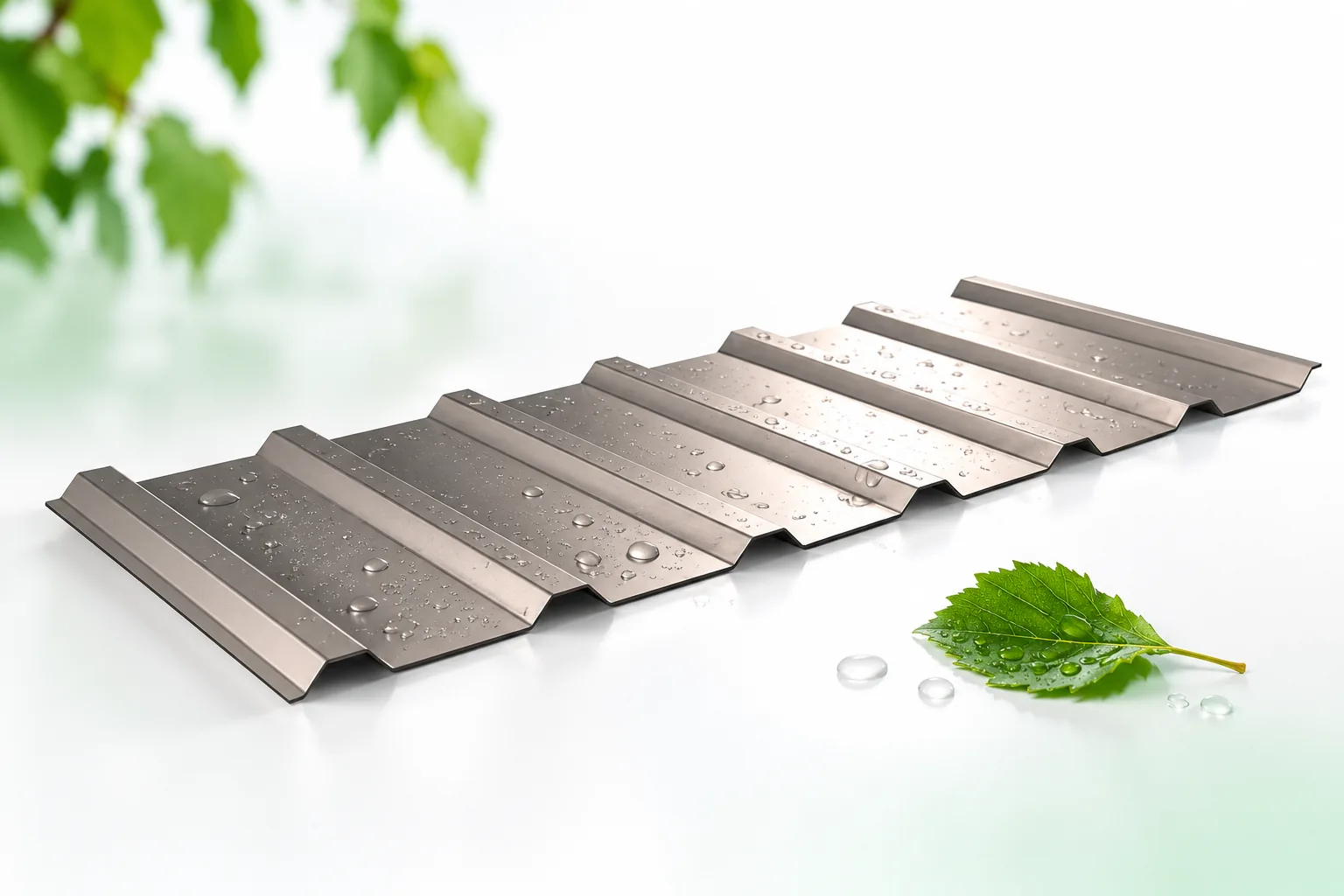
Start with the location and its immediate surroundings. Check the proximity of the sea, sources of pollution, a busy road and large clusters of plants. The time moisture remains on the surface also matters. A sheltered section may dry differently from an open roof slope. A general description of “a house outside the city” is not enough if a source of aggressive deposits is active nearby.
It is worth noting local areas of greater exposure, for example at installation outlets. Conditions on one roof need not be identical everywhere. Pass the information on to the person selecting the material. It allows them to check the scope of application and the warranty exclusions. Concealing unusual conditions does not save money but makes proper assessment difficult from the start.
Why must both sides of the sheet be examined?
The outer surface works under the influence of precipitation and solar radiation. The underside may be exposed to condensation or the environment of the room. In agricultural and production buildings these conditions can be demanding. One should not assume that a standard underside layer has identical properties to the outer decorative coating. Data for the specific product are needed.
In a heated building, the correct construction of the building envelope is important. The coating does not replace vapour control and ventilation. If water constantly condenses under the steel sheet, the cause must be established. Selecting a more resistant finish may be part of the solution, but it does not remove errors in the layers. Both issues should be considered together before the material is ordered.
How to compare declared properties?
Check the type of metallic layer, the organic coating and its parameters. Separate corrosion resistance from colour and gloss behaviour. If the documentation contains classes, their meaning in the given system must be read. The coating resistance class should not be equated with a simple guarantee of use in every location with a similar environment symbol.
Coating thickness is important, but not the only factor. Composition, substrate preparation and the construction of the entire system matter. A similar number of micrometres does not prove identical properties. Compare product data sheets with the same intended use. If anything is unclear, ask for confirmation of suitability for the specific location and method of use instead of creating your own ranking from names.

What do salt, dust and sheltered surfaces change?
Deposits may retain moisture or affect the surface in a way that depends on their composition. A roof by a road and a façade sheltered by a deep eaves overhang require a different view from a clean, open roof slope. Rain does not always effectively remove contamination. Soffits, laps and areas at flashings are often less washed and at the same time harder to inspect.
When choosing, it is worth checking whether these areas can be cleaned regularly. The type of cleaning agent and the cleaning method must comply with the instructions. Strong chemicals should not be used simply because the deposit is difficult to remove. In a demanding environment, specific care rules may be needed. These should be known before purchase so that the scope of subsequent maintenance can be realistically assessed.
How to read warranty limitations?
Check whether the document refers to the coating and application being ordered. The conditions may distinguish between environments, distances from specific sources of exposure or types of damage. The longest period in the offer must not be applied to every variant. Protection of appearance and protection against specific corrosion may have a separate scope.
It is worth clarifying the required inspections, documentation of works and permitted repairs. A warranty is not an exact prediction of durability. Nor does it replace proper installation. If you are planning a building for an unusual purpose, keep written confirmation of the material. This makes it clear later which conditions formed the basis of the choice and to which product the documents refer.
How to turn the selection into the right order?
Record the full coating variant on both sides, the material thickness, the profile and the colour. Also check that the flashings and fasteners are compatible with the system. The specified protection should not be replaced with another simply because it has a similar shade. In the case of substitution, suitability must be confirmed again. Saving on a non-compliant variant can impair the overall protective effect.
On acceptance, compare the labels with the specification and ensure proper storage. A coating selected for a demanding environment can still be damaged by dragging sheets or improper cutting. It is also worth establishing how subsequent inspections will be carried out. Selection for the environment is effective when the material decision, workmanship and care all relate to the same actual conditions.
7 branches. Materials closer to your project.