Roof coverings
When is sheet metal a suitable choice for a roof?
In brief
A metal roof is worth considering above all when you want to reduce the weight transferred to the structure — both in a new design and when replacing an old covering. Before choosing a profile and format, however, check the condition of the roof truss, the snow load and the wind action. A lightweight material will not repair weakened joints or damp timber. Compare weight for a specific sheet thickness, not a general declaration. Bear in mind too that attic comfort depends on the whole layer build-up, not the panel alone.
When is low weight a significant advantage?
A lightweight covering can reduce the load transmitted to the structure. This matters for a new design and when replacing an old roof. It does not mean, however, that the roof truss requires no inspection. The condition of the components, snow load and wind action must be taken into account. Reducing the weight of the material alone does not repair weakened connections or damp timber.
Weight must be compared for a specific profile and thickness. The entire assembly also includes the substructure, insulation and other layers. When organising the works, the weight of the packs must be kept in mind. Material spread across the roof and a whole pallet placed at a single point are different loads. The lightness of an individual sheet does not permit the delivery to be stored at any point on the structure.
How does the choice of profile help match the roof to the building?
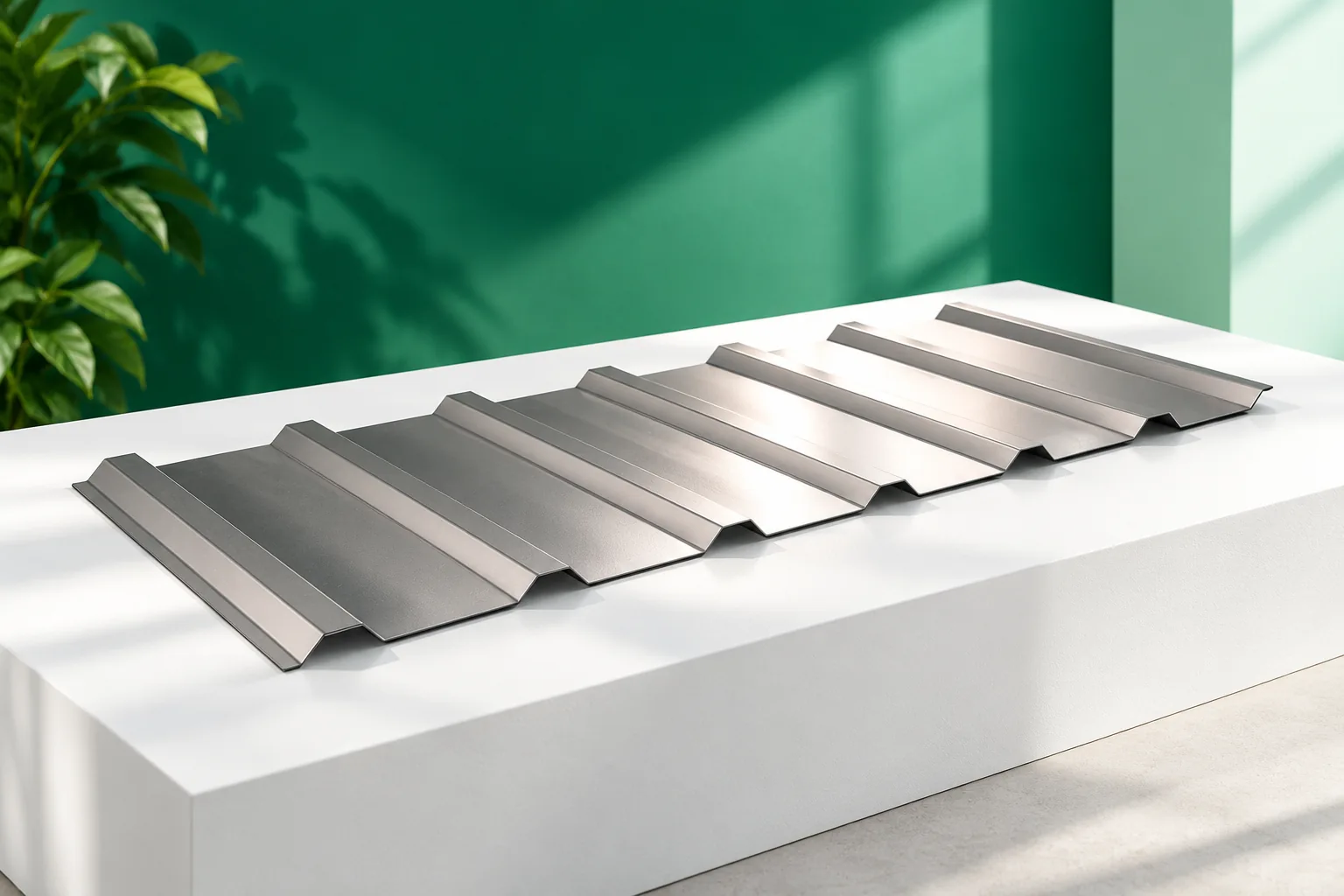
Tile-effect metal roofing gives a rhythm of waves and transverse pressings. It can suit buildings of various characters. Trapezoidal steel sheet creates a simpler pattern of parallel lines, so it is sometimes considered for garages, carports and other structures. T18 and T35 differ in geometry and selection conditions. They should not be chosen solely by appearance or abbreviated name.
The first constraint is the application described in the documentation. The pitch, support and method of fixing must be checked. Only among the suitable variants can the colour, texture and height of the pressings be chosen. This allows aesthetics to be combined with the needs of the building. A profile that looks attractive on a sample offers no benefit if it requires conditions that the existing roof does not meet.
What does the choice between sheet and module offer?
Long sheets cut to size can make good use of a rectangular roof slope and reduce the number of joints along its length. They do, however, require suitable transport, support and a method of handling. Small modules are often convenient on a restricted site and with complex geometry. This does not automatically mean less waste in every case.
The comparison should be based on the actual cutting plan. It is worth counting full elements, offcuts and pieces that can be correctly reused. A panel must not be turned arbitrarily just to use up a remnant. The edges of the laps must retain their function. The advantage of a wide choice of formats is the ability to match the work to the roof, not to bypass the rules of the system.

What can a rational cost of covering look like?
Steel sheet allows many profile and protection variants to be compared. The price depends, among other things, on thickness, coating and format. However, the effective area and the actual requirement must be calculated. A full square metre of sheet is not the same as a square metre of finished covering. The price of a panel must also be divided by its effective area.
Add flashings, fixings, transport, substrate and labour to the material price. On a simple roof, some of the advantages of large sheets can translate into site organisation. With many roof valleys the result will be different. There is no fair basis for treating every metal roof as the cheapest. The financial benefit must be demonstrated by a complete cost estimate for a variant that meets the building’s requirements.
How to address temperature, noise and condensation?
Thin steel sheet on its own does not constitute effective thermal insulation. In a heated building a designed layer build-up is needed. Conditions in the attic are determined by, among other things, insulation, airtightness from the inside and ventilation. Overheating should not be attributed solely to the colour of the covering. Roof windows and the way the rooms are used as a whole also matter.
Likewise, rain noise depends on the complete building envelope and its joints. Silence cannot be guaranteed by the choice of profile alone. Condensation also requires a solution in the design. Anti-condensation fleece has a defined function and operating conditions, but it does not replace insulation or all the layers of a residential roof. A well-prepared build-up allows the advantages of steel sheet to be used without neglecting interior comfort.
What preserves the benefits over the years?
The coating must be matched to the surroundings and to conditions on the underside. During installation, tools, removal of swarf and correct tightening of fixings are important. Later, inspections, cleaning and checking of details will be needed. The material does not become maintenance-free once the work is finished. The most attention is usually required at joints, penetrations and water drainage.
Before purchase, familiarise yourself with the warranty conditions and keep the designation of the chosen product. The protection period is not the date on which its use ends. It is also worth checking the availability of matching accessories and the repair rules. A metal roof is a sensible option when its format, parameters and handling match the building. This fit is a stronger argument than a general promise that one material will work everywhere.
7 branches. Materials closer to your project.