Roof coverings
How much does trapezoidal steel sheet weigh and what does kg/m² refer to?
In brief
The mass of trapezoidal sheet depends on thickness, profile geometry and the reference area, so no single universal value exists. Check whether the stated kg/m² refer to effective coverage or total area, and compare only figures based on the same basis. A profiled sheet has more metal than a flat strip of the same width viewed from above, so two profiles made from sheet of equal nominal thickness may differ in mass. Add protective layers and other components to the roof weight. Mass helps with planning, but it does not replace load capacity or the permissible support spacing.
Why is thickness alone not enough?
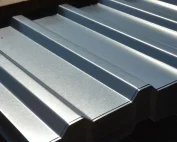
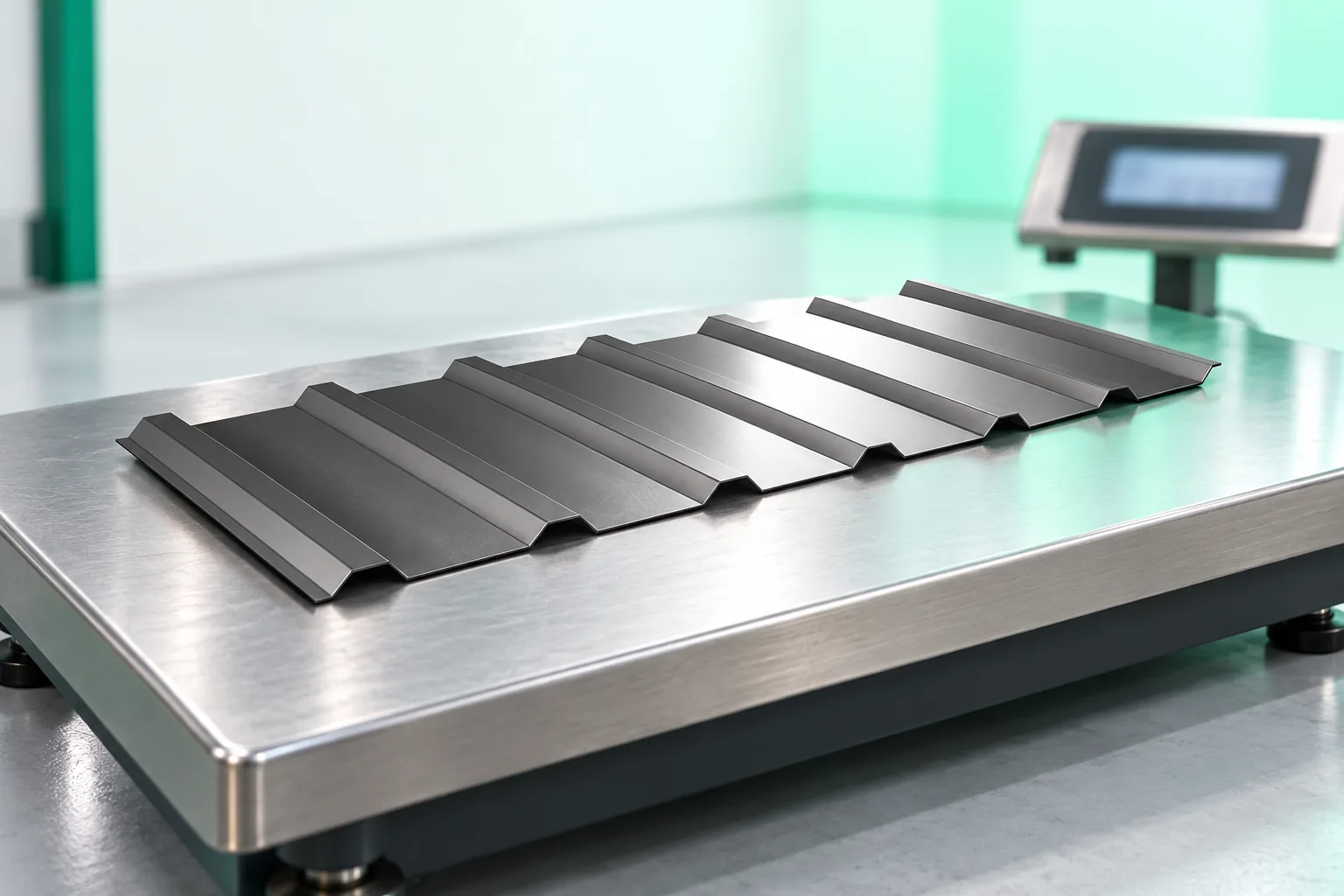
A profiled sheet contains more metal than a flat rectangle of the same width seen from above. Part of the material forms the sloping sides and upper flanges of the ribs. Therefore two profiles made of sheet steel with the same nominal thickness can have a different weight per metre of coverage. The entire cross-section geometry matters, not just the height.
Protective layers are added to the weight, and in some variants also additional equipment. Catalogue data should be checked for the correct material and configuration. It is not worth calculating the weight of a finished trapezoidal sheet solely from a flat sheet weight table. Such an approximation may omit the profiling and the difference between gross and effective area.
What is the difference between kg/m² gross and kg/m² effective coverage?
A gross metre covers the sheet area calculated from its full width. An effective coverage metre refers to how much roof area the element covers after allowing for the side lap. The same weight divided by a smaller area gives a larger result. Both figures can therefore correctly describe one product, although they are not directly comparable.
When calculating the weight of the finished covering, use one consistent basis. If the weight is given per effective metre, do not multiply it by the total area of ordered sheets without clarification. If in doubt, calculate the weight of each sheet or ask the supplier for a total from the schedule. Pay particular attention to additional longitudinal joints.
What do example data for T18 and T35 look like?
In the price list of 28 October 2026, the selected roof profile T18 has a weight of 4.43 kg/m² effective at 0.50 mm thickness, 5.32 kg/m² at 0.60 mm and 6.20 kg/m² at 0.70 mm. The T35 variant in the same table has 4.71, 5.65 and 6.59 kg/m² respectively. The data refer to specific cross-sections described in the document.
These values should not be transferred to all products bearing the designation T18 or T35. They may have different widths and shapes. Even the actual profile height may vary within trade names. Check the full data sheet before ordering. Weight is useful for planning, but on its own it does not replace load-bearing capacity and permissible support spacing.

How do you calculate the weight of the covering using an example?
If you assume 100 m² of effective coverage and 4.71 kg/m², you get 471 kg of sheet steel. This is a simple calculation example for the specified T35 variant. It does not include additional transverse laps, allowance or flashings. For a real order, use the exact material schedule and check that all items have the same basis.
The weight of the entire roof also includes battens or purlins, insulation layers, decking and other components. Snow load and wind action are considered separately. It must not be assumed that the structure is adequate solely because the calculated weight of the steel sheet appears low. The design takes into account far more than the weight of the visible covering. The side lap is already included in the mass referred to the effective metre. It should not be added again by a second factor, as this would lead to double counting of the same part of the sheet.
What does weight mean for transport and unloading?
The total delivery weight is important for selecting the vehicle and equipment. Packaging and accessories must also be taken into account. A long sheet can be difficult to handle even when its mass is not great. The challenges are support along its length, susceptibility to deformation and the surface exposed to wind.
Unloading capability should not be assessed solely on the basis of how many kilograms one person can lift. The instructions specify how the material is to be handled. Sheets must be lifted without dragging them over one another and without deforming the laps. It is worth preparing the place where the pack will be set down before the vehicle arrives, rather than organising it during unloading.
Why are bundles on the roof a separate problem?
The finished covering distributes the weight over a large area. A pack of steel sheet concentrates it on a small area and may load only part of the structure. It must not be assumed that because the roof can carry all the installed sheets, it will also withstand them stacked in one place. The location and support of the packs should follow from the organisation of the works and an assessment of the structure.
With tall structural sheets, staging and installation conditions are particularly important. Their permissible load may depend on the completeness of the fixings and support. For this reason, the kg/m² data serve to calculate the weight, not to determine the storage method on their own. It is worth agreeing this part of the work as precisely as the purchase of the material itself.
7 branches. Materials closer to your project.