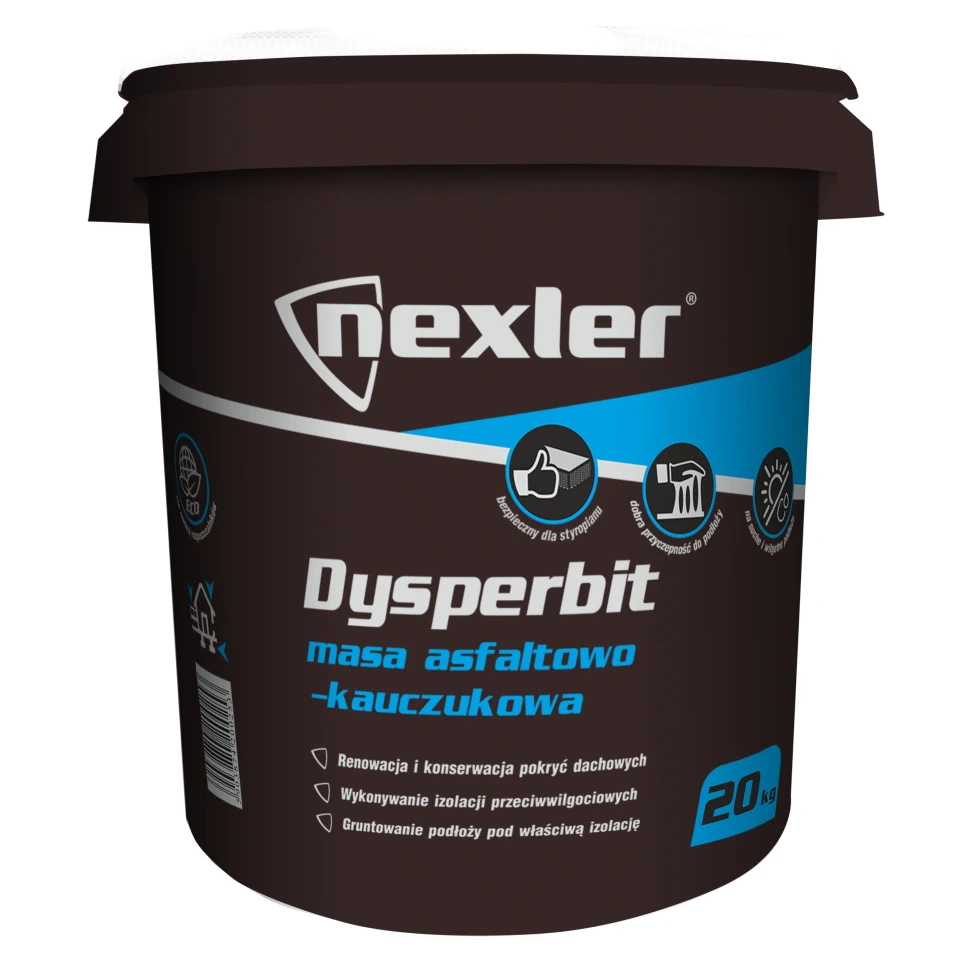
NEXLER Dysperbit for priming and maintaining hall roofing
NEXLER Dysperbit is a solvent-free waterborne bitumen-rubber dispersion intended for priming mineral and bituminous substrates and for maintaining bituminous coverings. In a hall context, the product supports both the preparation of the building envelope and the restoration of the roof’s protective layer. Its role is closely tied to the stage of work at which it is applied.
Drainage first, then roof maintenance
Before maintaining a bituminous covering, loose parts must be removed and defects, flashings and drains repaired, because without efficient drainage water standing on the roof undermines the effect of subsequent layers. Only after these works can NEXLER Dysperbit be used for maintaining the covering, with individual layers applied after an appropriate interval and without rainfall. Priming a mineral or bituminous substrate and priming wool under roofing felt are separate applications that also require the correct sequence relative to drainage repair.
Once the mineral or bituminous substrate has been primed and the drainage prepared, maintenance of the bituminous covering can begin, bearing in mind that priming wool under roofing felt is a separate task and does not replace repair of the drains.
Priming versus applying the coating
Priming prepares the substrate and improves the adhesion of subsequent layers, whereas applying the maintenance coating restores protection to the bituminous covering itself. NEXLER Dysperbit serves both functions, but at different stages of the work, so they should not be combined into a single step.
Divide the roof into sections that allow the interval between coats specified in the data sheet. If rain is forecast before that time has elapsed, leave the next section for another day.
The performance of the building envelope after maintenance depends on efficient drainage and proper substrate preparation, not on the coating alone, so the assessment of the result should cover both the condition of the outlets and flashings and the continuity of the protective layer.