Mineral wool panels
What can a 60 mm mineral wool wall panel be used for, and what about the 40 mm version?
Key points in brief
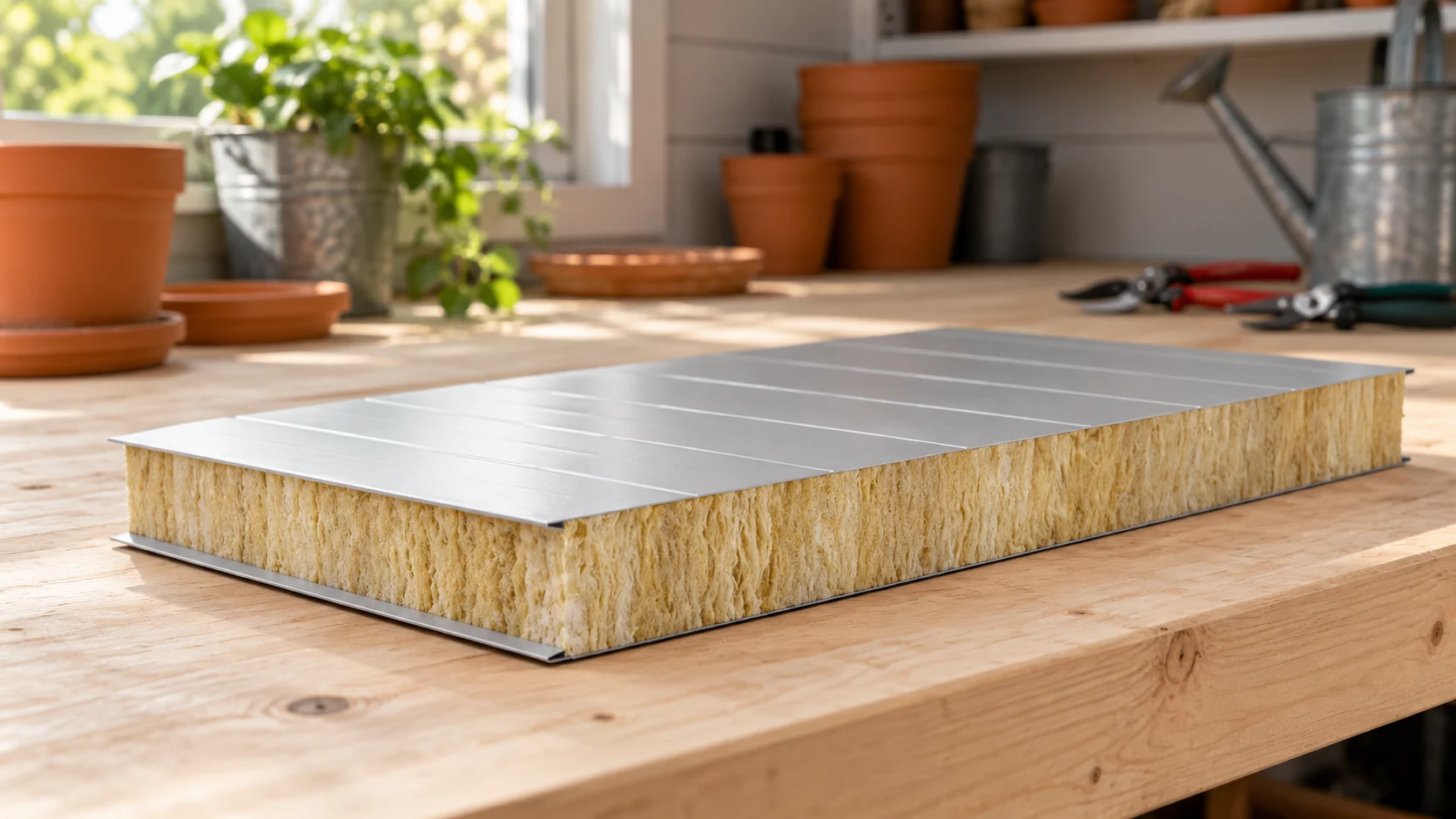
A thin mineral wool panel may be considered where a slim-profile cladding is important. However, good thermal performance or a specific fire resistance should not be assumed in advance. A range starting from 60 mm in one system does not mean that all panels on the market begin at the same point. The 40 mm version must be checked separately. A partition between two rooms at a similar temperature performs differently from a workshop wall facing the yard. In the first case, the temperature difference may be small. In the second, heat loss, the internal surface temperature and the requirements of the whole building must be assessed. The nominal thickness does not explain these differences.
First, separate the external wall from the internal partition
In a seasonal room for storing garden tools, the requirements may differ from those at an all-year work station. This does not, however, mean structural freedom. Even an unheated enclosure must carry loads and remain tight under the conditions for which it is intended.
Partitioning off a small storage space inside an existing hall also requires checking the ceiling and the connection to the floor. A thin wall alone does not yet create an enclosed room. If the stored items require stable conditions, the entire enclosure needs to be defined, not just the vertical partition.
What a sample datasheet for 60 mm shows
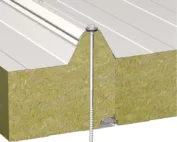
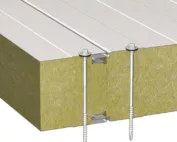
In one wall system with visible fixing and a lamella core of 100 kg/m³, a thickness of 60 mm has a Uc of 0.66 W/(m²·K). For facings of 0.5/0.5 mm, the stated average mass is 14.1 kg/m². These figures describe a specific configuration. They are not a common declaration for all panels with mineral wool.
In this data sheet, NPD appears for the fire resistance of the wall at a thickness of 60 mm. This means there is no declared property in this item. An EI class must not be added on the basis of the mineral core alone. If the project requires such a parameter, a solution with appropriate confirmation must be found.
The question about 40 mm requires precise designation
Catalogues include thin panels with various cores. The term “40 mm panel” may refer to PIR or another solution, not mineral wool. In addition, an insulation panel without two steel facings is not the same product as a sandwich panel. Comparing thicknesses alone easily leads to error.
In the wall system with mineral wool examined here, the range starts at 60 mm. This does not prove that 40 mm does not exist in every possible system. If such an offer appears, request the data sheet for the exact product, the declaration of performance and the intended application. The absence of this data is more important than an attractive name.
Occasional heating still creates moisture
In a cool storage area, once a heater is switched on, the air warms up faster than all the casing details. Wet tools or clothing brought in increase the amount of vapour. Adequate ventilation must be provided and surface temperatures assessed. A small panel thickness does not exempt you from such an analysis.
Do not plan supplementary heating as a way of dealing with every wet patch. First establish whether the water comes from condensation or from a leak. If the room is to become a workshop over time, it is worth taking this into account from the outset. Adding insulation from the inside later changes the make-up of the building element and may require a separate design.

A thin element must have adequate supports
The permissible spacing is determined by the properties of the specific panel, the loads and the structural scheme. The structure should not be selected on the basis that the element is lightweight. The wall must also resist wind suction, and the connections must hold the cladding and the entire panel. Values from another thickness do not automatically transfer to 60 mm.
With a thin building element, openings require particularly careful planning. Cutting an opening for a grille or hatch changes the behaviour of the element. A tool shelf should have its own proper fixing. The mere existence of a steel surface does not mean it can be loaded with any equipment.
Assess whether the space saving is genuinely needed
In a narrow corridor, a few centimetres can matter. In a separate garden shed, ease of installation and conditions of use may be more important. Compare the entire wall together with the frame and flashings. Reducing the core thickness does not always yield the same saving in room width.
Include the function of the building element and the expected parameters with the order. If the thin variant does not confirm them, the solution must be changed. A missing declaration is not replaced by the intuition that ‘it is wool after all’. A well-selected thin panel has a clearly defined purpose and remains within the range intended for the given system.
Short answers
Can a 60 mm panel form the wall of a heated building?
The requirements and calculations for the entire building element must be checked. The mere existence of a product does not mean that it meets the needs of every heated room.
Does a 40 mm mineral wool option have to be wrong?
This cannot be determined without the documentation. The exact product and application must be checked. The scope of a single catalogue does not describe the entire market, but cores and panel types must not be confused.
7 branches. Materials closer to your project.