Insulation and comfort
What can a mineral wool panel do about noise in a small workshop?
Key points at a glance
A workshop can be noisy despite thick walls. Sound passes through the partition, doors and ducts, and some of the energy is transmitted by structural vibration. A mineral wool panel is one element of an acoustic solution. To choose it sensibly, you need to distinguish between limiting sound transmission and reducing reverberation within the room itself. A conversation through the wall requires a different approach from the pulsing of a compressor. In an instrument repair workshop, noise can disturb the person at the desk even though it is slight outside. Note which equipment is running, for how long and where the sound is troublesome. This gives you a starting point for selection.
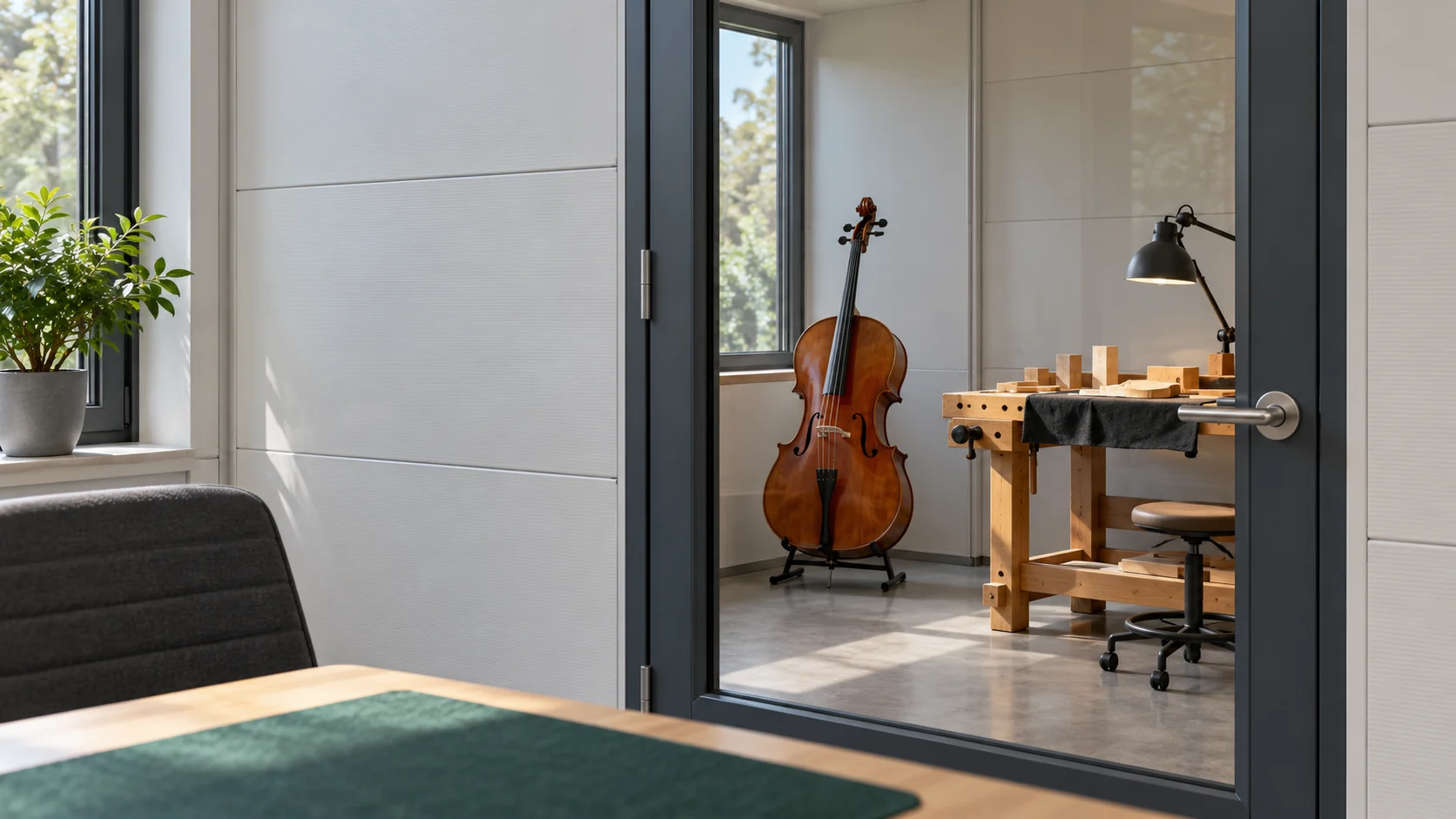
First name the source and the protected location
It is worth checking whether the problem disappears when the door is closed or one device is switched off. Such an observation does not replace measurement, but it helps point the way. Without it, you can improve a large wall while leaving a small gap that still determines the perceived noise.
Note whether the sound is constant or occurs with individual impacts. Short tool noises are perceived differently from continuous fan operation. Describing these differences makes it easier to talk to an acoustician and reduces the risk of buying a solution that is effective for a different type of noise.
Rw describes a specific result for the partition
The Rw indicator is a laboratory assessment of airborne sound insulation. It is given in decibels. It relates to a specific product or assembly under test conditions. It does not mean that the level of every sound in a real premises will decrease by exactly this number. The nature of the noise and the other transmission paths matter.
In the data for panels with mineral wool, you can find various results depending on the configuration. A single common value should not be created for an entire core type. For difficult noise, it is also worth checking the frequency characteristics and the relevant adaptation terms. Selection matched to the source is more accurate than comparing the highest numbers alone.
A steel surface is not automatically an absorber
Mineral wool hidden behind full sheet metal does not act inside the room in the same way as open sound-absorbing material. Sound can reflect off walls, the ceiling and a hard floor. Reverberation then persists in the room, even though the partition limits the passage of part of the energy into the adjacent room.
If an improvement in the sound of the interior is needed, separate absorbing solutions matched to the function are considered. Their installation and fire properties must be taken into account in the design. Do not perforate the cladding of an ordinary panel yourself to expose the mineral wool. Such a change compromises the construction and the scope of the declared parameters.
Doors and gaps can dominate the effect
The partition works as a whole. An ill-fitting door, a ventilation grille or a gap under the ceiling can reduce the benefit of a better panel. A complete sealing perimeter and properly detailed service penetrations are important. Using any foam in a visible gap does not confirm an effective acoustic detail.
Before choosing a more expensive wall, check the proportion of openings and how they are sealed. In a small office room, the door takes up a significant part of the partition. Sound can also pass over the wall through a shared ceiling void. These paths must be assessed together, because a single material parameter does not describe them.

Vibration requires work at the source
A compressor placed directly on the structure can transmit vibration to other elements. Then even a sealed wall does not eliminate the entire sound path. The solution may include proper positioning of the equipment and connections that limit vibration transmission. These are selected according to the mass and operating mode of the equipment.
Do not mount noisy equipment on the thin facing of the panel. The bracket should have a verified substrate, and the cable penetration should have an appropriate detail. Sometimes moving the machine away from the wall shared with the office helps more than changing the core itself. Such a decision should be based on identifying the source, not on a default assumption.
Assess the improvement for the actual use of the premises
After the solution is implemented, compare conditions during normal operation of the equipment. If measurement is required or the problem is serious, it should be planned by an acoustic specialist. The assessment should take into account the receiving room and the surroundings. Listening alone with the machines switched off explains little.
Keep information about the doors, connections and equipment used. A later grille or an open duct penetration can change the effect of the entire work. In everyday use, it is worth ensuring the doors close properly and the seals are in good condition. A well-chosen panel then helps as part of a coherent solution, not as the only barrier to every sound.
Short answers
Does doubling the thickness of the wool double the sound insulation?
No. Acoustic indicators do not increase in such a simple way. The result depends on the complete panel, the sound frequency, the connections and the other transmission paths.
Can echo be eliminated with the sandwich panel alone?
A full steel facing can still reflect sound. Limiting reverberation usually requires a separate choice of absorption within the interior. This task must be distinguished from the wall’s insulation performance.
7 branches. Materials closer to your project.