Insulation and comfort
Mineral wool wall panels: how to read the U-value and thermal conductivity
Key points in brief
Various heat-related figures appear on the material label and in the panel datasheet. Lambda describes conduction within the material, while U helps assess transmission through a building element or product in a specific configuration. These values are not interchangeable. Distinguishing between them makes it easier to select the wall of a workshop where people will be working throughout the day. The thermal conductivity coefficient is written as lambda and given in W/(m·K). At the same thickness, a lower value means greater thermal resistance of a homogeneous layer. However, the value appropriate to the specific core and the adopted calculation method must be used. A figure from any mineral wool mat should not be taken to calculate a sandwich panel.

Lambda refers to the core material
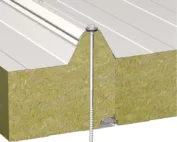
The core of the panel has a specific construction, density and lamella arrangement. Material parameters from another application may differ. In practice, the documentation for the selected product is checked first. The general name ‘mineral wool’ alone is not a complete data set for thermal design.
U relates to heat transmission through a specific configuration
The U-value has the unit W/(m²·K). A lower value means less heat transfer for the same area and temperature difference. The panel datasheet may state Uc including specific corrections. The meaning of the designation and the scope of the result must be read together with the footnotes.
The result for the panel alone does not automatically describe the entire wall with windows, door and base. The junctions create additional heat flow paths. Linear and point thermal bridges may be added to the building balance. Especially in a small workshop, the large proportion of doors means that improving the wall field alone has a limited effect on the whole.
The simple R calculation has a narrow scope
For a homogeneous layer, the resistance can be calculated as R = d/lambda. Assume, purely for illustration, a thickness of 0.12 m and a lambda of 0.040 W/(m·K). This gives R = 3.0 m²·K/W. This is the resistance of the assumed layer. It is not a ready U-value for the panel nor the result for the entire wall in the building.
For a full assessment, the remaining elements and the correct method must be taken into account. The assumed lambda must not be copied into the order as a declaration for any product. The example shows only the relationship: thickness increases resistance, and higher conductance reduces it. Values for the design are taken from the relevant technical data.
Compare data for the same panel construction
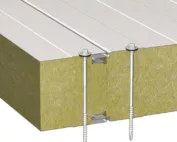
In an example wall configuration with a lamella core of 100 kg/m³, the Uc value for 100 mm is 0.39 W/(m²·K), and for 150 mm it is 0.27 W/(m²·K). These are data for one assembly with visible fixing. They should not be attributed to all panels of these thicknesses or to another type of joint.
Such a comparison shows the direction of change, but does not replace selection. Check the facing thicknesses, the module and the version of the documentation. If one offer describes the U-value of the panel alone and another gives the result for a section of wall, the figures are not directly equivalent. The scope of comparison must first be aligned.

At the desk, the temperature of the details also matters
In a heated tailor’s workshop, a workstation may stand next to a corner and a window. The user will feel the cold precisely there, even when the wall field has a good parameter. A correct detail limits local cooling and the risk of condensation. It is therefore worth examining connection cross-sections, not just a single figure in the offer.
A large door opened many times a day causes air exchange that the wall U-value does not describe. Ventilation, airtightness and the operating schedule are also needed to assess heating. For these reasons, a specific energy bill should not be promised solely on the basis of changing one panel thickness for another.
Turn the parameters into questions for the design
Ask what result the complete wall is to achieve and what temperature conditions were assumed. Establish whether the values include panel joints and how openings were assessed. Check the humidity conditions separately, especially with intermittent heating. Such a set of data allows assessment of whether the selection corresponds to actual use.
In the documentation, retain the parameter name, unit and exact configuration. The entry ‘insulation 0.27’ alone is ambiguous. A correct description helps later to check the offer, the delivered material and any change of product. This ensures that a saving on purchase does not result from an accidental comparison of different quantities.
When comparing offers, a separate column for the source technical configuration in the project’s working documentation is helpful. It shows whether the result related to the selected facings and the connection. It is not about repeating the same figures in many places, but about being able to check their meaning after a change of dimensions or panel variant.
Short answers
Does 1/R always give the wall U-value?
Not for the core resistance alone. The full result depends on the entire assembly and the method adopted, including surface resistances and appropriate corrections. R = d/lambda is only part of the assessment.
Does denser mineral wool always insulate better?
This should not be assumed. Conduction is described by the declared lambda, and the panel by its declared parameter. Density also matters for mass and mechanical properties.
7 branches. Materials closer to your project.