Panels for agricultural buildings
How to choose an insulated panel for a cattle shed, poultry house or piggery?
Key points in brief
In an animal building, the panel performs differently than in a dry warehouse. It must work together with the ventilation, withstand moisture and suit the cleaning method. The requirements of a cattle shed, poultry house and piggery also differ. It is worth starting the selection with a description of daily use, and only then comparing the core, thickness and price of the individual variants. Selection requires information on temperature, humidity, type of livestock farming and ventilation operation. The frequency of cleaning, the agents used and areas of prolonged dampness are important. Two buildings called a cattle shed may have completely different conditions at the wall and roof surfaces.
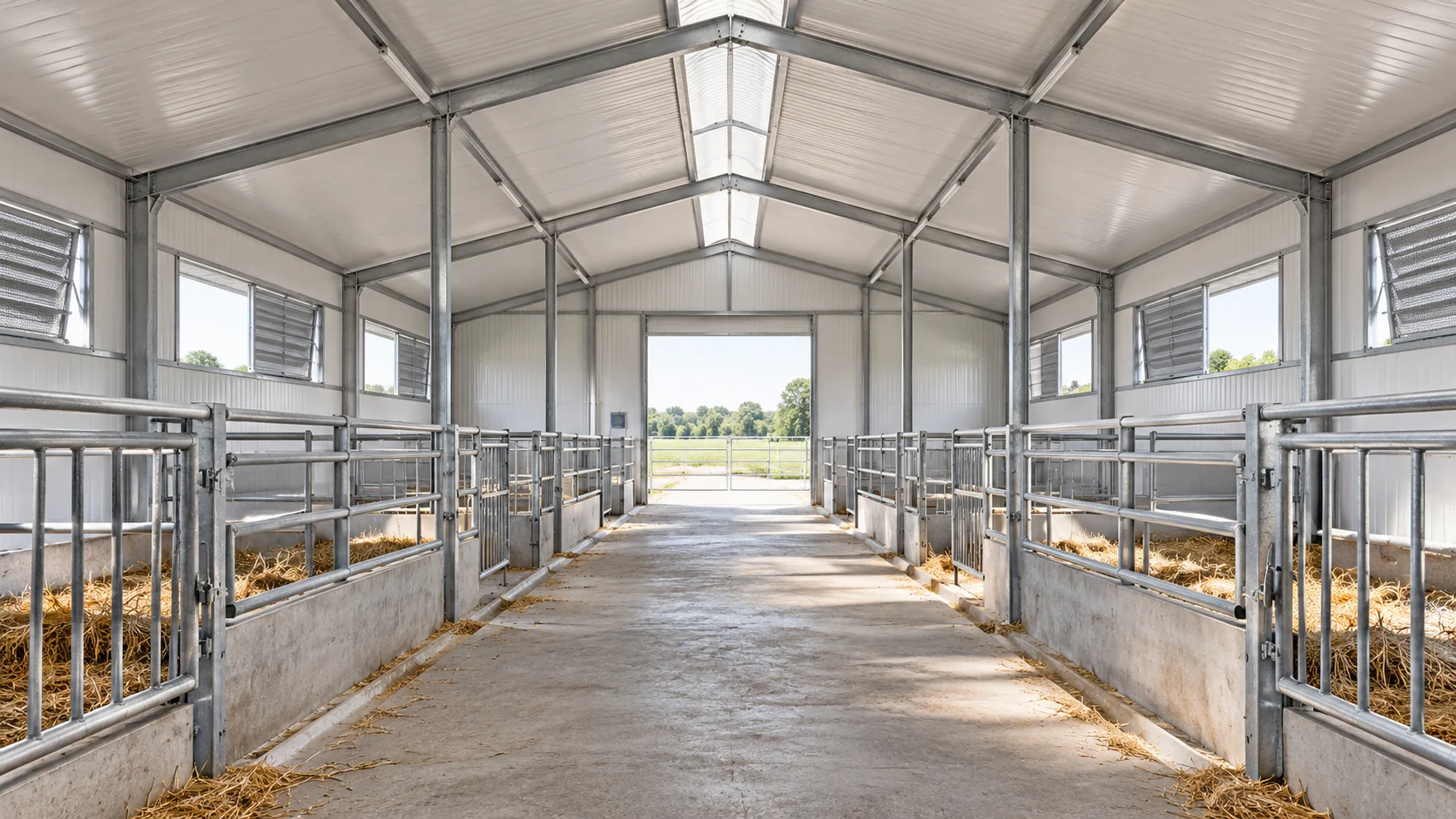
Describe the conditions inside, not just the name of the building
It is also worth identifying auxiliary zones: feed storage, technical room and back-up areas. Not all of them need the same cladding. Dividing the conditions allows the material to be matched to actual needs, instead of accidentally applying one variant throughout the building.
Consider steel with a suitable coating or a special lining
Depending on the environment, appropriately protected steel or a panel with an internal glass-fibre-reinforced laminate can be analysed. Each solution has a defined range of resistance and maintenance rules. White colour is not an indication of ammonia resistance.
The declaration should relate to a specific coating and side of the panel. The external surface is exposed to the weather, and the internal surface to the livestock and cleaning conditions. The same material does not have to be suitable on both sides. Resistance of the cladding should also not be attributed to all flashings and screws.
Choose the thickness together with the ventilation balance
Insulation limits losses and heat gain, but it does not control the amount of vapour or air in the building. Thermal selection should be coordinated with the conditions required by the operating technology. A tighter enclosure needs a planned supply and extract air path.
Overly simplified thinking that the thickest panel will solve every problem ignores overheating, humidity and air flow. In the design, the roof, walls, openings and equipment are assessed together. Different zones may require different thicknesses, provided the connections between them are correct.
Poultry house, piggery and cattle shed need different functional details
In a poultry house, sealing the joints to limit dust accumulation and pest access may be important. In a piggery, the compatibility of the surface with the cleaning procedure is particularly important. In a cattle shed, pay attention to water splash zones and the possibility of mechanical damage to the wall.
These are examples of questions for the design, not a ready-made selection for every livestock building. In impact areas, additional protection may be needed regardless of the core type. Exposed edges and the lower parts of partitions should have solutions that allow cleaning and repair.

Plan fan and installation penetrations
An opening for equipment interrupts the continuity of the panel. Its edge, fixing and sealing must be planned before ordering the material. Equipment should transfer loads to a suitable structure, not to an accidentally cut thin facing.
Well-planned installations reduce the number of later modifications. The connection at the fan must account for vibration and humidity conditions. Sealing from the room side and from the precipitation side are two tasks that cannot always be solved with a single surface-applied material.
Check cleaning as part of material selection
Before purchase, it is worth providing the list of agents along with concentration, temperature and contact time. Washer pressure is only one parameter. The nozzle, distance from the surface and directing the jet at joints and panel ends also matter.
The cleaning instructions should also include rinsing and post-cleaning inspection. A damaged coating or a loss of sealing requires repair by the proper method. It should not be replaced with an arbitrary paint or compound that may react with the substrate or be unsuitable for the environment.
Assess the full enclosure and future inspections
The specification should include the core, thickness, facings, coatings, fixings and flashings. Fire data must relate to the selected system. The reaction-to-fire class is not the same as the fire resistance of the wall or roof, and changing the facing may change the scope of the classification.
Already in the design, provide access for inspection of drains, joints and areas at equipment. The operating cost also depends on the ease of maintaining the building. A panel selected for the environment and correctly maintained gives a more predictable result than a material chosen solely by price per metre.
Short answers
Is a standard white panel suitable for every livestock building?
No. The type of coating, chemical conditions and cleaning method must be checked. A white colour helps in assessing cleanliness, but on its own does not confirm the material’s resistance.
Will a thick PIR core reduce humidity in a cattle shed?
Insulation can raise the surface temperature, but it does not remove vapour. Ventilation matched to the use, along with correct seals and enclosure details, is required.
7 branches. Materials closer to your project.