Selecting sandwich panels
What thickness of PIR wall panel suits a heated workshop?
Key points in brief
In a workshop, a wall panel should help maintain working conditions, not just shield the interior from rain. Temperature, heating duration and frequent opening of the gate matter. The PIR thickness should be chosen after assessing these needs. Load-bearing capacity and details must also be checked, because a warm wall with a leaky joint will still be a source of discomfort. A room heated all week has a different balance than a place used on Saturday. Note the expected temperature and operating time. It is also worth considering whether stored adhesives, paints or equipment require stable conditions even when unoccupied.
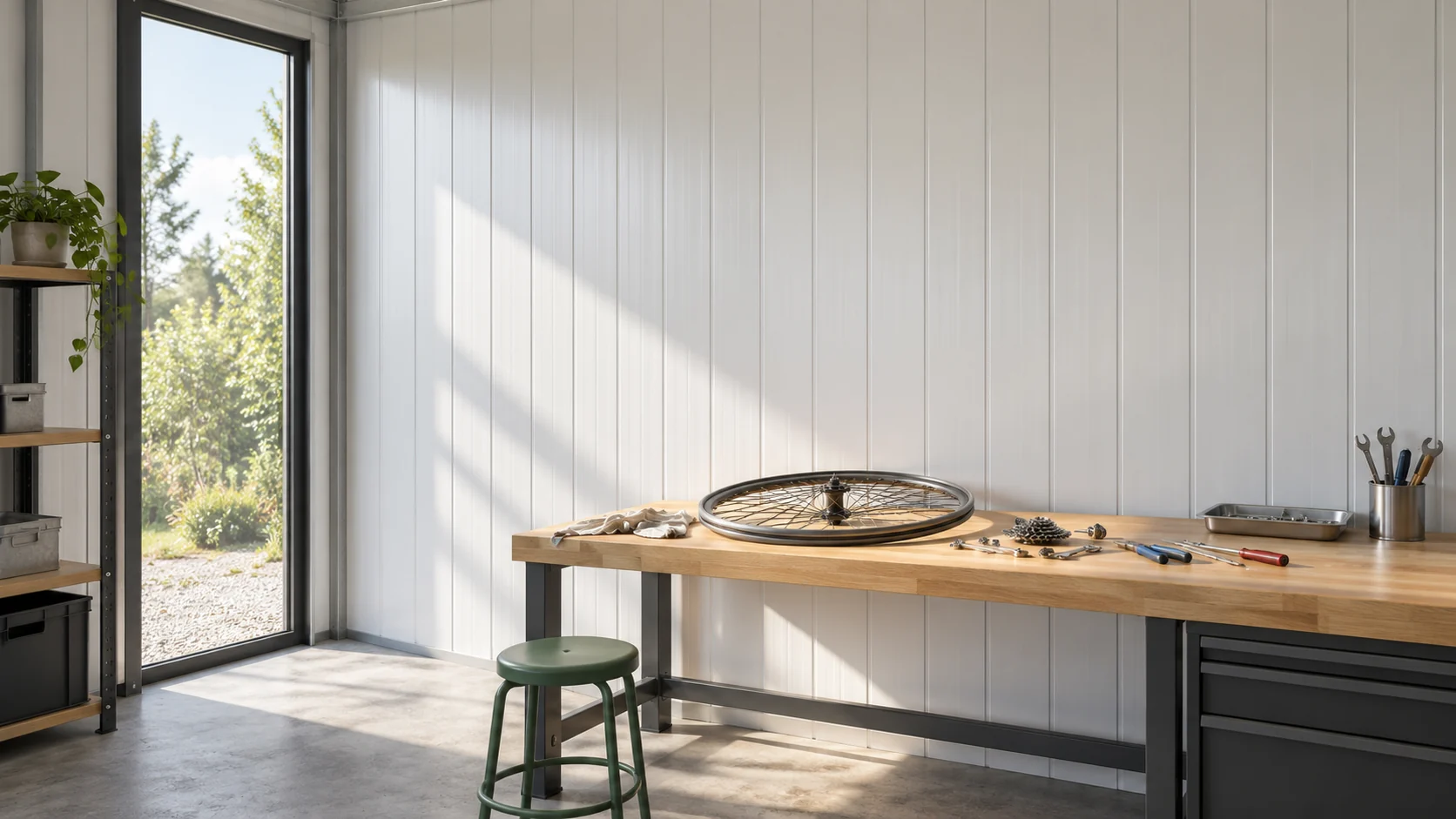
Determine whether the workshop is warm continuously or only during work
Insulation limits heat flow but does not replace heating. During a long break, the interior will cool down without a heat source. The thickness should not be selected on the promise that the panel alone will maintain a positive temperature regardless of the weather.
Read the U-value for the specific wall panel
The following values are declared for one example family of PIR wall panels with steel cladding. They are not universal for every joint and product of the same thickness.
| Core thickness | U-value |
|---|---|
| 60 mm | 0.37 W/(m²K) |
| 100 mm | 0.22 W/(m²K) |
| 120 mm | 0.18 W/(m²K) |
The right variant, the joints and the corrections are checked against the design. The panel U-value should not be replaced by a calculation from the lambda of the foam alone, nor should a roof table be used for a wall.
Assess how much a change in U-value gives for the assumed area
Assume 72 m² of wall and a temperature difference of 22 K. In a simple comparison, moving from U 0.37 to 0.18 reduces the instantaneous heat flow through that area by about 301 W. The calculation is 72 × 22 × 0.19. It applies only to the stated conditions and ignores the other loss paths.
The annual saving cannot be calculated directly from this figure. Heating time, varying temperatures and system efficiency are needed. The example shows the scale of a single change. It helps to compare it with the effect of the gate, the roof and ventilation, instead of attributing all energy consumption to the walls.
The gate and the connection to the floor can determine the feeling of cold
In a sports equipment service centre, a large gate is opened when goods are received. Some heat escapes with the exchanged air at that point. A thicker wall does not eliminate this effect. It is worth reconsidering how the entrance is organised and separating the permanent workstation from the unloading zone.
At floor level, the junction between wall insulation, plinth and floor matters. A cold strip around the perimeter can reduce comfort for someone working while standing. It is worth comparing the position of the workstation with the door and the circulation route. Moving the bench away from the cold draught can complement improvements to the envelope itself. Sealing the vertical joint between panels alone does not resolve the detail at the bottom edge.

Check the construction for the chosen colour and cladding
Loadbearing capacity depends on the complete panel, the support spacing and the loads. The sheet thicknesses, single- or multi-span arrangement and thermal effects are important. The purlin spacing should not be increased simply because a thicker core has been selected. Verification in the relevant tables and in the design is required.
If the workshop has a dark façade, its heating up must be taken into account. With large smooth fields, the expected appearance also matters. It is advisable to establish the profiling and the wall layout together with the structure before material is ordered in long lengths.
Moisture, noise and fire require separate decisions
Wet equipment and cleaning work introduce moisture. Air exchange and a coating suited to the conditions are needed. Thicker foam can improve thermal insulation, but it does not replace ventilation. Likewise, it does not guarantee quiet when loud tools are used.
Fire requirements are verified for the whole building and the specific separating element. The panel’s reaction-to-fire class is not the same as the wall’s EI. Openings, doors and service penetrations must match the design. A change in thickness alone does not justify assigning any class.
Choose the variant to suit the whole usage plan
Before deciding, compare two or three thicknesses together with the U-value, the price of the complete envelope and the structural conditions. Include flashings, fixings and the change in details at the door. It also matters whether the building will still be a workshop heated at the same rhythm in a few years’ time.
If a change to permanent commercial premises is planned, it is worth describing it to the designer now. This does not mean buying the thickest panel as a precaution. It is about a deliberate selection whose limitations are known and which suits the actual needs of the workplace.
Short answers
Is 100 mm PIR enough for every workshop?
No. The design requirements, the product’s actual U-value, the operating conditions and a check of the complete envelope are needed. The word ‘workshop’ alone does not define the temperature, humidity or heating duration.
Will thicker PIR quieten the compressor?
That cannot be assumed. Acoustic protection is assessed for the whole building element, openings and the noise source. Thermal parameters and core thickness do not replace acoustic data.
7 branches. Materials closer to your project.