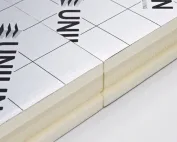
PIR insulation
How do you use the PIR calculator to choose a thickness for a specific wall?
Key points at a glance
The PIR thickness calculator is useful when it compares a known wall build-up with a specific board. It will not detect a hidden cavity, damp plaster or a thermal bridge at the ceiling. Treat it as a tool for organising options. Before you start calculating, note the wall build-up and the effect you want to achieve in the room, studio or small premises. You need the thicknesses of the layers and their thermal properties. If the calculator lets you choose a material from a list, check that the selected item matches the actual masonry. A hollow block with a similar name may have a different construction. In an older premises, it is worth filling in the missing information before buying insulation.
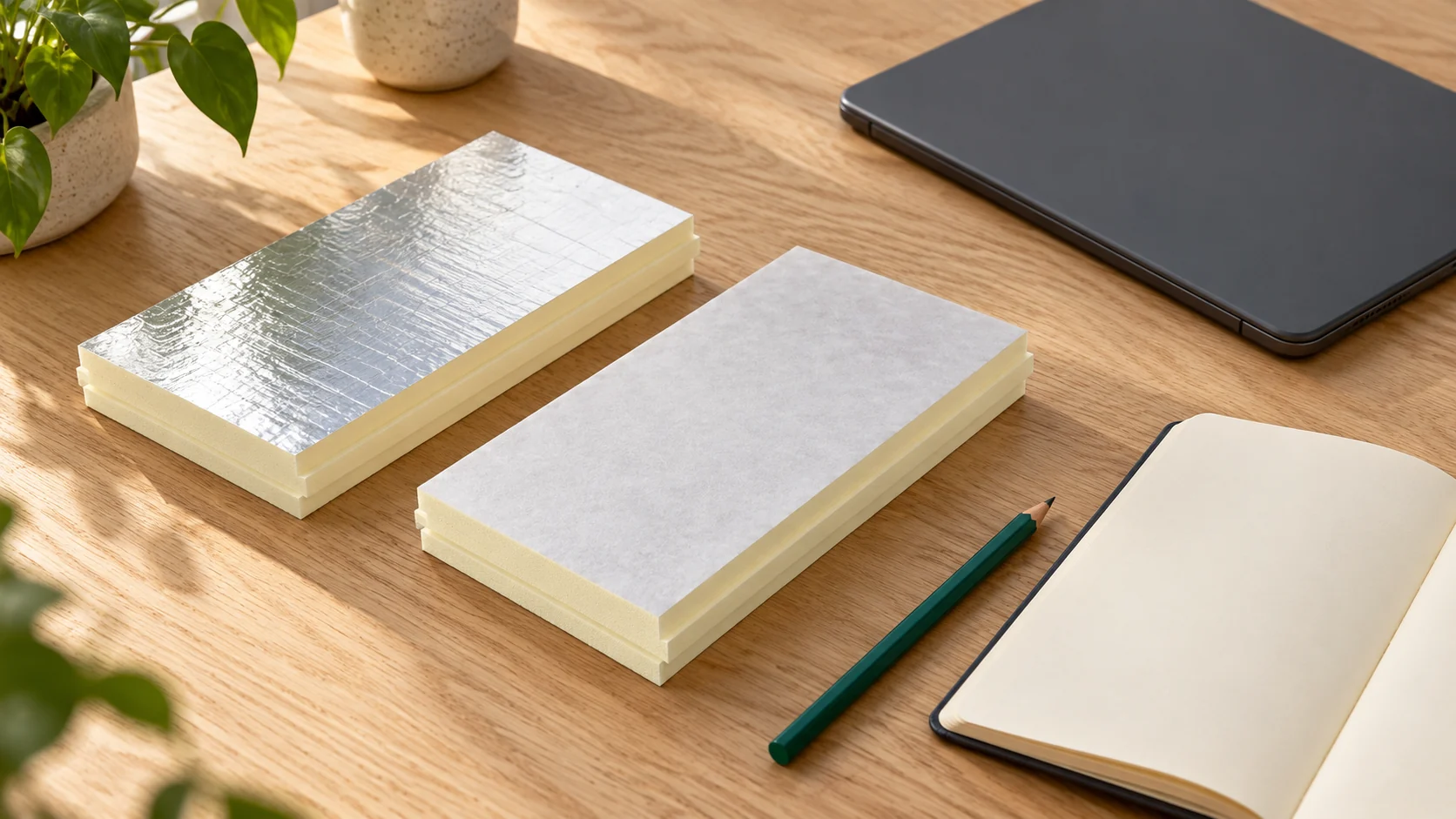
Prepare the data instead of choosing a similar wall
Determine the insulation side separately. Adding PIR to the façade and from the inside can give a similar thermal resistance in the middle of the wall, but different moisture conditions. A tool that calculates only U should not be used as confirmation of the safety of both variants.
Choose the right board and units
Enter the thickness according to the unit of the field. 80 mm is 0.08 m, not 0.8 m. Lambda has the unit W/(m·K), resistance R — m²K/W, and the U-value — W/(m²K). Converting these quantities can give a seemingly credible but completely wrong result.
The parameters should relate to the specific variant and thickness. For boards with a fleece, lambda may change with thickness. If the program assumes one fixed parameter for all PIR, it must be checked whether such a model actually fits the selected product.
Define the purpose of the comparison
You can calculate the thickness needed to achieve a given U-value or compare several available thicknesses. The target should follow from the design, requirements and pattern of use. For an office heated all day, a different system operating time matters than for a room used a few hours a month.
Don’t assume an old value from a guide is automatically a current legal requirement. The designer verifies the regulations applicable to the project. The calculator does not check all building-related conditions, even if it displays a green symbol next to the result.
Go through one example step by step
Let us assume a nominal U-value target of 0.22 W/(m²K), a resistance of existing layers of 1.10 m²K/W and total surface resistances of 0.17. In this simplification, the required insulation resistance is 1/0.22 minus 1.27, i.e. approximately 3.28 m²K/W. The target is solely an example assumption.
For an assumed PIR lambda of 0.022, we obtain a thickness of approximately 72 mm. Then the actual available board is selected and the entire result is checked again. The calculation does not account for thermal bridges, corrections or moisture. It is therefore not a standalone selection for wall construction.
Don’t overlook the effect of joints and fixings
The result for the flat field does not describe the temperature at the reveal or at the ring beam. These locations may require a different analysis and a separate detail. The smaller the wall and the more openings, the more attention should be paid to its edges instead of looking only at the centre-of-assembly parameter.
With internal insulation, the airtightness of the perimeter and service penetrations is added. The calculator will not see a poorly sealed back box or an empty gap behind the board. The documentation must describe the method of execution so that the assumed properties have a chance of occurring in the actual room.

Record two variants together with the full thickness
The comparison should be prepared for adjacent thicknesses available in the given system. Alongside the thermal result, record the total construction dimension, the finishing method and changes at the window. In a small retail salon, additional centimetres may affect the counter position or the passage width.
Add adhesive, sealants, fixings and the wearing layer to the budget. Do not attempt to calculate payback from the U-value difference alone. Floor area, climatic conditions, system efficiency and heating duration are needed. Without these assumptions, the payback period would be mere guesswork.
Pass the result for checking with a short note
Keep the calculation date, the board variant name in the private documentation, the layer thicknesses and the assumed parameters. Mark uncertain data. The person checking can then more easily determine whether the difference in result arises from the material, rounding or a different model.
If the wall is damp, has timber elements or is to be insulated internally, a broader assessment than a simple U-value may be needed. Attach the inspection date and the units used in the form to the note. This allows a return to the same assumptions when the thickness, cladding or finishing build-up changes. A good calculator shortens the arithmetic work. It does not replace building survey, detail design or the decision on the approved layer build-up.
Short answers
Why do two calculators show different U-values?
They may use different lambdas, surface resistances, corrections or rounding methods. Compare the input data and calculation scope before you consider one result incorrect.
Can I round the calculated 72 mm to 70 mm?
First check the result for the actual 70 mm board and its declaration. If it does not achieve the project target, a different variant is selected. Mathematical rounding alone is not a selection criterion.
7 branches. Materials closer to your project.