Roof coverings
Tile-effect or trapezoidal steel roofing: which suits the roof?
In brief
The choice between a tile-effect metal sheet and trapezoidal sheeting depends primarily on roof pitch and geometry, not on the price per square metre of the sheet alone. Check the specific profile’s conditions of use – requirements for laps and layers beneath the covering vary between products. Compare complete roof systems serving the same function, including support, coating and full cost. On complex roof slopes, lay out the sheets to assess cutting and waste. Ultimately, choose the solution that meets technical requirements and suits the building.
First check the pitch and the roof’s purpose
The initial choice starts with the roof pitch. Each profile has its own conditions of use, including requirements for laps and the layers beneath the covering. A single minimum angle cannot be assumed for all trapezoidal sheets or tile-effect metal roofing. Additional sealing does not automatically permit use of the material below the range specified in the documentation.
The function of the building matters. In an open carport, protection from rain and a proper solution for condensation are needed. Above a heated bedroom, thermal, acoustic and moisture requirements are added. A single sheet of either covering will not replace insulation. Compare complete roof systems intended for the same function, not just their visible layer.
What does the shape of the roof slope change?
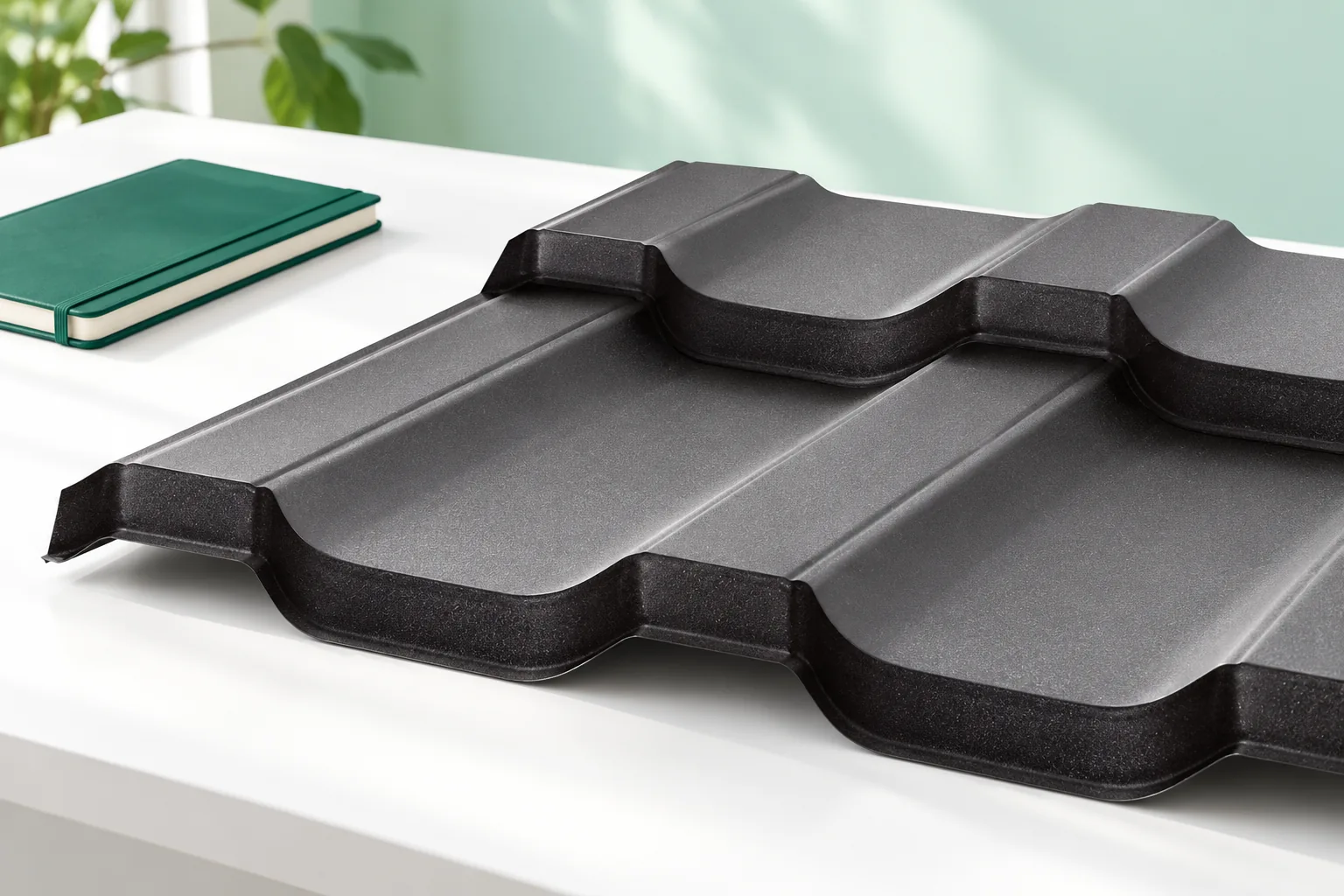
On a simple rectangle, both materials can be laid out with few cuts. Trapezoidal sheet has no transverse rhythm of steps, so its lengths are selected differently than for tile-effect metal roofing. With the latter, the module length and the position of the first pressing must be taken into account. These differences affect the cutting plan and the detailing at the eaves.
Roof valleys, dormers and triangular roof slopes increase the number of adjustments. In such places, it is also worth comparing the modular version of tile-effect metal roofing. Do not assume a fixed waste percentage in advance. A cut-off piece can fit elsewhere only if it retains the correct direction of the profile and laps. A layout of the sheets will show more than an approximate allowance added to the area.
How to compare appearance without being influenced by a photo?
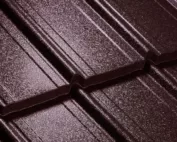
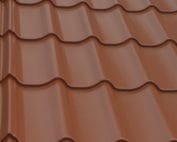
Trapezoidal sheet emphasises the direction of the roof slope. Tile-effect metal roofing also divides the roof slope transversely, which refers more strongly to traditional coverings. The impression changes with the height of the pressings, the width of the fields and the gloss. On a tall roof, details may be hard to see, while on a low annex the profile is viewed almost at arm’s length.
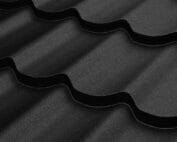
It is best to compare samples in the same colour and similar light. Comparing a red trapezoidal sheet with black tile-effect metal roofing mainly tells you about colour. It is also worth looking at the flashings. The ridge and barge boards should match the character of the profile. The aesthetics of the whole roof can easily be worsened by accessories chosen only after the sheets have been delivered.

Is a higher profile always stronger?
A higher pressing may improve rigidity, but load-bearing capacity also depends on geometry, steel thickness and support spacing. Therefore T35 is not an unconditional substitute for every lower sheet. Likewise, the pronounced wave of tile-effect metal roofing does not allow the required batten layout to be omitted. In both cases, data specific to the particular product is needed.
With trapezoidal steel sheet, supports are determined on the basis of loads and the profile documentation. With tile-effect metal roofing, the batten spacing is tied to the module, and their cross-section and fixing still need to be selected. A change of covering may therefore entail a change of the substructure. In a renovation, it is not enough to state that both materials are lightweight and suitable for the old battens.
What actually drives the price difference?
Trapezoidal steel sheet is sometimes the economical choice, but the comparison must concern a similar thickness and protection class. A cheap sheet with a basic coating is not equivalent to a more expensive tile-effect metal roofing with a different protective system. The difference may stem mainly from the material rather than the shape itself. In quotations, it is worth separating the profile, thickness and type of coating.
Next, check the price per square metre of effective coverage, the cost of flashings, transport and labour. For example, 100 m² of roof slope does not mean purchasing exactly 100 m² of the total sheet area. Some of the material will be taken up by laps and offcuts. That is precisely why two seemingly similar rates can produce different order totals. For example, a sheet with an overall width of 1.10 m and a coverage of 1.05 m has a difference resulting from the side lap. At a rate of €9.26 net per metre, the total cost of a metre of coverage will be approximately €9.70 net. This is a conversion example, not the price of a specific product.
How do you decide between two quotes?
Prepare one roof drawing and ask for two complete variants. Each should include the type of material, the sheet layout, the underlay, the flashings and the fixings. The contractor should indicate the differences in substrate preparation. Without this, it is difficult to assess whether the lower quote truly covers the same scope of work.
Ultimately, choose the solution that meets the technical requirements and suits the appearance of the building. If both are permissible, the organisation of installation, the availability of finishes and the cost of the entire roof may play a greater role. The choice of profile should not, however, replace the decision on ventilation, insulation or the quality of workmanship of difficult details.
7 branches. Materials closer to your project.