Roof coverings
Choosing a modern roof covering that will still look right in years to come
In brief
The choice of a modern roof covering depends above all on how well it suits the building’s form and the quality of its details, not on passing fashion. Start by checking the pitch, the structure and the material’s working conditions, then assess what will be visible from the street and the garden. On a tall house, colour and the proportion of the roof slopes make the first impression; on a low garage, the profile, joints and edges are more prominent. Walking the plot and identifying the key viewing points narrows the choice to the variants that genuinely shape how the building is perceived.
What will be visible from the street and garden?
A roof seen from ground level looks different from a sample held in the hand. On a tall house, the colour and the proportion of the roof slope are noticed first. On a low garage or carport, the profile, joints and edges are more visible. It is worth walking around the plot and identifying the key viewpoints. This helps assess which details will actually influence the perception of the building.
The pitch also matters. A large steep slope takes up a significant part of the visible volume. With a low pitch, the eaves line and side flashings are more pronounced. It is not always worth choosing the most striking profiling. Sometimes a calmer profile allows the architecture to be shown better. The decision can be checked on a simple comparison of roof, façade and joinery in the same proportions.
How to match the covering pattern to the building shape?
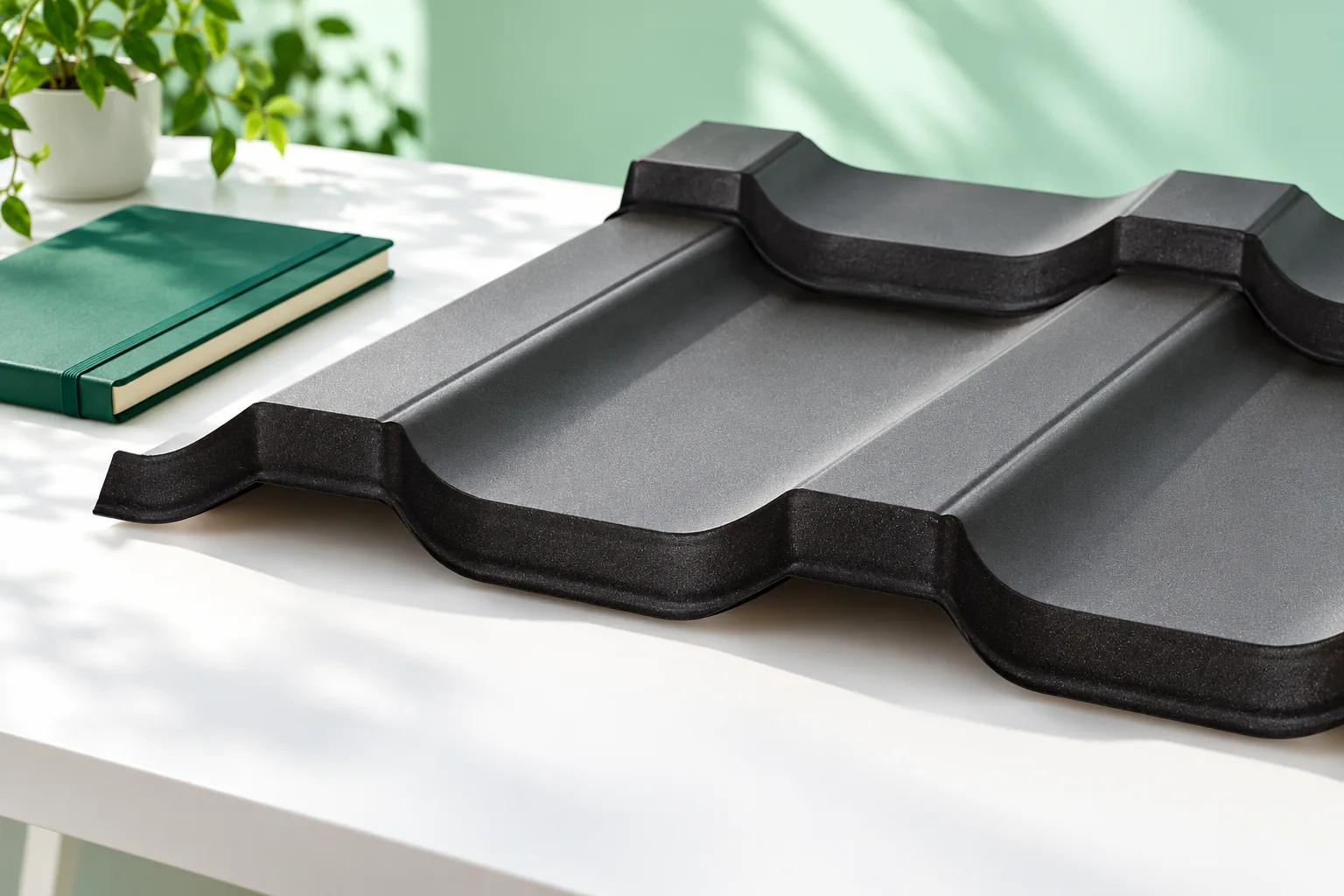
Tile-effect metal roofing creates a rhythm of waves and transverse profiling. It can suit both a simple and a more traditional volume. Trapezoidal steel sheet introduces parallel lines running along the sheet. The T18 profile gives a different shadow than the taller T35. The choice between them must, however, be preceded by an assessment of the permitted support and pitch. A drawing does not replace technical selection.
On a roof with many small slopes, how the layout ends at roof valleys and dormers becomes important. It is worth looking at the cutting plan, not just a single panel. Long sheets and modules may present a similar wave but organise the work differently. The format is also chosen according to transport, cuts and access to the slope. It is not in itself an architectural style.
How to choose a colour that works with the house?
It is easiest to start with elements that are difficult to change later: brick, stone, joinery or the surroundings of the plot. The roof colour should form a clear whole with them. It does not have to be identical to every detail. It is worth limiting the number of random shades at the eaves. The roof, gutters, soffit and flashings are viewed there at the same time.
Look at the samples in sunlight and under cloud cover. A dark surface can appear lighter under strong reflection, and a matt finish changes the perception of colour differently from a gloss one. A photo on a screen does not give a faithful comparison. If the house is to be built in stages, record the exact finish variant. The colloquial name “graphite” alone is too imprecise for ordering accessories later.

Why do simple details require a good plan?
A calm roof is particularly visually sensitive to a curved eaves line or random ends of flashings. It is worth agreeing in advance the height of visible bands, the position of gutters and the way they terminate at the gable. The details must still provide drainage and ventilation. The necessary gap must not be closed merely to achieve the impression of a uniform surface.
Planning the position of the aerial, vents and other equipment reduces later accidental penetrations. Access to the chimney may also be needed. Accessories are best matched to the specific profile and its instructions. A similar colour does not guarantee a match. Sorting out these elements at the design stage usually gives more than adding further decorative details.
Does appearance say anything about durability?
Matt, gloss and wave height are not enough to assess the protection of the material. You need to know the coating system, its intended use and the warranty conditions. Coastal, industrial or permanently damp surroundings require particular attention. Conditions on the underside are equally important. An aesthetic roof should have protection matched to the actual application.
It is worth thinking about cleaning areas sheltered from rain and about checking the gutters. Trees can increase the amount of leaves and deposits. You should not promise an unchanging appearance without maintenance. Colour retention and protection against a specific type of corrosion may have different warranty scopes. Clear documentation gives a better basis for choice than merely describing the roof as modern.
How do you compare two good options?
When both solutions meet the technical conditions, prepare a full comparison for them. Include the material, flashings, fixings, transport and labour. Also compare the actual cuts. A low price per sheet can lose its significance with a complicated geometry or difficult unloading. The comparison should refer to the same measured roof slope.
Finally, look at a larger sample next to the façade and decide whether you like its appearance up close as well. Imagine a change of render colour or planting in a few years. You do not need to predict future trends. It is enough to choose a solution linked to the proportions of the house, the way it is used and the realistic maintenance options. That is how a roof is created whose form has its own justification.
7 branches. Materials closer to your project.