Gutters and flashings
When a square gutter suits the eaves detail
In brief
Choose a square gutter when its clean line suits the proportions of the eaves and the system has verified capacity and a full set of fittings for your roof. Before deciding, check whether the fixings are concealed or visible, how corners and downpipes come together, and whether parts can be replaced later. Look at a sample assembly with joints, not just a straight length. A square profile does not guarantee greater water discharge or a hidden installation — these depend on the specific system.
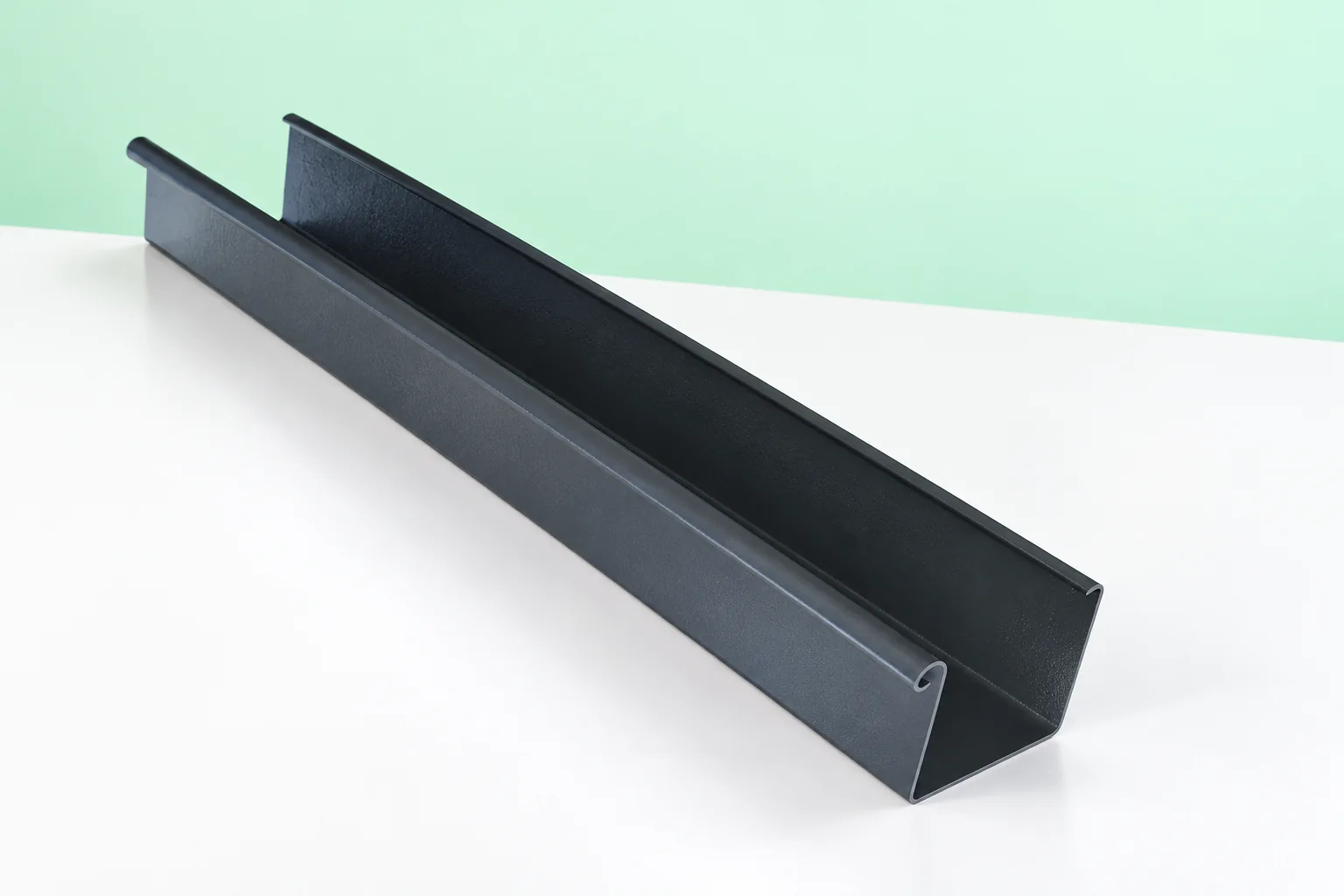
What does a straight gutter front achieve?
A distinct vertical face can form a calm roof termination and harmonise with rectangular joinery. It suits building forms in which horizontal lines matter. The effect depends, however, on the proportions of the eaves and the colour scheme. On a small roof, a substantial front may look different than on the long edge of a large building.
It is worth viewing the whole assembly with corners and downpipes, not just a sample of a straight run. Connection elements influence the rhythm of the façade. A matching colour of roof and gutter does not guarantee identical gloss. Real samples allow assessment of whether both finishes create the desired effect in daylight.
Are the hooks always concealed?
No. The mounting method is a feature of the specific system. Some solutions have hooks concealed within the gutter, others use visible supports. The available variants and compatibility with the installation location must be checked. The name ‘square’ alone does not describe all construction details or the appearance once mounted.
Concealed mounting does not mean there is no need for a stable substrate. The hooks still carry the load of water and other actions. Their spacing and connection to the building follow from the instructions. The number of supports should not be reduced just to make fewer elements visible or to simplify installation on an uneven eaves.
How does it differ from a concealed system?
A visible square gutter may have a smooth front and concealed hooks and still remain ordinary external drainage. A concealed system includes covering the gutter or downpipes and a suitable detail at the façade. These solutions are not identical. In the offer, it is worth clearly stating what is actually to be concealed.
Full concealment requires analysis of access for cleaning and emergency outflow. A simple front should not be taken as proof that all such functions have been resolved. A cross-section drawing will show the difference better than a trade name. It will also establish whether the chosen variant requires additional flashings and changes to the insulation.

How to check performance?
Data is needed for the specific cross-section, outlet and downpipe layout. The volume of water depends on the roof catchment area and the conditions adopted for the calculations. Front width alone should not be compared. Two systems with a similar appearance may have different interiors and different rainwater discharge capacities.
The length of the run and the position of the outlet matter. Corners may additionally affect the flow of water. Selection should be carried out on a plan of the entire roof. If the manufacturer states a supported area, the assumptions must be checked. A single figure without a description of the downpipe layout is not a universal answer for every house.
What to establish for metal roofing?
The gutter must be positioned where it will capture water from the sheets. It works together with the gutter apron and the lower edge of the profile. With tile-effect metal roofing, trapezoidal steel sheet and sandwich panels, the geometry may differ. The setting should not be chosen solely for the appearance of the front, ignoring the actual direction of flow.
Ventilation beneath the covering and the effect of sliding snow must also be taken into account. The gutter fixing should not conflict with these functions. If the roof and the drainage are installed by different teams, the detail should be agreed before installation. Later adjustment may require changing flashings that are already in place.
Which costs and constraints to compare?
Calculate the complete set: gutters, downpipes, outlets, hooks, corners, connectors and clips. Check the availability of parts for unusual angles and installation routes. Installation and any preparation of the substrate should be included. The price per metre of a straight profile does not show the value of the entire system, particularly with a complex building form.
Ask about access for cleaning and later replacement of components. The gutter should be maintainable without damaging adjacent details. Long lead times for unusual parts may matter during a repair. This does not rule out the solution, but it is worth knowing these conditions before purchase, rather than only after a corner is damaged.
When is it worth choosing a square profile?
When it matches the proportions of the house, has adequate capacity and can be correctly installed at the given eaves. If these conditions are met, appearance becomes a justified criterion. A square gutter does not need to be attributed a technical advantage in every situation in order to be chosen consciously for a specific building.
At handover, check the line, connections, flow and fixings. Pay attention to local ponding before the installation is considered complete. Keep the system data and the instructions. An aesthetic roof edge should go hand in hand with predictable drainage performance during ordinary rain and more intense rainfall.
7 branches. Materials closer to your project.