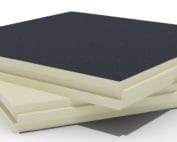
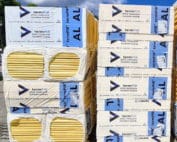
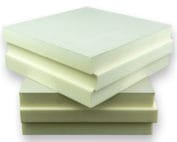
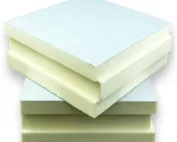
PIR insulation
PIR in warm roofs and XPS in inverted roofs: why the distinction?
At a glance
When comparing roof insulation, the order of the layers must first be established. PIR beneath the waterproofing and XPS in a suitable inverted roof do not perform the same function. Only once the build-up has been identified can the parameters be compared. PIR boards are particularly valuable where high thermal resistance is needed within a limited height. For illustrative thermal conductivities of 0.022 and 0.035 W/(m·K), 100 mm of the first material provides approximately the same thermal resistance as 159 mm of the second. This is an illustration of the calculation, not a fixed rule for replacing PIR with XPS. In practice, the available thicknesses are selected and the values declared for the finished product are checked. At a parapet or an existing roof threshold, a few centimetres can determine the scope of the conversion.
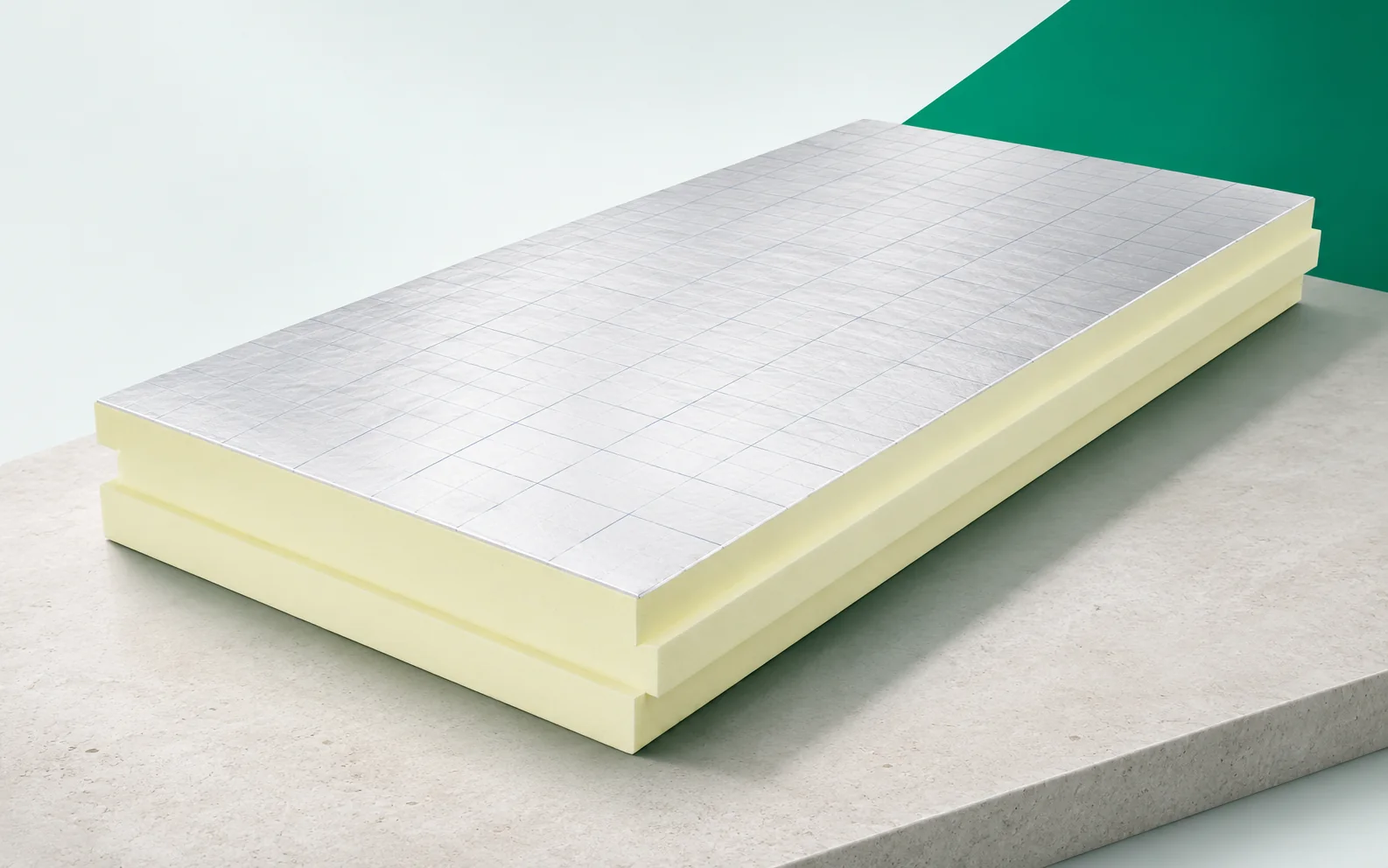
The advantage of PIR lies above all in the space it saves
It is worth then comparing polyurethane boards with a specific XPS in terms of the thickness needed for the same thermal resistance. This is not yet an approval for a straightforward substitution. The correct position of the insulation and the conditions in which it works must be maintained. The geometric benefit matters only in a system that still meets the other roof requirements.
Contact with water matters more than the appearance of the core itself
In a warm roof, PIR lies beneath the waterproofing, so the covering, not the board, retains the water. Closed cells limit absorption, but joints, edges and damage still belong to the building envelope. The facing is part of the product: the core’s resistance does not entitle you to lay any board in the ground.
In an inverted roof, the material is in a different environment from insulation shielded from above by waterproofing. Therefore, water-related requirements are not a minor addition to lambda. Polyurethane insulation with a typical facing cannot be transferred there without appropriate approval. For XPS too, the right product and system must be selected. The name of the material does not replace the assessment of the intended drainage solution and outer layers.
CS and creep do not describe the same situation
In XPS and PIR data sheets you will find the CS parameter at a defined deformation. It is the result of a compression behaviour test, not a ready-made service load value. A floor or roof performs over a long period. In addition, a point load may occur that the average per metre does not show.
Roof loads may include ballast, service traffic and equipment. Their effect must be considered together with the load-distributing layers. Polyurethane foam does not become a structural element because of its high CS. Likewise, the XPS result at a given deformation is not a ready permissible service pressure. The design must take into account the duration of the force and the way it is transferred over a larger area.
The facing and fixing restrict the possibility of substitution
On a façade, a solution approved for the given system is required. Not every PIR board with aluminium facing is suitable under render. The choice of XPS also requires the correct range of application. Ancillary materials, fasteners and finishing layers should form a compatible set.
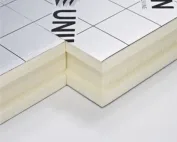
The facing of a PIR board can be selected for a specific waterproofing technology. XPS has a different surface and may require a different layer arrangement. A change should therefore not consist solely of substituting the name in the cost estimate. It is worth checking adhesive compatibility, the required separation of materials and wind fixing. If any of these elements changes, the entire relevant execution detail must be updated.
The most common situations where the choice is justified
In a warm roof, PIR under the waterproofing allows a high thermal resistance to be achieved in a small thickness, which helps at the parapet and threshold. The same product will work in a dry floor of limited height if it is intended for that. Thermal resistance alone is not enough — the operating conditions and the other requirements matter.
A flat roof is not a single category of conditions. A classic layer build-up is assessed differently from an inverted solution, and differently again from usable zones. PIR boards can be an appropriate choice in the right part, but the intended use must be assigned to the exact variant. In the comparison of offers, also enter the position of the insulation relative to the waterproofing. This short description often explains more than the general question of which material is better for a roof.
Compare assemblies with the same function
First record the thermal objective, the available space and the humidity conditions. Add the loads and the requirements regarding fire and finishing. Only then select comparable products. A table with only the price and thickness omits some of the features that can be decisive for correct application.
When comparing cost, include the full geometry of the slopes and drainage. A change in thickness may require different flashings and connection heights. Insulation with polyurethane offers a spatial benefit only when the remaining layers fit within a correct cross-section. The price difference of the boards should not be presented as the cost of the entire refurbishment. Two complete variants are needed, together with the rules for execution and acceptance.
How to compare complete roof assemblies
If the insulation is to be located above the waterproofing, the build-up of an inverted roof must be assessed. PIR must not be entered merely because it gives a smaller thickness. The first criterion is suitability for such conditions. Only within this scope are thermal performance and cost compared.
First draw a roof cross-section and identify the layer that retains water. Then mark the working position of the insulation and the anticipated loads. Only then select PIR or a suitable XPS for such a description. This makes it possible to avoid comparing products that are in reality intended to end up on different sides of the waterproofing. PIR boards can then be assessed by their actual thermal advantage, and the remaining requirements resolved on the basis of the relevant documents for the specific system.
7 branches. Materials closer to your project.