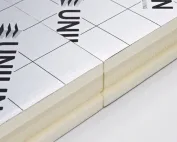
PIR insulation
IKO enertherm ALU: why the parameters must be related to the system
At a glance
The system description with ALU should indicate the specific version of the board and how it is installed. A classification given for a specific steel substrate does not by definition cover every wall or floor. The scope of the document must be compared with the cross-section. Otherwise the bill of materials may look complete even though it is based on a test result that does not fit. The cross-section under consideration comprises the assembly of the building component with aluminium-faced PIR boards. The task of IKO enertherm ALU must be described together with the layers adjoining its surface. An important junction is the penetration of services through the continuous layer of thermal insulation.
The function of the board in the cross-section
Before choosing materials, the thickness of the layer and the position of elements penetrating the insulation must be established so that the sequence of layers has a real reference. A correct arrangement should allow the resistance of the board to be used without omitting the application conditions of the entire system. The tasks of the remaining layers must be defined separately.
The correct product and the scope of its data
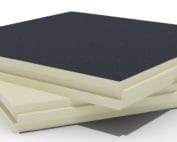
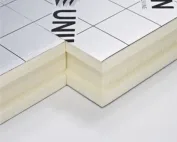
In IKO enertherm ALU, the carrier of the thermal properties is the PIR core with a closed-cell content of over 95%, enclosed by aluminium facings on both sides. The declared λD = 0.022 W/(m·K) and a compressive strength of at least 175 kPa at 10% deformation refer to the finished board, not to the foam alone. Reaction-to-fire class F describes the product, whereas B-s2,d0 is assigned to the specified end use on a steel substrate — the two designations must not be used interchangeably. Therefore, in this cross-section the board is assessed as a component of the building component assembly with aluminium-faced PIR boards, not as a standalone sheet.
The scope of the example comparison
Verification of IKO enertherm ALU in the system begins with the ordered version, its joints and the load-bearing substrate. The resistance of the layers can then be compared: 100 mm at a lambda of 0.022 W/(m·K) gives approximately 4.55 m²K/W from d/λ; with a lambda of 0.040 adopted purely for comparison, approximately 181.8 mm would be needed. This is not a declaration of another product nor the declared RD. A similar thermal result does not approve the jointing of the facings, the method of fixing and the other layers of the selected application.
The calculation involving IKO enertherm ALU describes the stated quantity, not automatically the class of the entire system. The essential assumption is a lambda of 0.022 W/(m·K) with a defined product construction. The result must be compared with the limitation defined as the condition that the facing and edges are compatible with the adopted building component. With regard to this cross-section, the data of the board itself must be separated from the results for the specified end use. A cross-section showing the full ALU designation and the required protective layers is helpful, as it indicates the position of each layer. Only then can the finish envisaged in the building component design be considered without automatically transferring rules from another combination of materials.
How to assess the proposed change
The variant based on the decision of selecting the thickness in the confirmed ALU assembly must be considered through the full cross-section. In the second step, the following action must be considered: changing the product variant together with a reassessment of the connections. With IKO enertherm ALU, both proposals must maintain the requirements at the point described as the penetration of services through the continuous insulation layer. Transferring the classification from the test on a steel substrate to any given building component must be excluded, because such a simplification changes the basis of comparison. The final scope should be confirmed by the designer of the building component with a specific ALU variant. For the selected solution, an unambiguous schedule of the variant, thickness and scope of application is needed, consistent with the materials located directly below and above the insulation.
Surface and joint finish
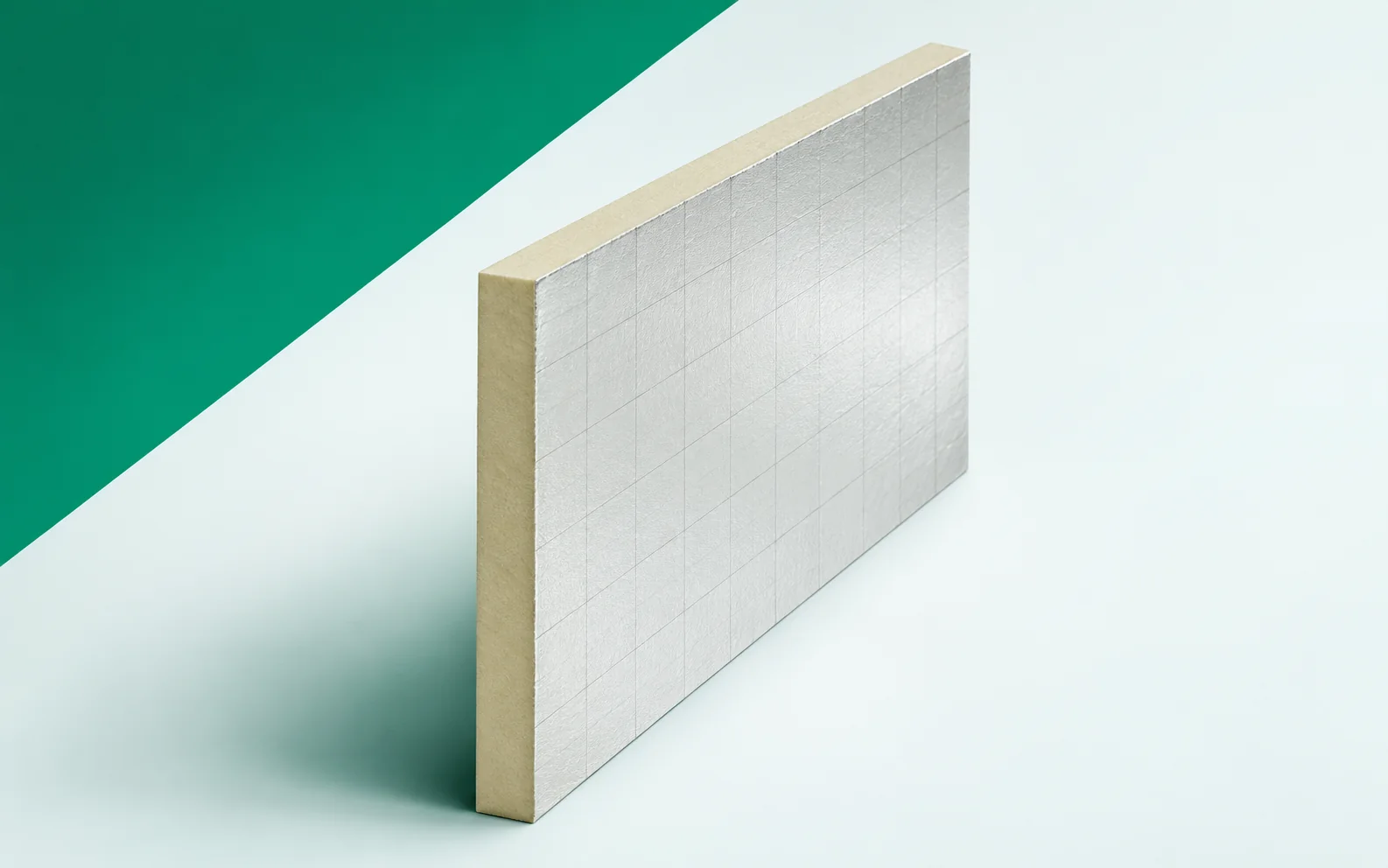
The surface of IKO enertherm ALU is a multi-layer gas-tight aluminium facing. Its type must be taken into account when selecting the layer with which it will work. In the documentation, the contact suitable for the ordered ALU version must also be identified, instead of replacing the actual geometry with a general symbol. Acceptance should be based on the record of the variant label together with the documentation of its end use. For this reason, the finish provided for in the design of the building component should only be carried out after the agreed inspection. In the drawing, it is worth highlighting the penetration of services through the continuous insulation layer, because that is where the course of the connection changes.
The sequence of work follows from the layout
Before IKO enertherm ALU is laid, a substrate capable of bearing the load in the selected application must be ensured. The schedule should include inspection of the element described as the penetration of services through the continuous insulation layer. For acceptance, a cross-section with the full ALU designation and the required protective layers must be prepared, indicating any execution-related changes. After this inspection, work can proceed to the scope that is the finish provided for in the design of the building component. The sequence should be agreed under the leadership of the designer of the building component with a specific ALU variant, especially when different layers are installed by different teams. This makes it possible to separate the tasks that the polyurethane insulation has from the works that ensure the other functions of the cross-section.
A specification ready for pricing
An enquiry for IKO enertherm ALU should clearly indicate the building component assembly with aluminium-faced PIR boards. The description must include an unambiguous schedule of the variant, thickness and scope of application so that the supplier knows the adopted variant. A separate item may be the work needed to utilise the thermal resistance of the board without omitting the application conditions of the entire assembly. It is worth asking for a specification of the changes caused by any replacement of the facing or geometry. Every such proposal should again take into account the condition that the facing and edges are compatible with the adopted building component. After selecting the solution, the record of the variant label together with the documentation of its end use must be retained as the basis for identifying the material on site. In such an order, polyurethane boards are part of a specific system, not a category of freely interchangeable sheets.
7 branches. Materials closer to your project.