PIR insulation
Recticel Eurothane Silver in a conventional warm roof: choosing the complete build-up
At a glance
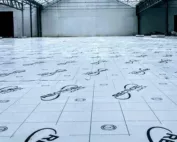
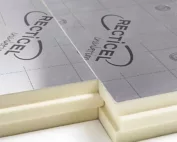
In a classic roof, the thermal insulation lies beneath the layer that protects against water. Eurothane Silver is intended for suitably selected roof systems. The specific method of fixing and the compatibility of the covering must be specified, rather than assuming that every combination is universal. Recticel Eurothane Silver is a PIR board with a multi-layer gas-tight foil on both sides and a printed grid. The current data sheet designates it for flat roofs in a classic assembly. When selecting PIR boards for an assembly, draw the classic flat roof for which mechanical fixing, bonding or ballast is being considered, in its actual cross-section. Eurothane Silver must be assigned to a specific mechanically fixed, bonded or ballasted assembly, because the other layers must match the same solution.
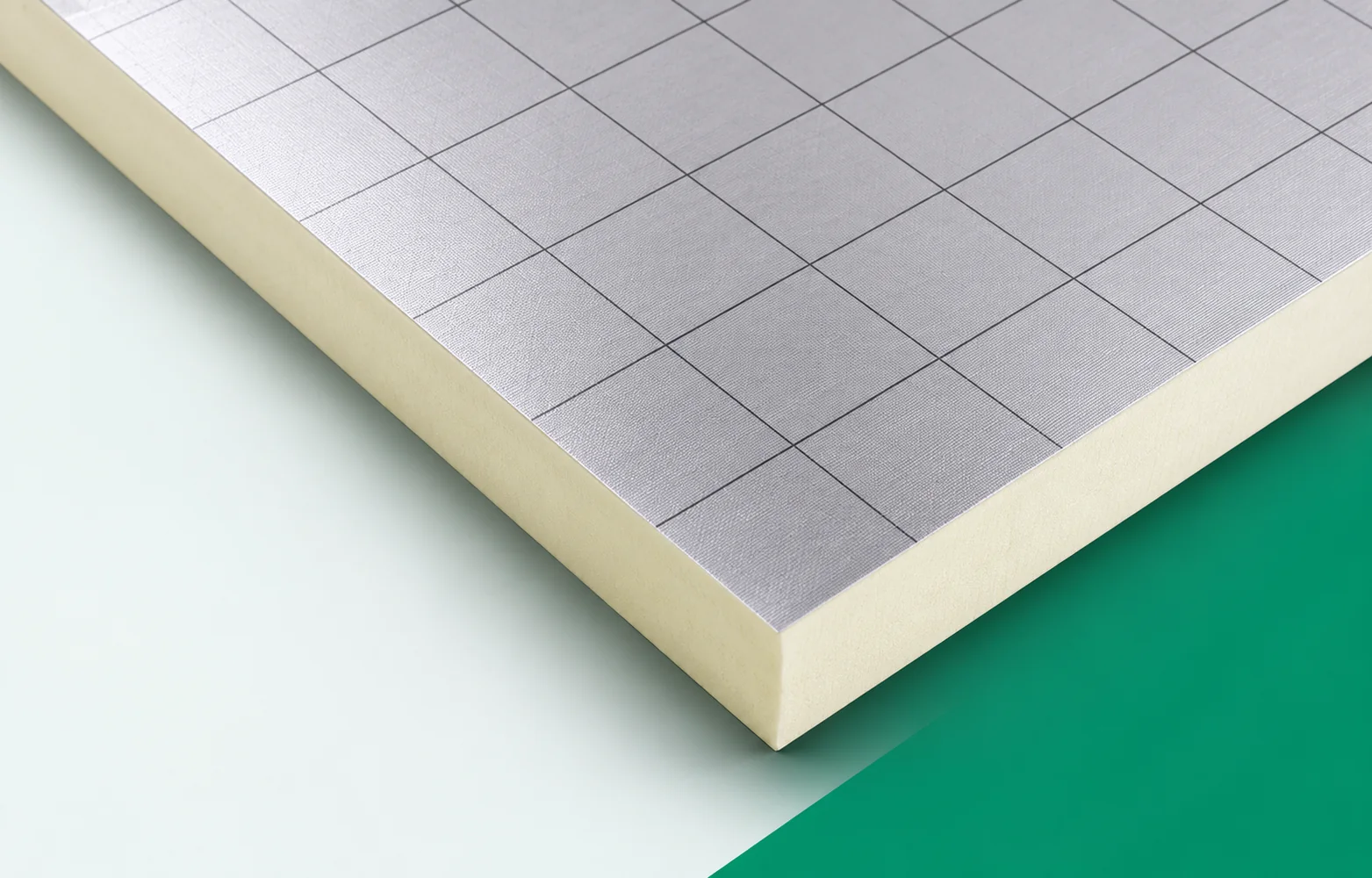
The role of the facing and the other layers
The individual layers must work together, because the board’s wide range of applications does not mean that components from different systems can be combined arbitrarily. The chosen set should allow one agreed assembly to be selected before the insulation and the waterproofing layer are ordered. In the description of the solution, add the substrate, the waterproofing variant and the documentation of how the roof layers are joined, so that the completeness of the layers can be verified.
Fixing suited to the substrate
The Silver format is 600 × 1200 or 2400 × 1200 mm, with 20 mm available only in the smaller of the two. The layout of the boards on the roof slope must therefore be based on the thickness actually ordered, not on the field pattern alone.
Continuous polyurethane insulation requires a correct detail; in the specification, include the choice of the 600 × 1200 or 2400 × 1200 mm format and the order of a specific edge. The Silver format and edge must be matched to the thickness of the delivery and the number of obstacles on the roof slope before the layout is considered ready for execution. The instructions for the full field do not cover all terminations, because the 20 mm variant appears in the data sheet only in the smaller format. The installation drawing should allow the insulation to be set out according to the variant actually available for the adopted thickness. Before you accept a substitute, check the dimensions of the delivered board, the square edge or the ordered overlap, and the coverage area in relation to the adjacent layers.
Eurothane Silver can be used in suitable mechanically fixed, adhered or ballasted systems. The choice between them changes the entire way forces are transferred and the layers are executed. Fragments of instructions for several systems must not be combined into one arbitrary assembly. This also applies to the fire assessment. The classification for a specific end use must be compared with the actual substrate, covering and fixing of the planned roof.
Air, vapour and water tightness
The choice of vapour control layer and waterproofing results from the conditions prevailing in the building. However, the gas-tight film on the Silver surface does not seal the gaps between boards or the joints with other roof components.
When selecting the protective layers, discuss the junction between the roof field and the parapet wall and the installation penetrating the roof. The water shield and the vapour control layer must be connected at the parapet and at the service penetrations, because airtightness must also be achieved at the junctions between the different parts of the system. In the completed assembly, the polyurethane foam needs a covering, because the gas-tight foil on Eurothane Silver leaves all the gaps between components to be resolved. The adopted detail must allow the sealing layers to be connected where different materials meet, without reducing the task to taping over the boards. In the description of the installation sequence, indicate the arrangement of the vapour control layer, the upstand of the covering and the method of sealing the specific penetration; this information should be consistent with the documentation for the complete system.
Thermal performance of the entire building envelope
For the 20–200 mm range, the declared lambda is 0.022 W/(m·K). The layer thickness must be derived from calculations for the entire assembly, not from the coefficient value alone.
In the system calculation, include the Eurothane Silver layer selected according to a lambda of 0.022 W/(m·K) and the required roof height. The influence of the fasteners and terminations must be checked in the calculation of the entire roof with Eurothane Silver, so as not to combine parameters from different material variants. A mere change of material name does not give equivalence, since the R of an equal section of board does not include a correction for each fastener passing through the insulation. When comparing polyurethane boards in alternative arrangements, the material parameter must be compared with the geometry and fixing method of the actual roof. In both variants, compare the thickness of the main field, the number and type of fasteners and the perimeter detail of the thermal insulation for the same function of the assembly.
Range of mechanical and fire-related parameters
For Eurothane Silver, the September 2026 data sheet separates the data according to thickness: 20 mm has CS120, and from 30 mm CS150. The reaction to fire of the board itself from 30 mm is class F, whereas for 20 mm it remains undetermined. When the thickness changes, both parameters must therefore be read again and checked to see whether they correspond to the designed system.
The summary of requirements for the system should explain the difference between CS120 for 20 mm and CS150 from 30 mm given in the current data sheet. After changing the Silver thickness, the mechanical data and the scope of the fire declaration must be read again, and the scope of the assessment must correspond to the actual configuration of the assembly. The significance of the parameters changes with the scope of the assessment, because B-s2,d0 refers to the specified application on sheet metal, not to any free-standing board. Before approving the structure, the distinction between the properties of Eurothane Silver and the assessment of the complete roof system must be maintained. In the application documents, find the relevant row of the parameter table and the classification conditions corresponding to the designed structure and compare them with the designed layers.
Complete specification for pricing
The quotation item for Eurothane Silver should include the thickness, the edge and the covering system, because visually similar PIR boards may have a different scope of application or different mechanical properties. The similarity of appearance alone is not sufficient to regard a substitute as equivalent in the adopted roof system.
When pricing the item “polyurethane insulation”, analyse quotations covering similarly looking silver boards but different roof systems. The equivalence of the Silver substitute must be assessed through the facing and the application in addition to the thermal parameters, so that the scope of purchase corresponds to the complete specification of the solution. An omitted item may come back as additional work, because a similar grid print does not prove identical suitability for the adopted covering. A well-described scope allows technical equivalence to be checked before comparing amounts per square metre of insulation. At the acceptance of the delivery and the works, confirm the full name Eurothane Silver, the thickness, the side profile and the scope of works at the roof closure, so that they match the agreed system.
7 branches. Materials closer to your project.