Roofs and metal sheets
How to choose trapezoidal steel sheet for a workshop roof? Profile, thickness, fleece and full cost
Key points in brief
The roof over a workshop is there to protect equipment and allow comfortable use of the interior. Cheap sheet metal alone does not solve the issues of moisture, heating or noise. It is therefore worth starting the choice of trapezoidal steel sheet with what will happen beneath it. Only then are the profile, steel, coating and accessories selected. A tool store opened once a week has different needs from a workshop used daily. Temperature, humidity and the presence of people matter. If wet items are dried inside, provision must be made for removing moisture. Sealing all openings tightly is not a way to make it disappear.
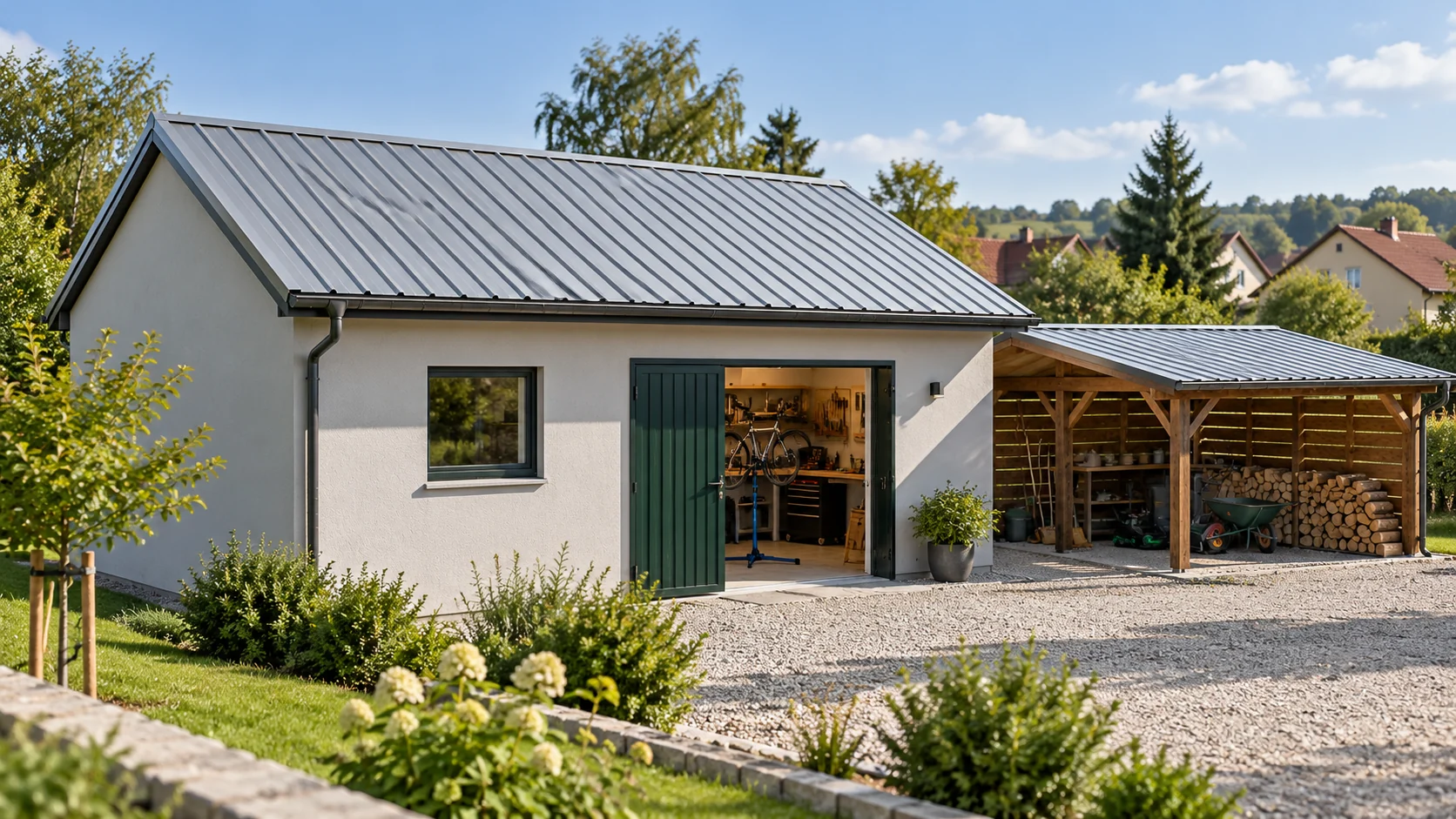
How will the building be used?
In a hypothetical garden storage yard in Pleszew, part of the space may remain cool while part is used for work. This division is worth allowing for in the design. It is not necessary to adopt an identical partition for all zones, but the connections between them must be resolved deliberately.
It is worth establishing straight away where wet tools and equipment will be placed. The arrangement of these zones affects the need for air exchange and the protection of stored items.
When should T18 be compared with T35?
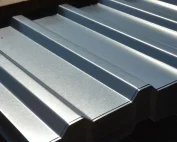
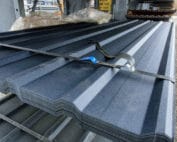
T18 is a family of lower profiles, while T35 has more pronounced ribs. A higher section may perform more favourably at a larger support spacing. This does not mean one universal advantage for every thickness. The data for the specific sheet and the design loads are decisive.
First state the purlin spacing and the support arrangement. Then compare the relevant tables. On a roof, snow and wind are taken into account. With an open part of the workshop, the actions may differ from those on a closed hall. Selecting the sheet alone without a description of the structure would be incomplete.
Is 0.5 mm thickness always sufficient?
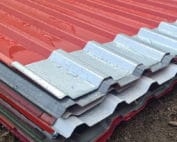
It is not possible to answer without the profile and structural parameters. Trapezoidal profiles in various thicknesses are available on the market, including 0.5, 0.6 and 0.7 mm. The value must be considered together with the steel grade. The coating thickness does not replace the thickness of the metal core.
Load-bearing capacity, deflection and the behaviour of the fixings are checked. A thicker sheet may be beneficial in a given arrangement, but it weighs more and costs differently. It should not be chosen as an automatic remedy for supports that are too widely spaced. Sometimes the entire structural solution needs to be changed.
What does fleece under the sheet metal provide?
Anti-condensation fleece temporarily retains some of the condensate on the underside of the sheet. It must then be able to dry out. It helps to limit dripping in some uninsulated buildings. However, it is neither thermal insulation nor a universal substitute for an underlay.
If a large amount of moisture continually enters the building, the capacity of the fleece may be exceeded. Airflow is required. At the overlaps and the eaves, the requirements for zones without active fleece are taken into account. The exact solution must be matched to the material rather than carried out according to random habit.

How should you compare square metres across two quotes?
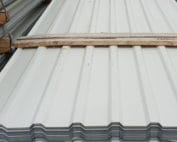
With trapezoidal steel sheet there is an overall width and an effective width. For example, a sheet may have a full width of 1.137 m and a coverage of 1.10 m. A 4 m length then has 4.548 m² of overall area but covers 4.4 m². Both figures are correct, but they describe different bases for settlement.
If the rate applies to a running metre, you do not multiply it by the roof area alone. The sheets purchased must be taken into account. Also compare the coating and the accessories. The surcharge for the fleece may be calculated from a different unit than the amount for transport or the complete set of flashings.
What should the cost of a finished roof cover?
In addition to the sheets, count the flashings, fixings and solutions at penetrations. Add the substructure if it is within the scope of works. Determine transport, unloading and installation. For a heated workshop, insulation and the remaining layers will be a separate part of the budget. Do not hide them in a comparison of the price of the sheets alone.
For example, saving €0.93 per m² on 180 m² of material saves €167.40. These are assumed figures, not a quote. One extra order with a delivery charge can change the result. A good cutting plan and a complete order often matter more than a small unit discount.
What should you agree with the contractor before purchase?
Provide the intended use, the structural design and the roof shape. Determine the profile, thickness, coating and the need for fleece. Ask about ventilation and the eaves details. If insulation is planned in the future, it is worth assessing that scenario straight away. Later modifications may require more than simply adding insulation.
Finally, confirm the lengths, the support layout and the scope of accessories. A workshop roof should be possible to inspect and clean. Plan access to the gutters and penetrations. A material that cannot be reasonably maintained may cost more over the years despite a low purchase price.
Short answers
Does T35 replace insulation?
No. A higher profile changes the geometry of the sheet, not its thermal function. A heated building requires properly selected insulation layers.
Does the felt allow you to dispense with workshop ventilation?
No. It must release the moisture it retains. Air exchange is also necessary because of how the interior is used.
7 branches. Materials closer to your project.