Costs and formalities
Comparing metal roofing costs with other coverings using a cutting plan
In brief
Before comparing the cost of metal sheeting with other roof coverings, decide whether you are choosing a variant for the whole roof or only part of the slope — this determines the scope of the estimate. Check that the offers cover the same drawing, actual dimensions, pitch, valleys, dormers, chimneys and windows, and how the loft will be used. For a renovation, first assess the condition of the structure, as repairs and dismantling depend on it. Only then compile complete amounts including substrate, flashings, transport and installation, on the same net or gross basis.
How do you prepare a common basis for comparison?
All quotes should be based on the same drawing and actual dimensions. Mark the roof valleys, dormers, chimneys and windows. State the pitch and how the loft will be used. These data affect the quantity of material and the build-up of layers. A quote for a simple roof without extras is not a good basis for comparison with the cost of a full covering with many penetrations.
For a renovation, start by assessing the structure. Lighter steel sheet may reduce the weight of the new covering, but it does not remove existing damage. A heavier variant requires confirmation that the building can carry it. The cost of necessary repairs or changes must be entered in the relevant version. Omitting this stage may give a seemingly attractive price for a solution that cannot be executed without additional work.
How do you convert units and material quantities?
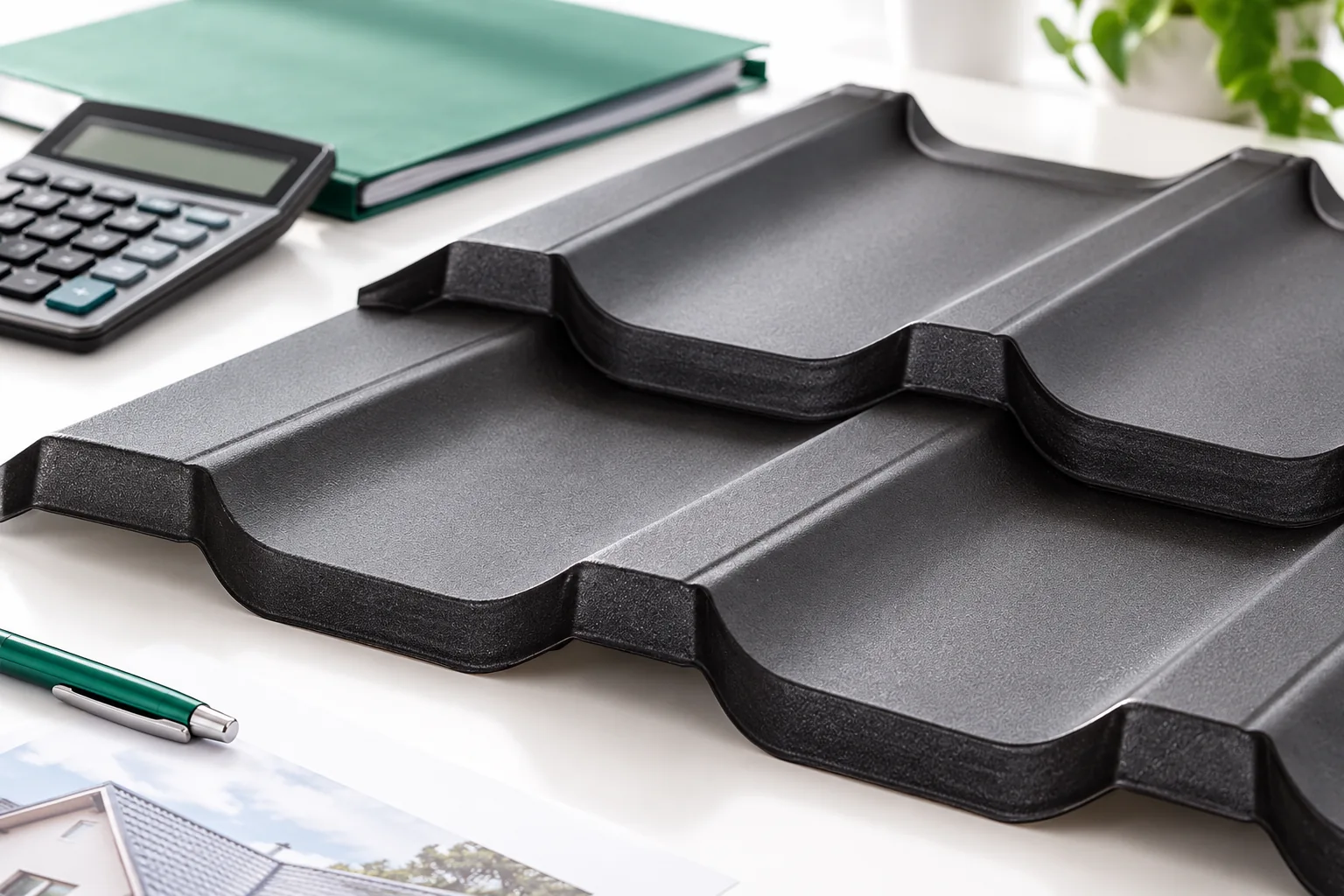
Steel sheet can be priced per total, effective, running or panel metre. Tiles are often compared after converting the number of pieces to the covering area. Each unit requires verification. For panels, the effective area per piece must be known. For long sheets, the covering width and longitudinal laps are important. A price without these data says little about the final sum.
In this example, one cutting plan needs 112 m² of material at about €9.08/m² before VAT. The other needs 105 m² at about €9.98/m² before VAT. The totals are €1,016.56 and €1,048.33 before VAT, a difference of €31.77. These figures illustrate the calculation and do not represent a price offer. The totals were converted from the original amounts in złoty before rounding, using the National Bank of Poland rate of PLN 4.407 per euro on 13 November 2026. The cheaper price per square metre need not produce the same percentage saving on the order. Both cutting plans must suit the roof.
How does the substrate change the price of the whole option?
Tile-effect metal roofing and tiles require support in accordance with their own system. Bituminous shingles require a suitably prepared continuous substrate and the layers specified by the manufacturer. The price of the shingles alone cannot be compared with a complete set of battens, membrane and steel sheet. Each variant must be brought to a similar stage of readiness in the cost estimate.
Thermal insulation and moisture control must also match the function of the building. A single steel sheet does not replace insulation. It is not worth subtracting necessary layers just to make the chosen option look cheaper. If two solutions provide different parameters for the entire building envelope, this must be clearly described. A common roof area does not automatically mean the same function of the assembly.

How much do flashings and accessories matter?
On a simple roof, the area of the main covering accounts for a large share. With numerous edges and openings, the importance of details increases. The ridge, roof valleys, gables, eaves, penetrations and connections at chimneys must be counted. Add to this the fasteners, sealants and accessories required for the specific solution. Their number does not result solely from the square footage of the roof slopes.
Assess the roof access and safety provisions specified in the design separately. A quote without these items may be incomplete. Not all accessories are interchangeable between profiles. Also check the finish and colour of the flashings to avoid later surcharges for the correct variant. A shared list of extras helps you quickly see whether the price difference comes from the material or from omitted scope.
What should be included in transport and labour?
Long sheets require suitable access and support during unloading. Modules can make handling easier in a tight space, but they have their own laying sequence. Heavier coverings change the organisation of deliveries and lifting onto the roof. The quote should be prepared by a contractor familiar with the geometry of the building and the specific system. A rate per metre from another project does not determine the cost of this installation.
Also establish the scaffolding, site protection, dismantling and waste collection. For renovation, temporary protection of the exposed structure is important. It is worth separating the cost of typical work from items dependent on the condition of the roof once uncovered. This makes clear what the quote covers and which circumstances may change it. Final amounts should be given on the same net or gross basis.
How should later use be taken into account?
Compare the required inspections, cleaning and access for repairs. Check the availability of matching parts and how a damaged element is replaced. Do not assume a single service life based on the warranty. The terms of cover may relate to different phenomena. It is worth reading them alongside the care instructions, especially in a demanding building environment.
The price list is a reference point for building a cost estimate, not a ready-made quote for the whole roof. Note its date and confirm prices before ordering. Make your decision on the basis of the full total and the described differences in use. Then you can consciously choose the cheaper variant or justify the surcharge, without confusing the low price of a single product with the cost of a correctly executed covering.
7 branches. Materials closer to your project.