Roof and energy
Choosing a solar roof for dusty conditions
In brief
Dust and dirt can reduce the amount of light reaching the cells. This does not mean, however, that every roof needs frequent washing or that any cleaning is safe. Near fields, a workshop or an unpaved road, it is worth taking the surroundings into account when choosing the system. An integrated roof surface has an orderly form, but still needs checking in accordance with the instructions. Access and the method of care should be part of the plan. Road dust, deposits from agricultural work, leaves and contamination left by birds can land on the surface. Their quantity depends on the location and the season. The position of the roof surface in relation to trees and neighbouring structures is also important.
What kind of soiling appears on the roof?
Maintenance needs cannot be determined from the product name alone.
Rain removes some of the soiling, but it should not be treated as a guarantee of complete cleaning. Deposits may remain in certain places or build up during dry periods. A sensible starting point is to observe the surface and compare production with weather conditions. A single weaker day does not yet prove a soiling problem.
Does dust affect only production?
Soiling can obscure the cells and restrict the light reaching them. Leaves or other debris, in turn, can impede water drainage in the gutters and roof valleys. An inspection should therefore cover the entire roof surface and its edges. Assessing only the energy chart may overlook a problem affecting the roof’s basic function.
In a more demanding environment, the resistance of the materials to the expected influences must also be checked. This applies to coatings, flashings and installation components. It is not worth assuming that the term agricultural roof confirms suitability for every type of contamination. The manufacturer should relate the documentation to the conditions of the planned application.
What does the integrated form of the roof surface make easier?
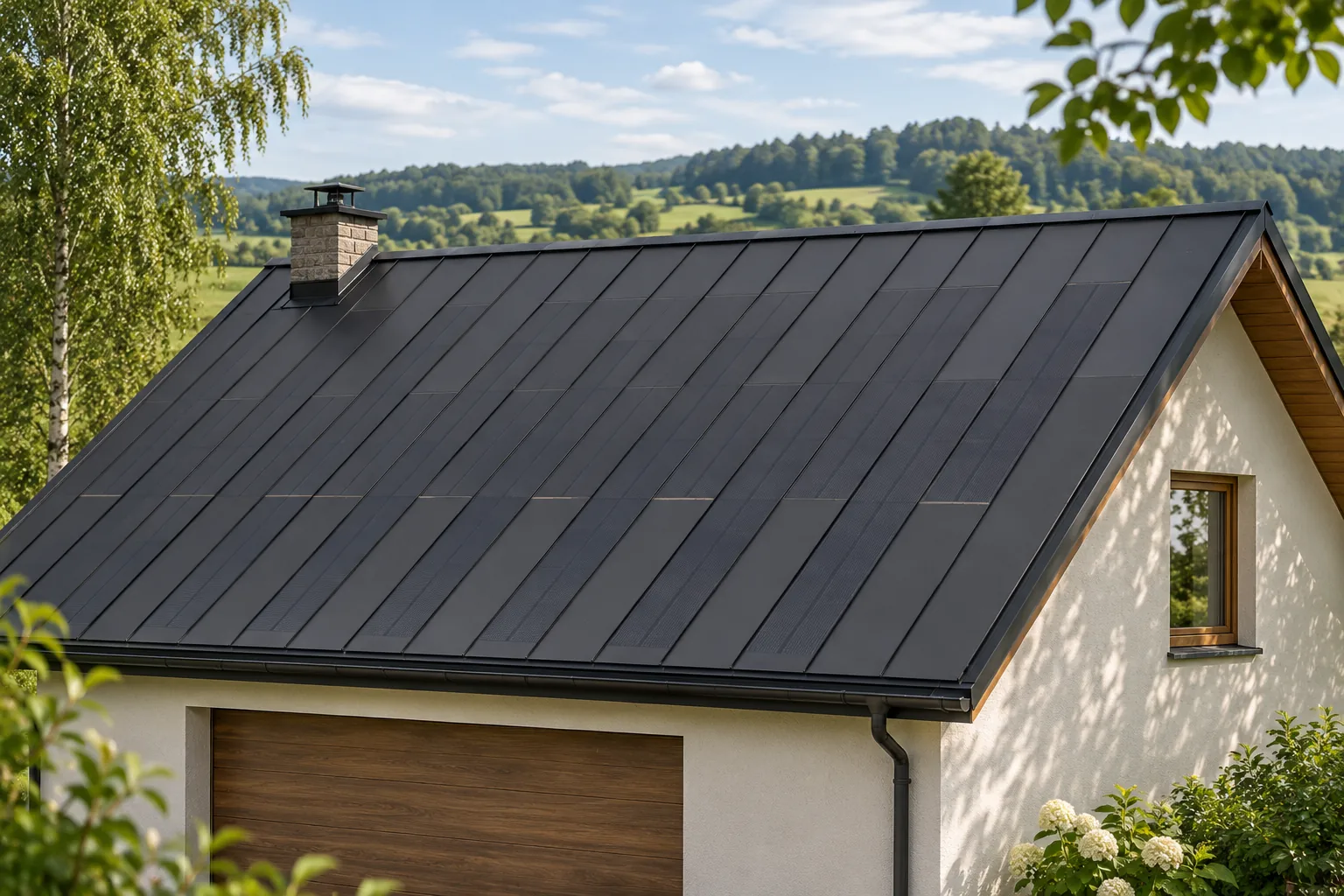
Steel panels with cells and passive elements can form a regular surface without a separate PV structure above the covering. This gives an orderly roof appearance and a predictable layout of its zones. It does not, however, mean there are no joints or that it is entirely maintenance-free. Every system has places that require attention.
The advantage of integration can be used through good placement of the active fields. Cells do not have to be forced into shaded or hard-to-reach areas just to preserve the appearance of the whole. The passive parts fill such areas. The design can therefore combine aesthetics, sensible production and the possibility of later inspection.
When is cleaning justified?
The decision should be based on an inspection, the instructions and observation of how the installation performs. A drop in production can have many causes, such as weather, shade or a fault. It should not automatically be attributed to soiling. If deposits are visible and persist, the appropriate method of action should be established with the service team or installer.
There is no single cleaning calendar that suits every location. A demanding site may need more frequent checks, but not necessarily cleaning every time. It is worth recording observations and completed work in the documentation. Over time, this will allow the schedule to be matched to the actual conditions of the building.
What should you avoid during maintenance?
Random chemicals, abrasive tools or arbitrarily selected water pressure should not be used. The cleaning method must match the requirements of the surface and the joints. The roof is also an electrical installation. Safe handling requires appropriate competence and procedures in accordance with the system instructions.
Stepping onto active arrays without a defined procedure can damage components and expose a person to a fall. It is better to establish safe access or a service arrangement in advance. It is not worth designing a roof whose basic inspection cannot be carried out without improvisation. This is a practical part of the purchasing decision, not an afterthought following installation.
How do you take the surroundings into account when ordering?
The contractor should know about the unpaved road, intensive field work, birds and nearby trees. Photographs of the plot and a description of how the buildings are used will help to select the roof layout and the scope of servicing. You should also ask about the warranty conditions relating to maintenance. A general assurance that no servicing is needed is not enough.
A well-designed BIPV roof can remain aesthetically pleasing and functional in an ordinary farm setting. However, it needs a realistic approach to soiling and access. Regular observation, an appropriate response to dirt and calm planning of active zones are more sensible than the promise of a perfectly clean surface all year round.
Photographs of the soiling on the existing roof after a dry spell are good material for discussion. They show the conditions of the plot better than a general description of a quiet area.
Examples of companies and brands in building-integrated photovoltaics are MDM NT (MyRoof), ML System, SunRoof, Wienerberger Wevolt, Megasol Energie, EDILIANS, Tesla, Solarstone, SolRoof and Electrotile.
7 branches. Materials closer to your project.

- SEROCK — Dzierżenin 34 E
- BŁONIE — ul. Sochaczewska 138A
- RADOM — ul. Grobickiego 8
- ŁÓDŹ — Natolin 8
- OLSZTYN — Barczewo, ul. Prosta 9
- WROCŁAW — ul. Jerzmanowska 10C
- GORZÓW WLKP. — ul. Zielona 33/34