Roof and energy
Can photovoltaic roofing replace insulated sandwich roof panels?
In brief
A photovoltaic covering and an insulated roof panel perform different functions. The panel combines facings with an insulating core and behaves within a defined support arrangement. A steel BIPV panel can cover the roof and generate electricity at the same time, but it does not thereby become an insulated sandwich panel. Replacing one solution with the other requires the design of the entire building envelope. It is precisely this distinction that helps avoid errors when pricing a new roof. An insulated sandwich panel has a defined construction, thickness, core type and facings. Its parameters relate, among other things, to thermal insulation and to behaviour between supports in the intended arrangement. Selection covers span, loads and service conditions. This material cannot be reduced solely to the outer metal sheet visible on the roof.
What does an insulated sandwich roof panel provide?
Replacing the panel with a different covering requires checking the functions that must be retained. These are protection against water, thermal insulation, airtightness and load transfer. If even one of these roles remains unresolved, the price comparison will be illusory. A cheaper external element may require additional layers and supports.
What role does a steel panel with solar cells play?
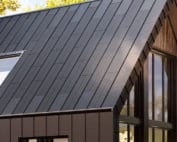
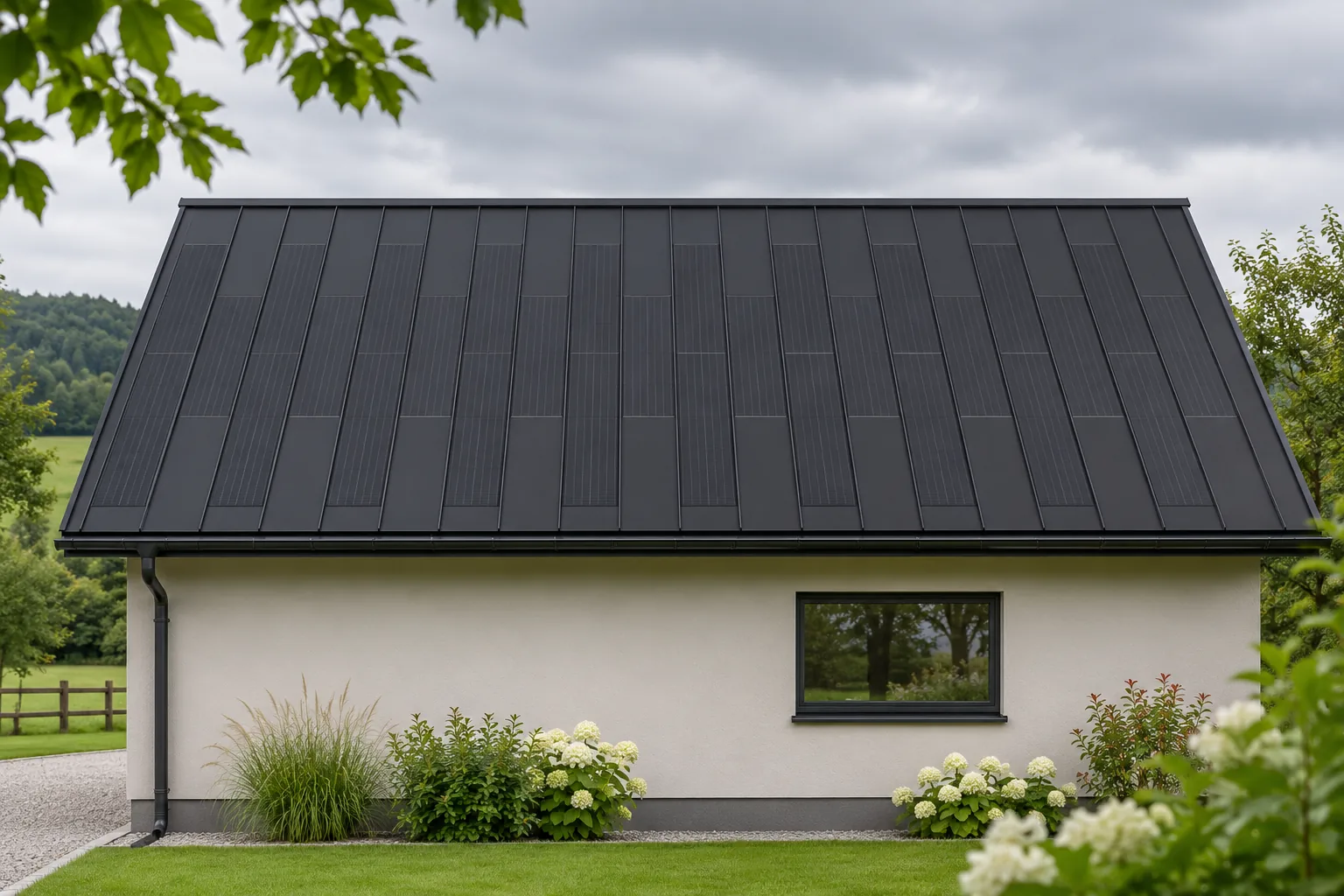
In an integrated steel roof, the solar cells are bonded to the covering element. Active panels work together with passive parts of the roof slope. This enables a compact appearance without a separate mounting frame above the roof. The energy function is therefore combined with the covering function, which is the main advantage of this solution.
However, this does not imply self-supporting capacity corresponding to any roof panel or a specific thermal insulation value. These properties must be ensured in the building design. The system has its own requirements for the substrate and pitch. Use on a hall requires adapting the structure, not merely choosing a similar surface colour.
Can BIPV be laid on an existing sandwich panel?
Such an arrangement requires clear confirmation of compatibility and resolution of all layers. It must not be assumed that any sandwich panel is an approved substrate for every integrated roof. Fixings, force transfer, moisture, ventilation and the warranty conditions of both systems must be assessed. Similarity of materials alone is not sufficient.
If a complete sealed covering remains beneath the photovoltaics, it is also worth precisely naming the role of the new arrangement. It may differ from a solution in which BIPV replaces part of the roof. For the investor, function, documentation and cost are more important than the label. The term integrated should not mask an unclear cross-section.
When is it worth comparing two full variants?
For new construction, a roof made of sandwich panels with a separate PV installation can be compared with a roof designed for a BIPV system. Both variants should meet the same requirements of the building. The calculation must include the structure, insulation, substrate, covering, installation and electrical system. Only such a scope yields comparable results.
The building geometry is also important. Many halls have a low pitch and large support spacings. Not every integrated roof is intended for such conditions. A small building with a simple, suitably inclined roof slope may, however, allow sensible use of steel BIPV. The decision should follow from the design.
Equally important are the programme of works and the possibility of access to the interior. Rebuilding the layers may affect the use of the hall differently from installing a separate system above the existing roof.
How to avoid confusing classification and warranty?
A document concerning the PV module does not replace the documentation for the entire roof. Similarly, the parameters of the panel core do not automatically describe the behaviour of every possible layer arrangement. Fire requirements must be verified for the specific assembly and application. A class from a single component should not be transferred to the rebuilt envelope.
In warranties, it is worth separating material, airtightness, installation and cell power performance. Their scopes and conditions may differ. If the roof combines elements from several systems, responsibility for the interfaces must be established. A clear division reduces the risk of the investor later being referred between suppliers.
How to ask the contractor the right question?
Instead of asking whether a photovoltaic panel will replace the sandwich panel, it is better to request a cross-section of the complete roof. It should show the support, insulation, sealing layers, ventilation and covering. It is worth attaching the building’s performance requirements and the structural geometry. The discussion then concerns a possible solution rather than a comparison of two non-interchangeable products.
A BIPV roof can be a good choice for an appropriately designed building. Its advantage is the combination of energy and an aesthetic covering. The sandwich panel, by contrast, offers a different set of structural and insulation functions. A reliable design allows the advantages of both categories to be used without attributing to them properties that the documentation does not confirm.
Among the manufacturers and brands of photovoltaic roofs are LUMA Solar, Solartag, Wienerberger Wevolt, MDM NT (MyRoof), SunRoof, ML System, Electrotile, BIPVco, Dyaqua and SolRoof.
7 branches. Materials closer to your project.

- SEROCK — Dzierżenin 34 E
- BŁONIE — ul. Sochaczewska 138A
- RADOM — ul. Grobickiego 8
- ŁÓDŹ — Natolin 8
- OLSZTYN — Barczewo, ul. Prosta 9
- WROCŁAW — ul. Jerzmanowska 10C
- GORZÓW WLKP. — ul. Zielona 33/34