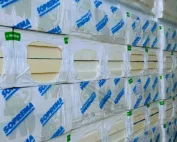
PIR insulation
EFIGREEN ALU+ in a bonded system: the role of the composite facing
At a glance
The ALU+ composite surface is designed to work with a specific covering and fixing method. It should not be described in shorthand as any arbitrary aluminium sheet. The kraft paper, aluminium and PE layers are part of a specific product. The compatibility of the adhesive and of the other components must be confirmed for such a build-up. The function of EFIGREEN ALU+ must be described together with the layers adjacent to its surface. A key point of the connection is the contact between the composite facing and the selected adhesive layer. The basis for coordination is a cross-section showing the substrate, adhesive, insulation and covering. Before selecting materials, the board thickness and the surface and condition of the substrate intended for bonding must be established, so that the sequence of layers has a real reference.
Function of the board within the cross-section
A correct build-up should combine the required thermal resistance with the compatibility of all layers of the bonded system. The functions of the remaining layers must be defined separately.
The correct product and the scope of its data
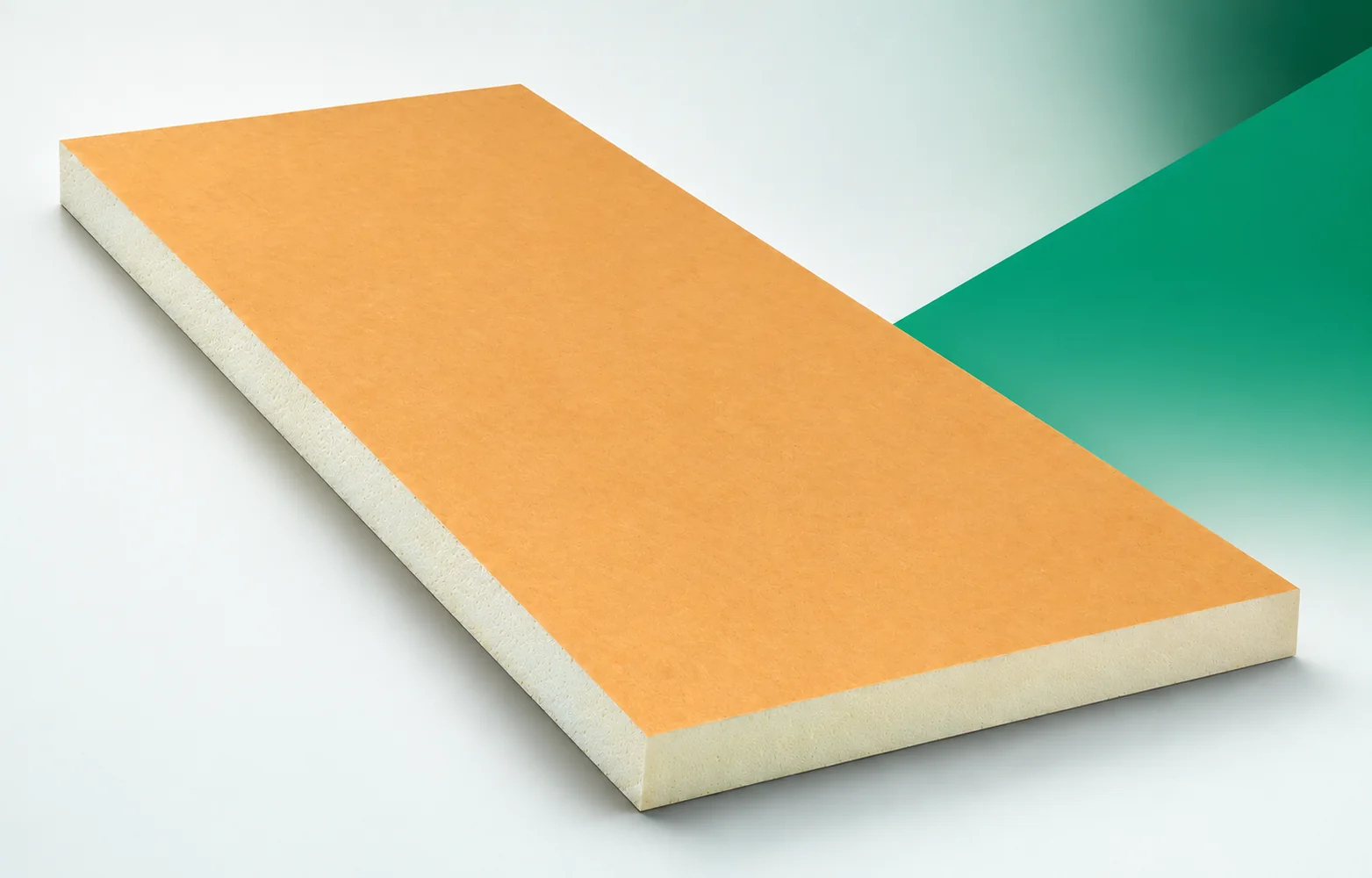
In EFIGREEN ALU+, the PIR core is enclosed by a composite kraft–aluminium–PE facing, so the declared properties refer to the finished board, not to the foam alone. Lambda is 0.023 W/(m·K) for 30–35 mm and 0.022 W/(m·K) in the stated range of 40–160 mm, and the data sheet gives CS(10/Y)200. The Polish product page designates the reaction to fire as NPD, i.e. no declaration of this property. The basic format is 600 × 600 mm, whereas ALU+ XL has different dimensions depending on the variant. SOPREMA PIR boards are considered here for an application covering roof insulation in a system with a confirmed bonded joint, where the contact between the facing and the adhesive layer also matters.
Scope of the example comparison
In a bonded system with EFIGREEN ALU+, a thermal comparison does not replace checking the surface for adhesive. For an example of 100 mm and a lambda of 0.022, the quotient d/λ is approximately 4.55 m²K/W, whereas a material with a hypothetical thermal conductivity of 0.040 would require approximately 181.8 mm. This is a comparison of layers, not a declaration of another product; do not label the calculated result as the declared RD. Once the thickness has been established, return to the square-edged joints, the substrate prepared for bonding and the connections above the insulation. Equivalence also requires matching facings and method of fixing.
The calculation involving EFIGREEN ALU+ describes the stated quantity, not automatically the class of the entire system. The key assumption is the composite construction of the kraft–aluminium–PE facing. The result must be compared with the limitation defined as the adhesive’s scope of application confirmed for the specific facing. With regard to this section, the full material designations should be compared with the documentation of the adopted solution. A section drawing showing the substrate, adhesive, insulation and covering is helpful, as it shows the position of each layer. Only then can a covering fixed by a method approved for the described facing be considered, without automatically transferring rules from another combination of materials.
How to assess the proposed change
The variant based on the decision to retain the confirmed set of board, adhesive and covering must be considered through the full section. In the second step, the following action must be considered: reassessment of the joint after any component has been changed. With EFIGREEN ALU+, both proposals must retain the requirements at the location described as the junction of the composite facing with the selected adhesive layer. Any attribution to the composite facing of conformity appropriate for any aluminium foil must be excluded, because such a simplification changes the basis of comparison. The final scope should be confirmed by the designer of the roof joint system. For the selected solution, a schedule of materials is required describing each bonded joint in the section, consistent with the materials located directly below and above the insulation.
Surface and joint finish
The surface of EFIGREEN ALU+ is a composite of kraft paper, aluminium and PE foil. Its type must be taken into account when selecting the layer with which it will work. In the documentation, the junction of the straight edges with the resolved connection of the layers above the insulation must also be identified, instead of replacing the actual geometry with a general symbol. Acceptance should be based on the complete set of documents confirming the intended connection of materials. For this reason, the covering fixed by the method approved for the described facing should only be installed after the agreed inspection. In the drawing, it is worth highlighting the junction of the composite facing with the selected adhesive layer, because that is where the course of the connection changes.
The sequence of works follows from the build-up
Before EFIGREEN ALU+ is laid, a substrate prepared in accordance with the requirements of the selected bonding method must be provided. The schedule should include inspection of the element described as the junction of the composite facing with the selected adhesive layer. For acceptance, a section must be prepared showing the substrate, adhesive, insulation and covering, with any execution changes marked. After this inspection, work can proceed to the scope consisting of the covering fixed by the method approved for the described facing. The sequence should be agreed under the lead of the designer of the roof joint system, especially when different layers are carried out by different crews. This makes it possible to separate the tasks that polyurethane insulation has from the works ensuring the remaining functions of the section.
Specification ready for pricing
An enquiry for EFIGREEN ALU+ should clearly indicate roof insulation in a system with a confirmed bonded joint. A schedule of materials describing each bonded joint in the section should be attached to the description so that the supplier knows the adopted variant. A separate item may be the work needed to combine the required thermal resistance with the conformity of all layers of the bonded system. It is worth asking for a specification of the changes caused by any replacement of the facing or geometry. Each such proposal should again take into account the scope of application of the adhesive confirmed for the specific facing. After the solution has been selected, the complete set of documents confirming the intended connection of materials must be retained as the basis for identifying the material on site. In such an order, polyurethane boards are part of a specific system, not a category of freely interchangeable sheets.
7 branches. Materials closer to your project.