Roof and energy
Does a photovoltaic roof make sense for a seasonally used building?
In brief
A building used for only part of the year can have a photovoltaic roof, but it requires a careful comparison of production and consumption. A summer house, a seasonal warehouse and a farm outbuilding have different needs. An integrated covering provides an aesthetic roof without a separate panel structure, particularly in new construction or when replacing the roof covering. Whether the investment makes sense also depends on what happens to the energy and to the building itself outside the season. In one property this means regular operation for several months. In another, only weekend visits or a short period of intensive storage. Such different situations should not lead to an identical choice of installation. It is worth describing a typical week in the season and the periods when the building remains empty.
How to understand seasonal use?
Devices that operate without people present must also be taken into account. Monitoring, ventilation or frost protection may draw energy all year round. However, you should not assume that this consumption automatically justifies a large roof capacity. Data on actual consumption helps separate needs from assumptions.
For a recreational building, the travel plan also matters. The roof may produce the most precisely when the owners are away from the property for extended periods.
When does production match use well?
If the building is used intensively during the day in months with good sunlight, some of the energy can be used directly. That is a favourable starting point, but it still requires calculations. The operating hours of the loads and their power rating are important. Summer use only in the evenings has a different effect from daytime operation of devices.
You should also check whether the installation can work with other loads on the property. This possibility depends on the electrical design and the way it is connected, not on the proximity of the buildings. If surpluses arise outside the season, the way they are accounted for must be taken into account. They should not be treated as energy available later without limits.
What speaks in favour of an integrated covering?
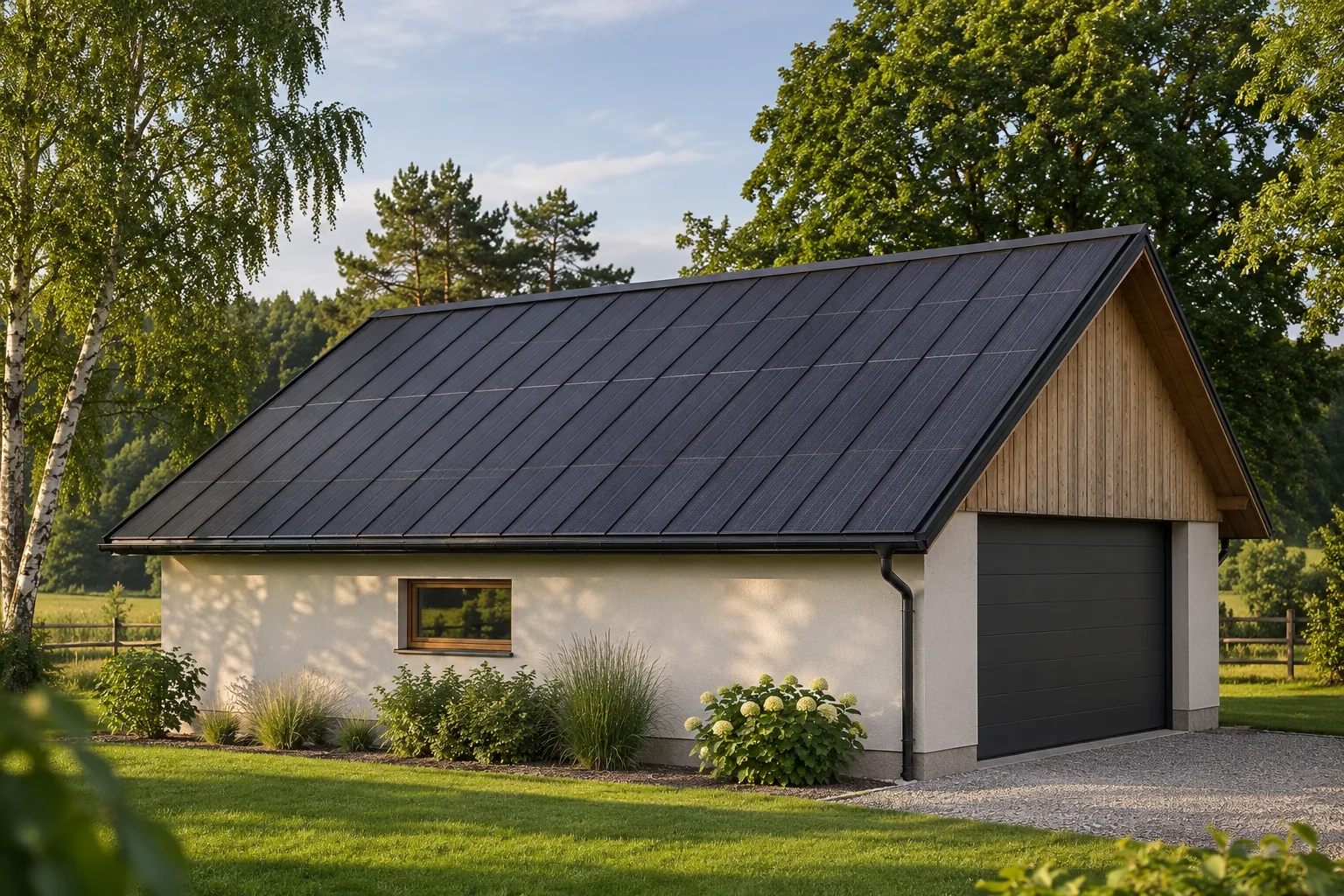
When the roof is being redone anyway, BIPV allows its primary function to be combined with electricity production. Active and passive steel elements can form a coherent roof surface. There is no need for a separate array of modules above a finished covering. In a small recreational building, aesthetics is often an important part of the decision.
This does not mean the entire roof has to be covered with cells. The size of the active area should be matched to the conditions and the consumption plan. The remaining areas can take a form consistent with the rest of the system. As a result, choosing the capacity does not have to lead to a random appearance, but the formats and installation rules must still be observed.
How to look after a property left unsupervised?
The roof needs checking even when the building is not in use. Blocked gutters, storm damage or a visible defect do not wait for the start of the season. It is worth appointing a person responsible for periodic inspections and a way of reporting problems. Production monitoring can help spot an irregularity, but it does not replace inspection of the covering.
Electrical devices must be installed in conditions that meet their requirements. An unheated room is not automatically suitable for every inverter or storage unit. Temperature, humidity and access for maintenance are important. These points must be checked before purchase, especially when the building remains closed in winter.
Does storage solve all the problems of seasonality?
A storage unit can shift some energy between periods of production and consumption, but its capacity is limited. It should not be assumed that a typical domestic device will retain summer surpluses for the entire winter. Actual operating cycles, user needs and installation conditions must be calculated. This is a separate investment decision.
If the aim is off-grid supply or backup of selected circuits, an appropriate design is required. The PV roof alone does not provide these functions. It is worth clearly defining the priority, for example lighting and communications during a power failure. This avoids buying extensive equipment without specific justification.
How do you decide on the basis of full costs?
The BIPV variant should be compared with a roof that would have been installed anyway and with a possible separate installation. The calculation should include flashings, the passive part, devices, cables and subsequent maintenance. For a small building, fixed costs may account for a large share. It is therefore worth evaluating several active area sizes.
A solar roof can be well suited to a seasonal building if its functions and costs are consciously chosen. The aesthetic combination of roofing and energy generation remains an advantage. However, a realistic plan for consumption and year-round care of the building is a prerequisite. A large roof area alone is not a sufficient argument.
Examples of companies and brands in roof-integrated photovoltaics are Ennogie, ML System, Electrotile, Solarstone, Nelskamp, Wienerberger Wevolt, SunRoof, Dyaqua, MDM NT (MyRoof) and SolRoof.
7 branches. Materials closer to your project.

- SEROCK — Dzierżenin 34 E
- BŁONIE — ul. Sochaczewska 138A
- RADOM — ul. Grobickiego 8
- ŁÓDŹ — Natolin 8
- OLSZTYN — Barczewo, ul. Prosta 9
- WROCŁAW — ul. Jerzmanowska 10C
- GORZÓW WLKP. — ul. Zielona 33/34