Insulation and energy
What does a roofing underlay do and how do you choose one?
In brief
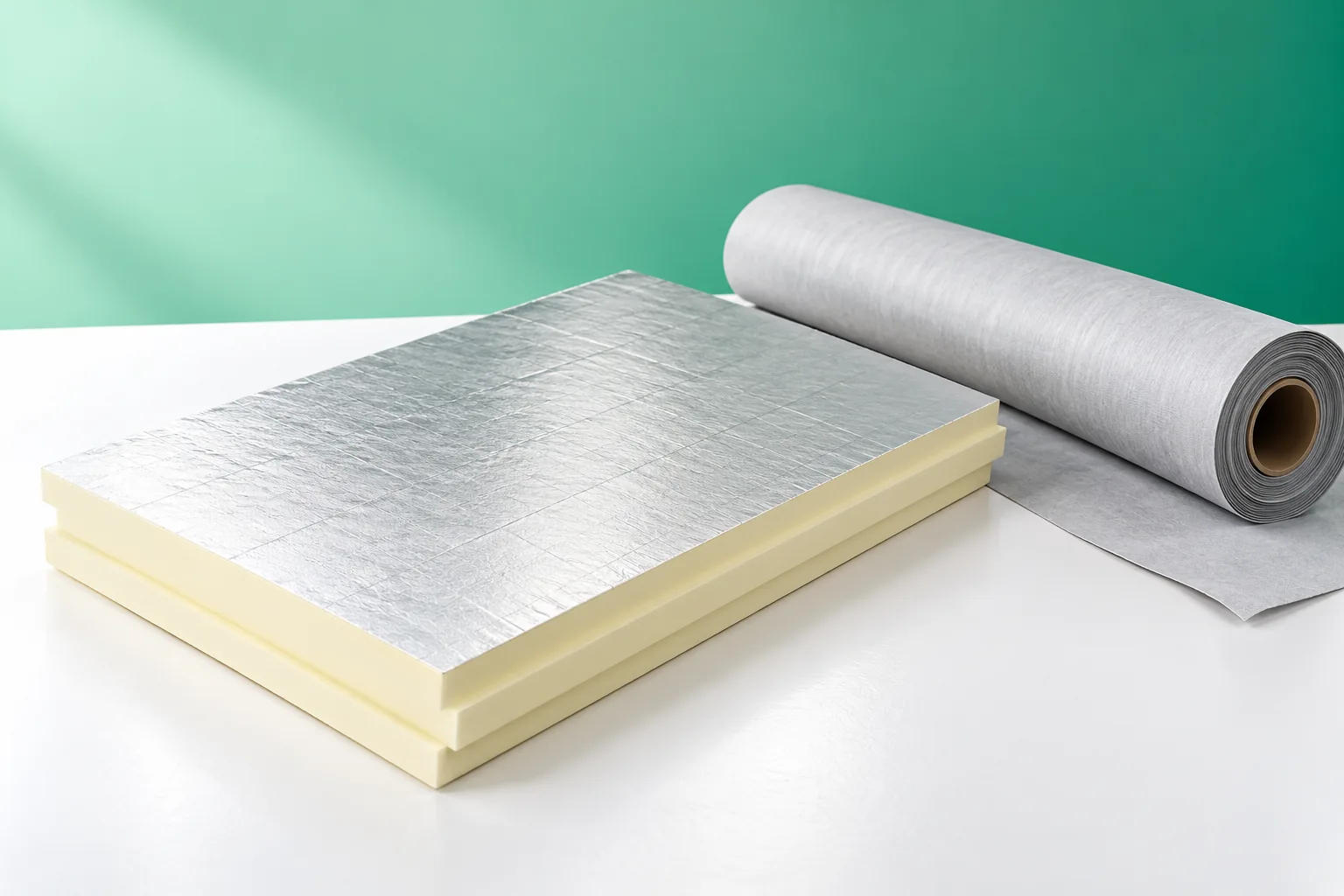
The underlay membrane beneath metal roofing is there to intercept water that gets under the covering and direct it outside before it reaches the insulation or structure. When choosing, check whether the manufacturer allows installation on the given substrate, along with water resistance, temperature range and the durability of joints. The Sd value alone does not settle suitability, because the whole roof assembly matters. Also establish how laps and the eaves termination are detailed, since these determine how the membrane performs in practice.
What water is the membrane supposed to take up?
Small amounts of precipitation blown in by the wind can get under the covering. Condensation can also form on the underside of the sheet metal. The membrane is intended to direct this water out of the building before it reaches the insulation or the structure. Its performance depends on continuity and on how it is terminated, particularly at the eaves.
It should not be used to permanently take up a large leak from faulty flashing. If the primary covering is not watertight, the cause must be repaired. The membrane provides additional protection, but its water load and exposure time have defined limits. It should not be left as the final roof covering merely because it initially does not let precipitation through.
How do you read the technical data?
It is worth checking the water penetration resistance class, the tensile and tear strength, and the temperature range. Properties after artificial ageing are also important. The mass per unit area does not fully describe these characteristics. Two materials with the same mass per unit area can behave differently during installation and in service.
The Sd value indicates the resistance to water vapour diffusion. For a highly vapour-permeable membrane it is low, but it is not the sole selection criterion. The value must be considered in relation to the other roof layers. The lowest Sd will not remedy a damaged surface, an unsealed lap or a poorly executed penetration at the chimney.
Is every membrane suitable for boarding?
No. It should be checked whether the manufacturer permits installation on a full substrate and direct contact with the insulation. Some products have specific application restrictions. The substrate surface is also important. Sharp edges, protruding fasteners and unevenness can damage the material even before the covering is laid.
During renovation, it must be established what is beneath the new membrane. Retained old roofing felt changes the diffusion resistance of the assembly. Adding a vapour-permeable layer on top does not automatically remove this limitation. The entire system should be designed with the possibility of drying out and with ventilation where required.

How do you allow for temperature and sun?
Variable temperatures occur beneath metal roofing. Colour, exposure and ventilation affect the membrane’s working conditions. It is worth choosing a product intended for the given system and temperature range. Information on resistance to short-term external exposure is not the same as durability during many years of service under the roof.
The permitted time left uncovered must be treated as a limitation, not as a scheduling target. UV radiation, wind and precipitation act on the exposed surface. Breaks in work require appropriate protection. If the material was exposed for longer than permitted, its condition should be assessed before the roof slope is closed.
How should laps and penetrations be executed?
Successive strips should drain water in accordance with the slope. The size of the overlap and the method of bonding result from the instructions and the roof pitch. A single width should not be assumed for every material. Sealing at the points under the counter-battens is also important, if the system provides for it.
Compatible details are needed at windows, chimneys and ducts. Water from the higher part of the slope should bypass the opening. Cutting and incidental bonding with ordinary tape can quickly lose tightness. Accessories must match the membrane, and the substrate should be clean and prepared for bonding at the appropriate temperature.
Why is ventilation still necessary?
Vapour permeability describes the transport of vapour through the material. Ventilation under the roofing consists of air movement in the space created by the counter-battens. The two mechanisms are different. In a typical roof with sheet metal, open inlets and outlets must be maintained, even if the membrane has very low diffusion resistance.
Control of moist air inflow is also needed from the interior. Leaks at slopes and installations can supply moisture faster than the assembly can dry out. The membrane does not replace a tight internal layer or room ventilation. Selection should cover all these elements together.
How should the material be checked before covering?
It is worth checking for damage, overlaps and the method of water drainage at the eaves. Holes from unnecessary fastenings require repair in accordance with the system. Penetrations and areas around windows should be inspected. Once the sheet metal is laid, access will become much more difficult, so acceptance at this stage is of great value.
It is good to keep the roll label, the instructions and photographs of the details. For later repair, this allows the correct accessories to be selected. If the material was changed during installation, conformity with the design must be confirmed. A similar colour and trade name do not prove the same diffusion resistance, durability or approval for the given substrate.
7 branches. Materials closer to your project.