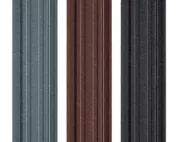
Metal fences
Metal picket fencing at commercial premises: separating customer access from the service area
In brief
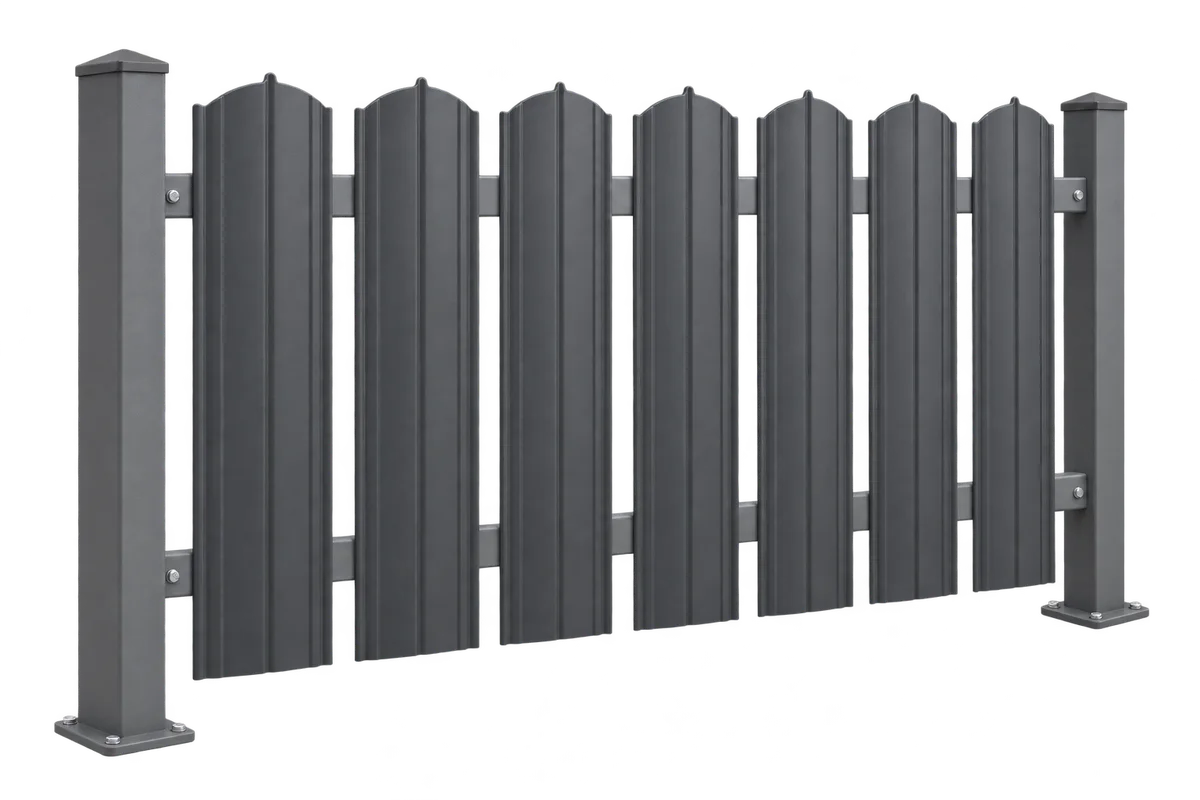
A metal picket fence at a commercial property should organise movement and clearly indicate the entrance while still allowing back-of-house operations. Before choosing colour and profile, it is worth drawing out the zones: customer access, parking, deliveries and areas requiring screening. On Sandwich-panel.pl we show how to combine these tasks in a single project. Pickets are the infill of the bays; their appearance does not on its own determine the load-bearing capacity of the posts, gates or foundations. Before ordering, you need to establish the gaps, the direction of layout and the fixing conditions for the specific product. Consistency of the fence does not require the same degree of screening on every section. What matters more is maintaining a clear division and the correct construction of each zone.
Map out pedestrian and vehicle movement
First mark out the route from the car park to the entrance and the delivery route to the rear.
Check the turning areas and gate opening zones, as well as the position of the pedestrian gate relative to the building doors. The fence should not force an ill-considered crossing of routes. The corner at the entrance needs a visibility assessment. Dense infill can obstruct observation at such a point, even if it provides the desired screening further along the plot.
Match the gaps to the task of the section
At the entrance, visitor orientation is usually important, whereas at the rear, limiting the view of stored materials may be more significant. Both objectives can be described separately in the design. Do not assume, however, that the arrangement of the pickets alone will create a complete visual barrier: visibility also depends on the viewing angle.
The density of the elements changes the degree of screening and the wind effect on the bay. The substructure is selected for the chosen variant, not for the lightest section of the fence. Additional screens should not be added later without checking their impact. This also applies to advertising banners hung between the posts.
Choose shared features for different bays
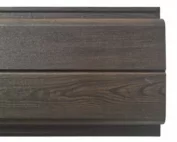
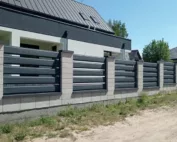
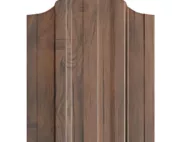
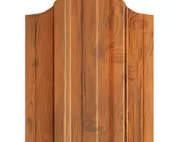
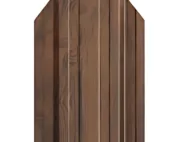
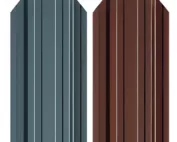
A consistent effect can be achieved with a shared profile, colour or method of finishing the top edge. The gaps and heights may differ if this results from the function of a given section. It is worth viewing the arrangement on the fence elevation drawn together with the building. A single photograph of a picket does not show the rhythm of the entire frontage.
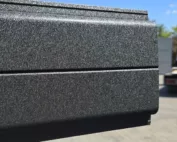
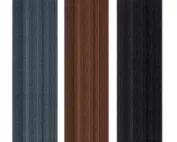
If the building has a facade of sandwich panels, compare samples of its cladding with the finish of the pickets. The same colour code does not guarantee a match in texture and gloss. Also check the view from the property side: the rear surface of the infill may have a different finish from the side facing the street.
Separate the infill from the gate structure
The gate and pedestrian gate are moving elements, so they require an appropriately selected frame, fittings and support. A picket fixed in a bay does not thereby become an independent load-bearing element of the leaf. The designer or system supplier should confirm how the infill is fixed to the specific structure.
For a wide entrance, take into account the position of the drive, stops and safety components. The rhythm of the pickets can be matched to adjacent bays, but not at the expense of the specified working clearances. Before ordering the infill, it is advisable to have an agreed drawing of the entire gate, not just its clear width.
Prepare a clear order schedule
Give the sections designations and enter for each the length, height, profile, gap and the finish of both sides. List the gate and the pedestrian gate separately. Such a schedule makes it easier to check quantities, assemble packages and distribute components after delivery. It also helps to identify differences between the front side and the rear.
Select fasteners to suit the material of the crossbars and the recommendations for the chosen profile. If cutting is necessary, the tools and edge protection must be agreed. Do not treat an arbitrary screw of the right length as a confirmed solution. On acceptance, also check the surfaces for metal particles and damage.
Allow for daily site operations
Leave room for cleaning the lower edges and removing leaves at the base. Near a car park or delivery route, consider separate protection against vehicle impacts. The fence should not automatically be treated as a vehicle-stopping barrier; that task requires a separate solution.
Inspections can be linked to gate servicing and site tidying. They cover fastenings, surface damage and areas of persistent dampness. Keep the profile and coating designation for any replacement of individual pickets. This will make repair easier without changing the appearance of the entire section.
7 branches. Materials closer to your project.