Roof coverings
How do modular sheet metal tiles differ from stone-coated roofing?
In brief
Modularity and a granular finish are two different features of a roof covering that can occur together. The modular layout concerns the format of the panels, while the stone granule finish describes the surface treatment. When choosing, check whether you are comparing the material in terms of appearance, construction and installation rules, not just the number of modules. The key decision variable is the complete system: from the profile and finish to the flashings and fixings. This allows you to assess whether a difference stems from the surface, the geometry or the accessories.
Why do the names need to be clarified first?
The term “modular” means that the covering is made up of panels of a repeatable format. It does not determine whether the surface will be smooth, matt or covered with granules. Stone granule coating is one of the possible finishing layers of a metal covering. Comparing these names as two mutually exclusive categories therefore leads to incorrect conclusions.
In an enquiry it is best to describe the material directly. State the format, the type of core and finish, and then compare specific products. This makes it clear whether a price difference results from the surface, the geometry or the scope of accessories. It should not be assumed that all granular-coated coverings have an identical construction and can be installed according to a single set of instructions.
How does the surface construction differ?
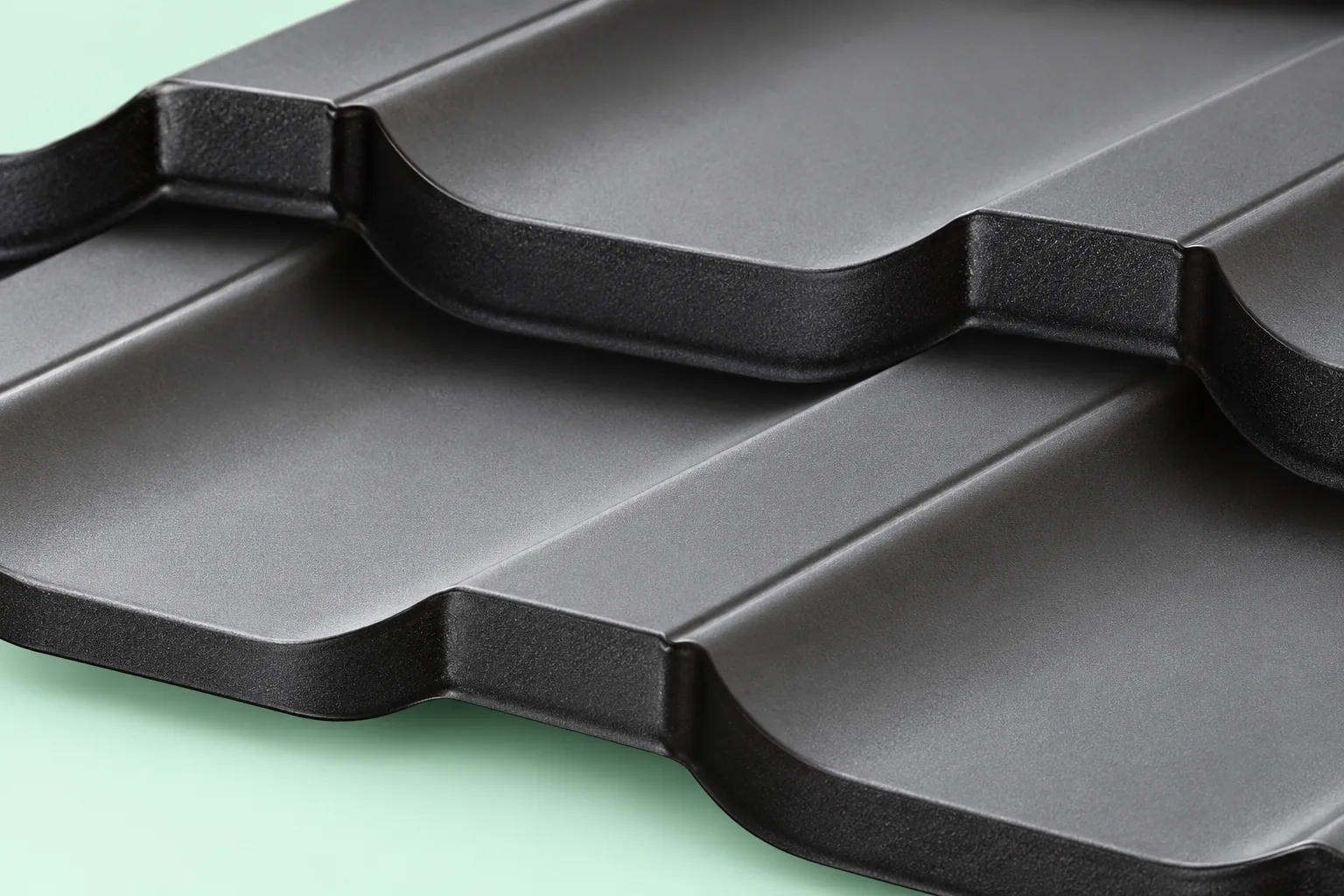
In a typical coated steel sheet, the visible colour is formed by a suitable organic layer. Beneath it is a system for preparing and metallically protecting the steel. The finish may be smooth or have a distinct texture. Individual systems differ in resistance and the permissible environment of use. A matt appearance alone does not describe their full properties.
In granular-coated roofing, the granules are bonded to the prepared surface of the panel. Depending on the system, additional bonding and protective layers are used. These give it a characteristic texture. The granule coating must not be treated as a loosely scattered additive that can be replaced with any material. Surface repairs should also be carried out using the method intended for the product.
What will be visible on the finished roof?
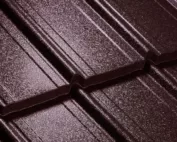
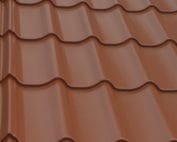
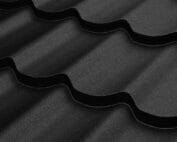
An organic coating clearly shows the line of the profiling and the way light is reflected. Granule coating scatters the image of the surface and gives it a more granular character. This may suit various architectural styles. However, the effect also depends on the profile itself. A flat panel with granule coating will look different from a heavily profiled element made using a similar technology.
Samples should be compared from the distance at which the house is normally viewed. Up close the texture appears dominant, but on a high roof slope it may be less noticeable. It is also worth checking the colour in shade. A natural or decorative character of the surface does not mean that all batches are perfectly identical. The rules for mixing and laying the material must be established before installation.

Does granular coating solve the noise problem?
The surface layer may influence the way the panel reacts to the impact of rain. However, this does not provide a basis for promising silence in the room without assessing the entire roof. The substrate, insulation, ventilated spaces and internal lining also matter. A marketing comparison of two samples does not replace data on the designed building envelope.
Snow should be approached in a similar way. Surface roughness may change how the snow cover behaves on the roof slope, but it does not replace a design for protection against sliding. Above an entrance or a walkway, solutions must be used that follow from the roof conditions. It is not worth giving up the necessary components simply because the surface feels rough to the touch.
What differences arise during installation?
The panels may have different fixing points, different fasteners and a different laying sequence. The rules for bending, cutting and forming terminations also differ. An installer who knows one type of tile-effect metal roofing should not automatically transfer all their habits to another. The instructions and available tools must be checked.
Both variants require the correct flashings, ventilation and layers beneath the covering. It is worth making sure that the quote covers the complete system and not only the basic panels. For repairs, check the availability of materials and whether an element can be replaced. Damaged granule coating and a scratched organic coating may require different approaches. Also make sure that the quote includes the repair kit appropriate for the surface if the installation technology requires one. Not every repair patch suits both types of finish.
How do you choose a solution to suit the budget?
Compare the cost per square metre of effective coverage after allowing for the cutting layout. Add the edge components, the ridge, the fixings and the labour. The price of the panel alone can be misleading, because its surface and the way the details are finished differ. Also pay attention to the warranty conditions and the scope of the required inspections.
The decision is worth basing on the expected price, conformity with the design and a full calculation. If you like a smooth, even pattern, there is no reason to choose granule coating solely because of a promise of greater durability. If you want a granular surface, check it on a real sample and choose an installer who can execute its details correctly.
7 branches. Materials closer to your project.