Roof coverings
Single- and double-module metal roof tiles: which differences matter?
In brief
What matters is not the number of modules itself but the covering area of a specific panel. Before comparing, check the product dimensions and the cut plan on the actual roof slope, including the ridge, eaves and obstacles. A module is a repeating section of the pattern along the slope; overall length also includes the parts needed for joining, so it is not equal to the covering length. The format affects handling, the number of joints and the fit of edge rows, but it does not by itself determine steel quality or coating durability. The choice should be driven by roof geometry and installation organisation, not by the label ‘single-’ or ‘double-module’.
What does the number of modules actually mean?
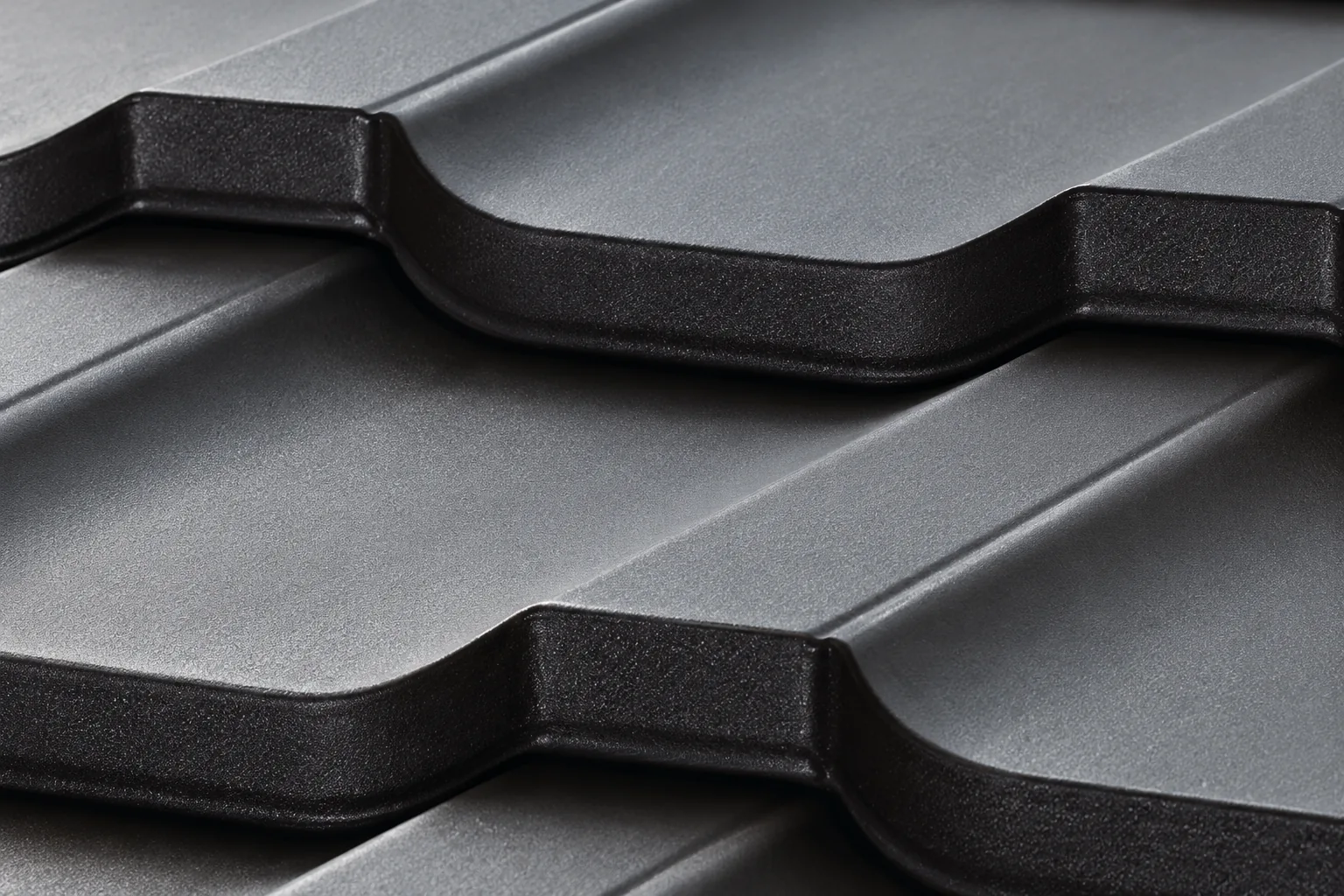
A module is a repeating section of the pattern along the roof slope. A single-module panel has one such section, while a two-module panel has two. The overall length of the element also includes the parts needed for joining. It is therefore not a simple synonym for the cover length. When ordering, you must use the dimensions given for the specific product.
Not all tile-effect metal roofing sheets have an identical module. They also differ in effective width and wave geometry. Therefore, the number of panels needed for a roof does not result solely from the designation ‘one’ or ‘two’. First you need to know the coverage area of one element, and then distribute these elements on the actual roof slope plan.
How does handling convenience change?
A smaller panel is easier to handle and position in a confined space. This can be helpful with dormers, scaffolding and staged installation. A larger element, in turn, covers a larger portion of the roof in a single operation. The advantage depends on work organisation, roof dimensions and crew experience, not on the format alone.
Both types require careful handling of the side edges. Lifting them by unsupported parts can deform the joining areas. Panels should also not be slid over one another. A convenient size does not replace proper storage and delivery of material to height. The details of gripping and lifting are specified in the instructions for the given model.
Which format will reduce waste?
Single-module elements can make it easier to fit the final rows and sections at obstacles. However, this does not mean they will always produce less waste. On a straight slope, a two-module panel may fit very well. The difference must be calculated on the cutting plan, taking into account the actual position of the ridge, eaves and side edges.
For example, a small strip remaining under the ridge may require cutting an element in both systems. The result will be determined by the cover length and the permitted method of finishing. Not every cut-off fragment can be used elsewhere, because it must retain the correct direction of water flow. Optimisation does not consist in turning panels against their construction.

Does more joints mean poorer tightness?
A smaller format usually involves more transverse joints for a similar layout. This does not make it leaky by definition. The joints are part of the designed system and must be executed correctly. What matters is the fit of the profile, the order of laying and fixing in accordance with the documentation.
It is equally a mistake to assume the opposite: that a larger panel will forgive inaccuracies. An incorrect overlap, a distorted edge or the wrong batten spacing can make correct connection difficult for any format. Before installation, the plane of the substructure must be checked. Forcing mismatched panels together with screws should not be a method of correcting the geometry of the substrate.
How do you compare the price of a single element with that of the whole roof?
A single-module panel may cost less per piece, but it covers a smaller area. A price per square metre of effective coverage is needed for comparison. The number of elements actually ordered, the cut-offs and the complete set of accessories must then be taken into account. The price of two small panels does not have to equal the price of one larger one.
With the same cladding, also check the cost of labour and logistics. Smaller components may make handling easier but increase the number of operations. On a complicated roof this convenience may be valuable, whereas on a large simple slope the area of a single panel will be more noticeable. The contractor’s quote should refer to the chosen layout, not to the overall square footage. For example, a panel with 0.80 m² of coverage and a price of €11.57 net costs €14.46 net per metre of coverage. A panel with 0.40 m² of coverage at €6.25 net gives €15.63 net per metre. This is purely a calculation example. It does not include offcuts or additional parts needed on the roof.
When should you choose a specific variant?
The single-module format is worth considering where handling convenience and fitting small sections matter. The two-module format may be convenient on larger, regular slopes. Both solutions require an assessment of the roof pitch, the quality of the substrate and the available flashings. It should not be assumed that elements from different systems can be freely connected to one another.
Before purchase, compare two layout drawings and two complete schedules. Check especially the last rows, the roof valleys and the areas around windows. If the contractor can explain why a given format suits these places, the choice has a technical justification. A larger or smaller number of modules alone should not be the only sales argument.
7 branches. Materials closer to your project.