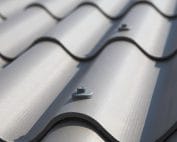
Fibre cement roof coverings
Ventilated ridges in livestock buildings: their role in the roof
At a glance
The ridge can be an important point for air to escape from a livestock building. However, its operation depends on the entire ventilation system. Fibre cement sheets require a finish matched to the profile and the design. Asbestos-free fibre cement does not in itself determine the width of the opening or the type of ridge cover. Stale, humid air should be able to leave the interior. In a building with natural ventilation, the outlet at the top can work together with an inlet through the walls or the eaves. Effectiveness depends on the geometry, weather conditions and use. There is no single gap suitable for every cowshed or stable. The design also takes into account the places where air is to flow through the interior.
The ridge is part of the flow path
Obstacles and closed zones can change its path. An open ridge without suitable inlets does not provide the expected exchange. That is why buying a ventilated ridge fitting alone does not complete the design of the system.
The cover must simultaneously drain water
The air outlet is located in a place exposed to rain, snow and wind. The ridge solution must limit the ingress of precipitation and direct the collected water onto the roof slope. An arbitrary opening should not be made and covered with a randomly selected sheet. The geometry of the entire detail matters.
Fibre cement sheets have a corrugated profile, to which the shaped pieces must fit. The height and pitch of the corrugation affect the contact between the components. Some accessories cover a specific range of roof pitches, but this does not thereby determine the minimum slope of the entire roof. These two parameters are checked separately.
The profile on both sides should be coordinated
In a gable roof, the wave pattern of both slopes matters for matching the termination. The arrangement of the sheets is determined on the installation plan. If the rows are started without agreement, the ridge element may not fit as intended. Such a mismatch should not be removed by screwing the fitting.
Fibre cement sheets and ridge tiles are materials that cannot be adjusted by force like a thin flexible covering. Stress may remain invisible during acceptance. The correct solution consists in correcting the layout or selecting a compatible detail. A screw is not used to straighten the roof geometry.
The support is planned together with the opening
The ridge requires correct positioning of the end supports and fixings. Their position depends on the selected elements and the roof slope. Enlarging the ventilation opening may change the required support. Such an adjustment should not be carried out without checking the structure and the method of fixing the covering.
Asbestos-free fibre cement does not exempt you from assessing wind forces at the roof ridge. The covering and the fittings have their own surface exposed to actions. The weight of the element is not sufficient protection against lifting. Fixings in accordance with the design and the building environment are required.
The seal must not block the ventilation function
The contractor should know which joints are to be sealed and which remain part of the airflow path. Accidental filling of all voids can deprive the ridge of its function. Conversely, leaving an unforeseen gap can let precipitation in. The distinction follows from the system detail.
Fibre cement sheets require suitable seals and overlaps at the locations specified in the instructions. Not every compound is suitable for a cement surface, and not every tape retains the required properties. The method of use is determined for the specific set. The quantity of sealing material alone does not measure the quality of installation.
Humidity in the building must be assessed more broadly
Even a correct ridge does not guarantee the absence of condensation under all conditions. Temperature, the amount of vapour and the air supply are significant. Fibre cement sheets can temporarily buffer moisture, but they do not absorb it indefinitely. A cold surface can still cause condensation.
If droplets appear after renovation, it is worth checking whether the inlets or the use of the facility have been changed. A larger stocking density, washing or closed walls affect the internal conditions. Asbestos-free fibre cement should not be treated as a substitute for ventilation regulation. The covering and the air exchange perform different tasks.
Clear passage requires periodic inspection
Over time, the outlet can become partially obscured by contamination or by elements added during other work. It is worth checking its condition during roof inspections. The cross-section should not be reduced by incidental mesh or seals without assessing the flow. Protection against animals should also be part of the design.
Inspecting the ridge requires safe access. Walking along the corrugations or along the line of screws is not planned. During the inspection, the condition of the fixings and the support is also assessed. Much information can be obtained from a suitable platform or from photographs, without loading the fragile covering.
Keep the drawing of the detail as actually executed.
After the work is completed, it is worth recording the type of cover, the accessories and the fixings used. If the arrangement differs from the earlier design, the documentation should reflect the agreed change. This makes servicing and later extension easier when the original contractor is no longer on site.
Well-chosen fibre cement sheets work together with the ridge without improvisation. The geometry, the support and the path of the water should be known. Assessing these three things helps distinguish an aesthetically covered ridge from a correctly functioning ventilation solution. In a livestock building, this difference matters every day.
Prepare a cross-section of the building with the air inlets marked. Only on this basis is it worth selecting the ridge and the termination of the corrugated sheets.
7 branches. Materials closer to your project.