Insulation and energy
Which roof insulation should you choose – PIR, EPS, XPS or mineral wool?
In brief
The choice of roof insulation depends on the entire assembly, not on the lambda value alone. Check where the material sits, the loads, the risk of moisture and the available thickness – these narrow down the realistic options. PIR helps where height is limited, EPS can be beneficial in a designed warm roof, XPS in wet conditions, and wool where fire and acoustic requirements matter. Compare variants with similar thermal performance, including details and the product datasheet. Without this, a price-per-metre comparison says little.
First establish which roof you are insulating
A pitched roof between the rafters needs different insulation from a flat roof beneath a waterproofing layer. Yet other conditions apply in an inverted roof, where the insulation sits above the waterproof layer. You need to establish the material’s position, the loads, the risk of moisture and the expected thickness. Without this, comparing prices per square metre is of little use.
During renovation, the condition of the existing layers must be checked. New insulation should not be laid on a wet substrate without identifying the cause of the moisture. The height of parapets, thresholds and flashings must also be assessed. Sometimes it is the available space, rather than the cost of the material itself, that most severely limits the possible solutions.
What does the low lambda of PIR boards offer?
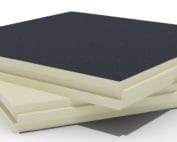
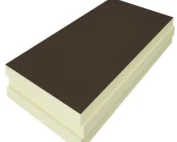
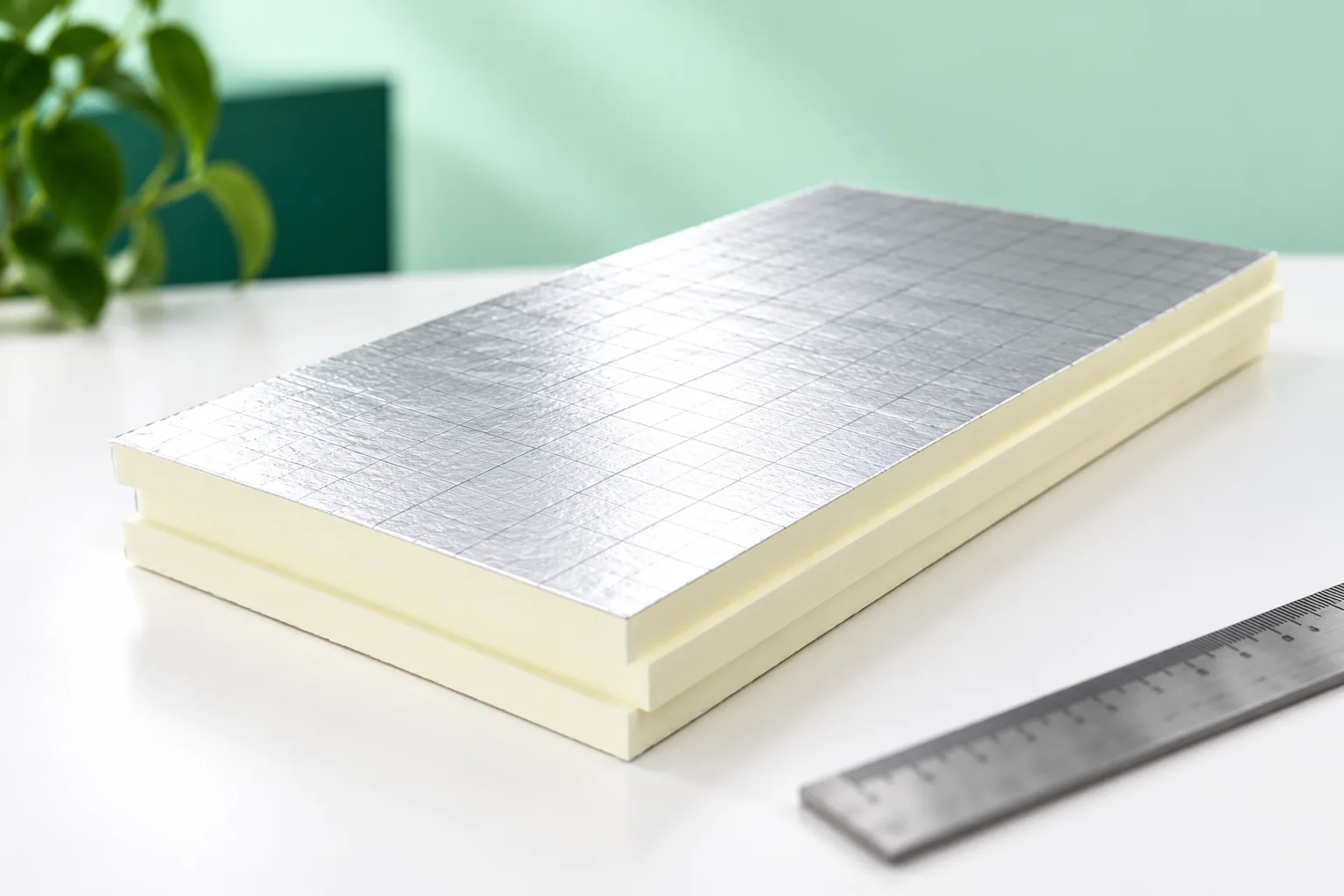
Suitable PIR boards with a gas-tight facing can have a declared λ of 0.022 W/(m·K). At this value, a 12 cm layer gives, by simple calculation, an R of approximately 5.45 m²K/W. A material with λ 0.035 would need approximately 19 cm to achieve the same resistance of a homogeneous layer. This is a real benefit where height is limited.
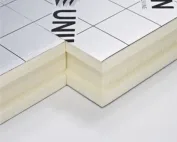
Not every PIR has identical parameters, however. Thickness and facings matter. The U-value table for a finished roof must additionally account for the structure and the joints. An insulation board with a foil facing also differs from a sandwich panel with steel facings. These products serve different functions and require different support.
When is EPS worth considering?
A suitable grade of EPS can serve as flat roof insulation in a designed system. Its mechanical parameters must be matched to the loads and its compatibility with the waterproofing checked. Facade polystyrene does not become a roof board simply because it has an attractive lambda. What counts is the intended use and the full declaration of properties.
Among the available grades, λ values vary considerably. Good PIR should not be compared solely with the thermally weakest EPS. Where more height is available, cheaper, thicker insulation may be rational. However, the calculation must account for the effect of thickness on flashings, fasteners and the height of the remaining roof elements.

What speaks in favour of XPS?
XPS is worth considering where the project places high demands on water resistance and loads. Suitable products are used, among other things, in inverted roofs. In such an arrangement the insulation has different operating conditions from PIR covered on top with a sealed membrane. Changing the material requires an assessment of the whole solution.
Low water absorption does not exempt the roof from proper drainage. The parameters of the specific board, the thickness, the protective layers and the permitted application must be checked. Compressive strength is not the only criterion. Long-term deformation is also important, as it can affect the surface or elements placed on the roof.
Where is mineral wool at its strongest?
Mineral wool is often considered where there are requirements for fire and sound protection. In a pitched roof the resilient material makes it easier to fill the space between the rafters. On a flat roof, however, a suitable roof board with different parameters from light insulation for pitched roofs is needed.
It is not enough to write “wool” in the design and assume any product. The thickness, lambda, mechanical properties and layer build-up must be specified. Fire resistance and acoustics are determined by the complete building element. PIR is not non-combustible, so it should not be given a fire advantage solely on the basis of a good thermal result.
How can costs be compared on a fair basis?
The variants should achieve a similar target insulation performance. Only then can the material price, the number of layers and the accessories be compared. In the sample material price list valid from 28 October 2026, a 100 mm PIR board costs €21.06 net, i.e. €25.91 gross, per m² of nominal area. This is the catalogue price of one variant, without installation and details.
Such a reference point is not the price of every PIR nor an offer for a complete roof. Transport, waste, offcuts and any minimum order quantity must be added. With tongued-and-grooved boards the coverage area may be smaller than the nominal area. Comparing only the prices from the first column therefore easily overstates the apparent saving.
How do you reach a final decision?
For each variant it is best to compare the required thickness, load-bearing capacity, moisture conditions and fire protection. The feasibility of correct installation at the wall plate, parapet and windows must also be checked. A material with excellent lambda will not help if large gaps remain at the details or the build-up traps moisture without a drying path.
It is worth choosing a solution described as a complete system, with instructions and available accessories. The design should indicate the method of fixing and acceptance. Then the advantage of PIR, EPS, XPS or wool follows from the specific task. There is no need to attribute superiority in all categories to one material.
7 branches. Materials closer to your project.