Roofs and metal sheets
How does a standing seam roof work and what does its watertightness really depend on?
Key points in brief
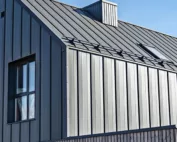
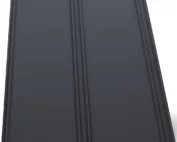
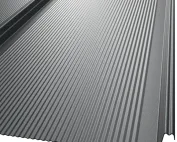
The standing seam raises the longitudinal joint above the plane of water runoff. This is one of the reasons for using such a covering. However, it does not make the roof watertight regardless of how it is installed. Water must have a correct path from the ridge to the gutter. Equally important are the panel ends, the flashings and the ability of the metal sheet to move thermally. The visible strip is a thin metal sheet with appropriately formed edges. On the roof it may be flat or have small pressings. Adjacent strips are joined by traditional folding or a snap lock. From the outside both solutions create a longitudinal rhythm, but they have a different construction.

What is between the visible lines?
In click panels, the fastening part is sometimes covered by the next element. In a traditional layout, appropriately selected clips are used. The final fastening method depends on the system. The term “concealed” alone does not indicate which fasteners were used or what they are anchored to.
Why does a raised joint help?
Water flows mainly along the flat part between the standing seams. Raising the joint limits direct inflow onto the connection. However, its closure and the precipitation conditions also matter. Wind, lying snow and a low pitch can create different conditions than a calm run-off of rain.
It is therefore not accurate to claim that every standing seam will always be more watertight than every other covering. Solutions are compared under specific conditions. A well-executed roof requires compatible panels, correct details and a suitable substrate. One good feature of the seam will not fix the other errors.
What happens at the end of the panel at the eaves?
At this point, water must leave the covering and reach the gutter. The end of the panel must work together with the eaves strip or the profile provided in the system. The outlet must not be accidentally closed by excessive bending or a wrongly positioned flashing.
In a ventilated roof, the air path must also be maintained. The inlet should be protected against unwanted access but not blocked. Thus two flows meet in one detail: water on top and air beneath the covering. Each has its own route.
Why are transverse joints so important?
A longitudinal standing seam does not resolve the junction of two panels along the length of the roof slope. Such an overlap requires a separate detail. Pitch, support and the way water is conducted all matter. If the roof length exceeds the range of a given panel, it is not enough to lay one section on top of another.
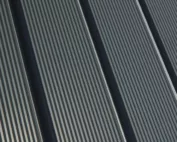
An example panel with a cover width of 510 mm may have different recommended maximum lengths depending on the profiling. A flat surface and a fine corrugation need not have an identical range. The choice of format should therefore take into account both the appearance and the permitted method of joining.

How does metal behave with temperature changes?
Steel sheet changes dimensions as it heats and cools. Long strips require appropriate fixings and end details. Restraining movement can cause stress and deformation. The instructions specify where the panel is fixed and where it must be able to move as intended.
Allowance should also be made for slight waviness of flat fields visible against the light. Not every such effect indicates a sealing defect. Evenness of the substrate and correct installation limit the unfavourable appearance. Nevertheless, thin steel sheet does not behave like a thick, completely rigid plate.
What should be checked at the chimney, roof valley and installations?
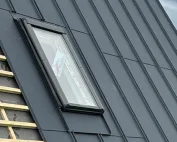
Every obstacle changes the path of runoff. At a chimney, water must be routed around it and properly connected to the wall. A roof valley collects precipitation from two sides. Supports for equipment must be matched to the profile and loads. A solution from another type of standing seam must not be transferred without checking compatibility.
Penetrations should be planned before ordering the panels. Cutting openings later increases the scope of work and the number of places to be sealed. This also applies to the layers beneath the steel sheet. A careful collar on the outside does not repair a cut and poorly joined sealing layer on the inside.
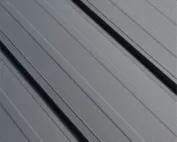
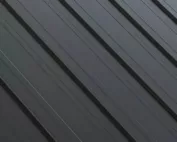
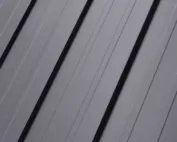
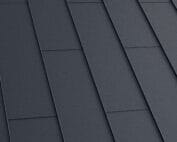
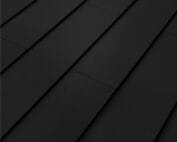
On a sample, it is easier to compare a flat surface with a gently profiled one. The difference may be subtle up close and more visible on a large roof slope in light falling at a low angle.
How do you keep a roof watertight over the years?
Check places where leaves accumulate, flashings and penetrations. Keep gutters clear. After work by other teams, check whether swarf and coating damage have been left behind. Cleaning rules are selected according to the material. An aggressive agent can worsen the condition of the surface.
When reporting a defect, describe when the moisture appears. Droplets on the underside of the roof may result from condensation. In that case, all visible joints should not be sealed without diagnosis. A proper diagnosis allows the problem of the covering to be separated from the problem of moisture in the entire building envelope.
Short answers
Does a standing seam roof have no screws at all?
It has fixings, although they may be concealed under the adjacent panel or associated with the seams. Their type and arrangement depend on the specific solution.
Does the seam alone allow you to dispense with the layers under the metal sheet?
No. The build-up of the substrate, insulation, sealing layers and ventilation results from the roof design. The type of external joint does not replace these elements.
7 branches. Materials closer to your project.