Selecting sandwich panels
Mineral wool or PIR: which core suits the way the building is used?
Key points at a glance
The choice between mineral wool and PIR should not begin with the question of which material is always better. What matters more is the specific task of a given wall or roof. A warm workshop, a noisy workshop and a cool storage area each need a different set of characteristics. A comparison makes sense when it covers complete panels, the same function and clearly stated requirements. A mineral wool panel has a fibrous core, while PIR has a closed-cell foam core. In both cases, the facings and joints also determine performance. Comparing the insulation materials alone is not enough. Two panels with the same core can differ in load-bearing capacity, weight and range of application.
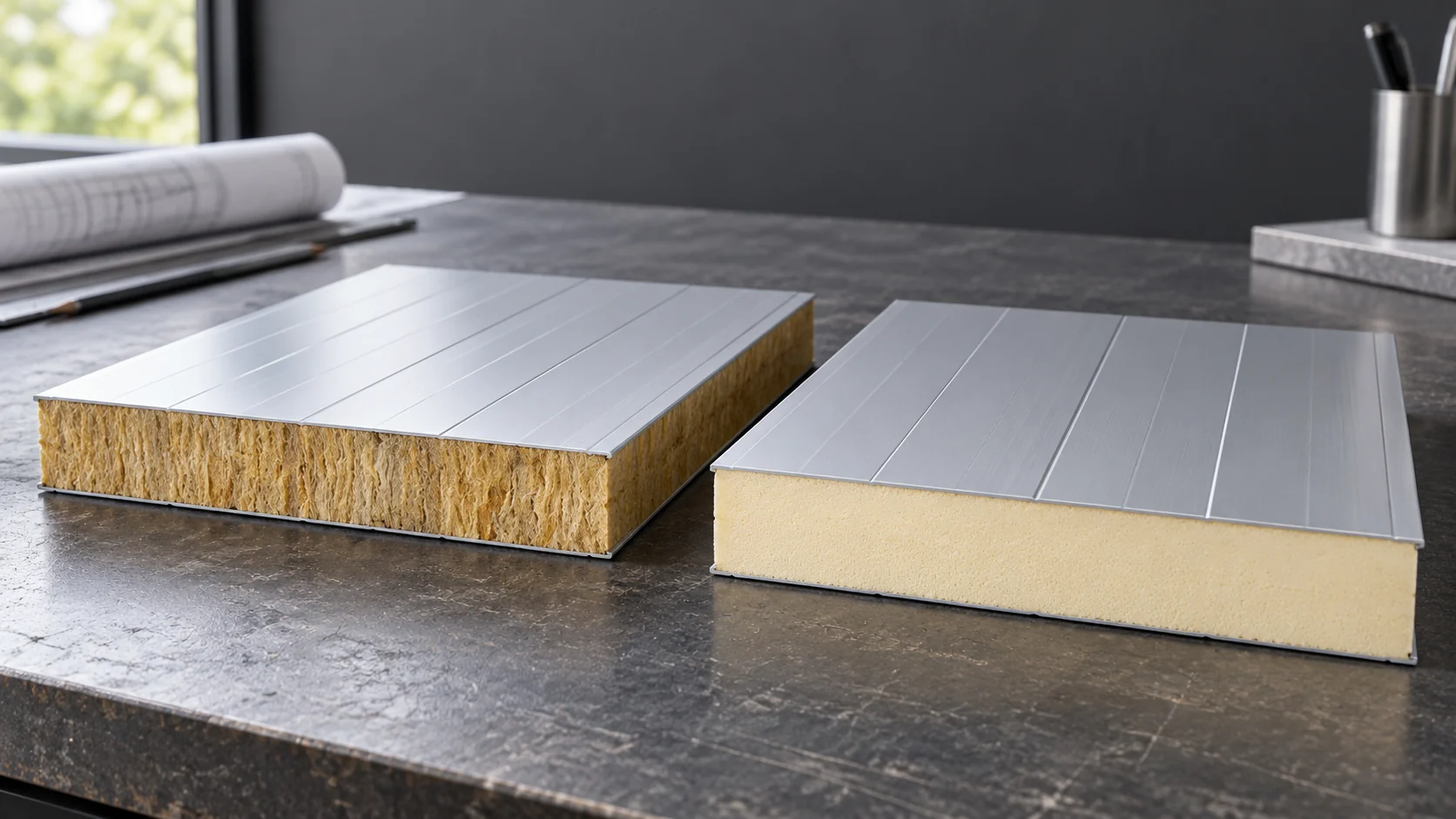
Compare two finished products
First establish whether it is a wall or a roof. Their profiles and how they perform are not interchangeable. Then select thicknesses that meet the functional requirements. A comparison of equal thickness shows material differences, but does not always lead to variants with the same level of thermal insulation.
PIR can reduce the thickness required for thermal performance
In the example wall configurations at 100 mm with visible fixing, Uc 0.22 W/(m²·K) is given for PIR and 0.39 W/(m²·K) for mineral wool at 100 kg/m³. These are data for specific products. They must not be treated as common values for all panels of these types.
In a small heated workshop, limiting the thickness can make window details easier and preserve space. However, the entire building envelope must be checked, including thermal bridges and connections. The low lambda of the foam does not by itself describe the wall result or the building’s heating energy demand.
Mineral wool is often chosen for fire performance
A mineral core is an important feature when selecting a building envelope with specific fire requirements. The class of the complete panel and the scope of the wall’s resistance must still be read. Non-combustibility of the core is not automatic confirmation of every EI class. For a roof, the appropriate data for the roof system are required.
PIR should not be described either as always non-combustible or as lacking any confirmed fire properties. Specific systems have their own classifications. The design specifies the requirements, and the product documentation allows conformity to be assessed. Changing the core therefore requires the entire solution to be checked again.
Assess noise together with the room
Mineral wool can be advantageous when selecting the acoustic insulation of the panel. This does not mean that every wall with such a core will silence any device. Sound also passes through doors, penetrations and the structure. A full steel surface can reflect it within the interior regardless of the core type.
If a quiet service point adjoins a workshop, first identify the noise sources. Then compare the relevant data for the panels and the entire partition. Reverberation may require a separate solution. Do not perforate standard cladding or add random layers without assessing load-bearing capacity, moisture and fire performance.

The difference in mass affects the structure and installation
For the specified example panels 100 mm with 0.5/0.5 mm facings, the average mass is 12.3 kg/m² for PIR and 18.1 kg/m² for mineral wool. The values relate to specific configurations. For an actual order, the relevant data, element lengths and handling method are required.
A lighter panel may facilitate some work, but still requires safe lifting and verified fixing. A heavier panel does not automatically constitute a stronger structure. Load-bearing capacity results from the system and tables. When renovating an existing frame, the mass difference must be taken into account in the assessment of supports and their connections.
Combine the total cost with the expected effect
Compare variants that meet the same project requirements. Include panels, structure, flashings, fasteners and logistics. It is possible to use different solutions in different parts of the building, but their junctions must be designed. Matching colour and thickness do not guarantee compatible locks.
In a small building divided into a warm workshop and a technical back area, the needs may differ. Record the benefit expected from each partition. This gives the selected core a justification in use. There is no need to create a single ranking in which a material wins regardless of room and working conditions.
In the comparison, also consider access for later changes. If new ventilation is planned in the workshop in a few years, suitable penetration locations can be planned now. The core alone does not determine these. Both solutions require proper edge closure and airtightness. A considered installation plan reduces the need to interfere with random wall areas after the business starts operating.
Short answers
Can PIR and mineral wool be combined in one façade?
This may be possible in the intended solution, but edge compatibility must be confirmed and details designed. Fire, thermal and structural requirements are also important.
Should panels of the same thickness be compared?
Such a set shows product differences, but when deciding it is also worth comparing variants that serve the same purpose. They may have different thicknesses, weights and costs for the entire building envelope.
7 branches. Materials closer to your project.