Costs and purchasing
First grade or outlet: how to choose the right panel for the place of use?
Key points in brief
In a commercial premises, the wall by the entrance and the back-of-house partition serve different roles, even though they may have similar dimensions. The choice between first grade and outlet should take these roles into account, as well as the condition of the specific panel. A reduced price does not describe the type of deviation. Appearance, installation and confirmed properties must be assessed separately. On a façade visible from the pavement, a consistent shade, gloss and regularity of joints will be important. In an enclosed dry storage area, a minor aesthetic blemish may matter less. This does not, however, mean technical freedom in the back-of-house. Requirements for load-bearing capacity, thermal insulation and fire protection derive from the function and the design.
Define the requirements for each surface
Prepare a simple schedule of areas, with a description of visibility and conditions of use. Mark the places exposed to water, cleaning or trolley impacts. This will allow you to check whether a defect in a given panel will actually not be a problem. The decision concerns a specific element in a specific place, not an assessment that all second-grade material is good or bad.
Ask what outlet means in this offer
Under the name outlet there may be production remnants, surplus lengths, an unusual colour or goods with described deviations. There is no single common reason for the price reduction across all offers. Establish whether the product has full documentation and whether the scope of the declared properties has been changed. The absence of a visible scratch alone does not settle these questions.
First grade is also worth checking on delivery for transport damage. The commercial grade designation does not replace inspection of the delivery. For a batch of reduced grade, on the other hand, a description of the accepted characteristics is needed. The more precise the arrangements before purchase, the fewer disputes about what the buyer was later to regard as normal.
Separate an appearance blemish from a jointing problem
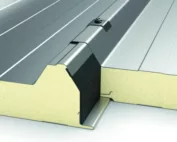
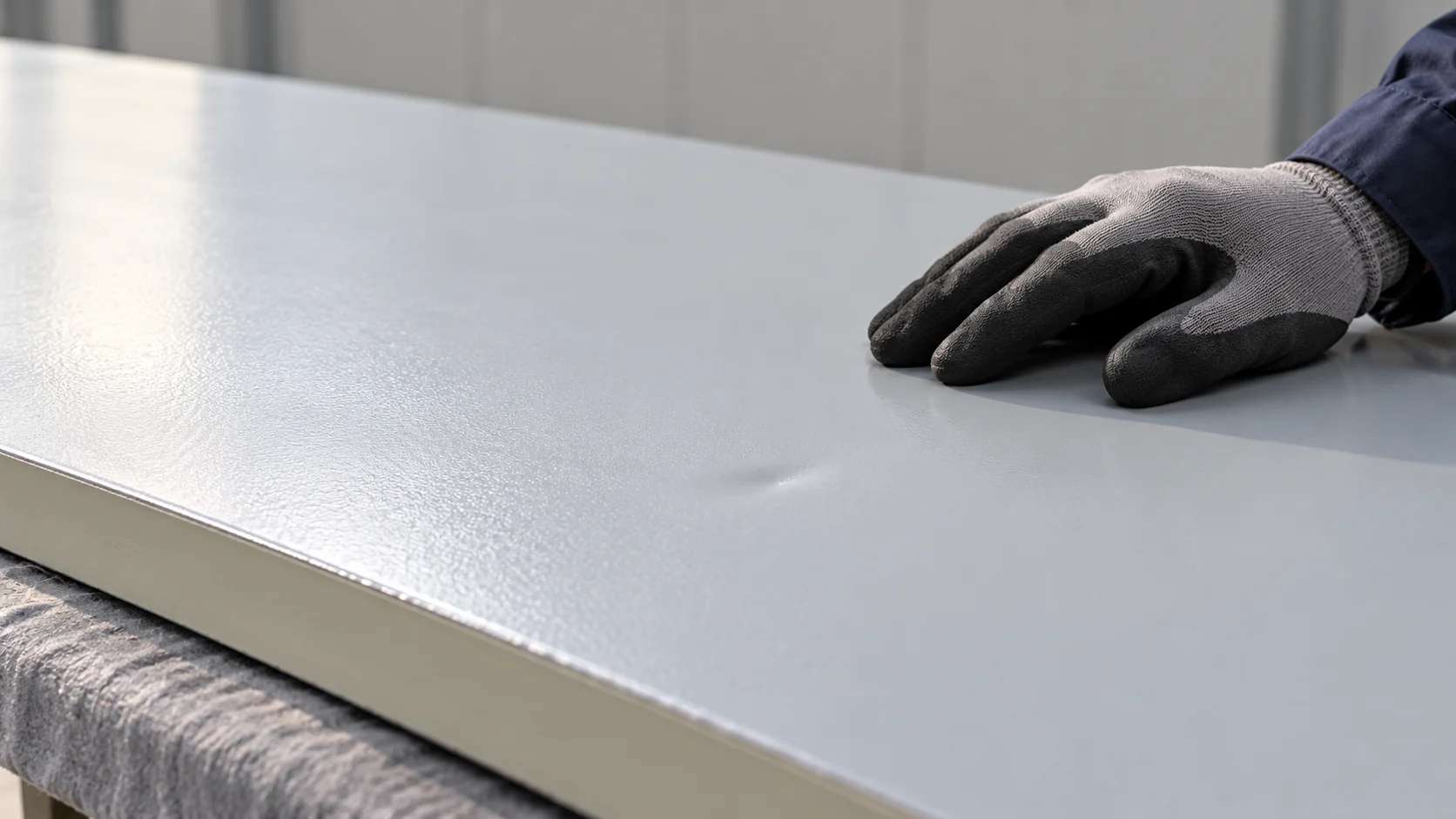
A scratch, a dent and damage to the interlock may require a completely different assessment. A deep scratch that breaches the sheet’s protection is not merely a colour change. A deformed joint can make sealing and core contact more difficult. Detachment of the facing requires a separate assessment of suitability; covering it with a trim does not restore the interaction of the layers.
A conclusion about load-bearing capacity should not be drawn from touch or the appearance of one side. If the documentation and batch information do not allow the project requirements to be confirmed, clarification is needed before installation. Trying to fit two pieces together may reveal a geometric problem, but it does not replace testing of the material properties.
See how the defect affects cutting
A damaged end can sometimes be cut off if sufficient length remains. This requires checking the position of supports, openings and edge finishing. The offcut does not automatically become a usable element in another place. On a roof in particular, an additional joint introduces new requirements for support and tightness.
In a worked example, 60 m² of the first option at €32.40 per m² before VAT costs €1,944.00. The outlet batch costs €27.31 per m² but requires 72 m², totalling €1,966.32. Despite the lower rate, the material alone costs €22.32 more. These hypothetical figures exclude cutting and extras.

Allow for batch matching and future changes
A uniform façade requires a consistent colour, profiling and laying direction. The same RAL number does not necessarily mean an identical surface appearance from different batches. Side lighting can reveal differences in gloss and minor unevenness. Samples should be viewed side by side before deciding to mix material.
If an extension is planned, check the possibility of subsequently obtaining compatible components. An unusual profile or a short end of series may be more difficult to supplement. This does not mean it must be abandoned, but the consequences must be accepted. Maintaining the described reserve makes sense when it results from a genuine servicing or cutting need.
Choose the variant according to the cost of the completed partition
Add transport, selection, cutting, flashings and installation time to the price of the panels. If the installer has to work around defects and frequently change lengths, the purchase saving may disappear. Check whether the estimate covers this specific batch and not perfectly repeatable material. For a roof, the cost of correctly making additional connections is particularly important.
The purchase should be approved on the basis of a list of accepted pieces and characteristics. For a representative façade, uniform first-grade material can simplify the decision. For a less visible location, a batch with an acceptable blemish and confirmed suitability may be possible. The outcome is determined by compliance with requirements and the full calculation, not by the word ‘promotion’ alone.
Short answers
Does outlet mean used panel?
Not necessarily. It may include new end-of-series, surplus or material with a described deviation. The origin and condition of the specific batch must be established.
Is it enough to cover a seam defect with a flashing?
This cannot be assumed. A flashing does not automatically restore the geometry of the connection, tightness and load-bearing capacity. Suitability requires assessment for the specific solution.
7 branches. Materials closer to your project.