Insulation and energy
When is PIR a better choice than EPS, XPS or mineral wool?
In brief
PIR wins where a high thermal resistance is needed within a limited thickness, but it is not a universal solution. Before choosing, establish the available height, the required resistance, the loads and the fire requirements, then compare specific products and complete assemblies. Check the declared lambda and the intended use of the product, not just the material name. This article explains when EPS may be more favourable in the budget, why XPS is considered where there is contact with water, and what speaks in favour of mineral wool.
Why does PIR allow a reduction in thickness?
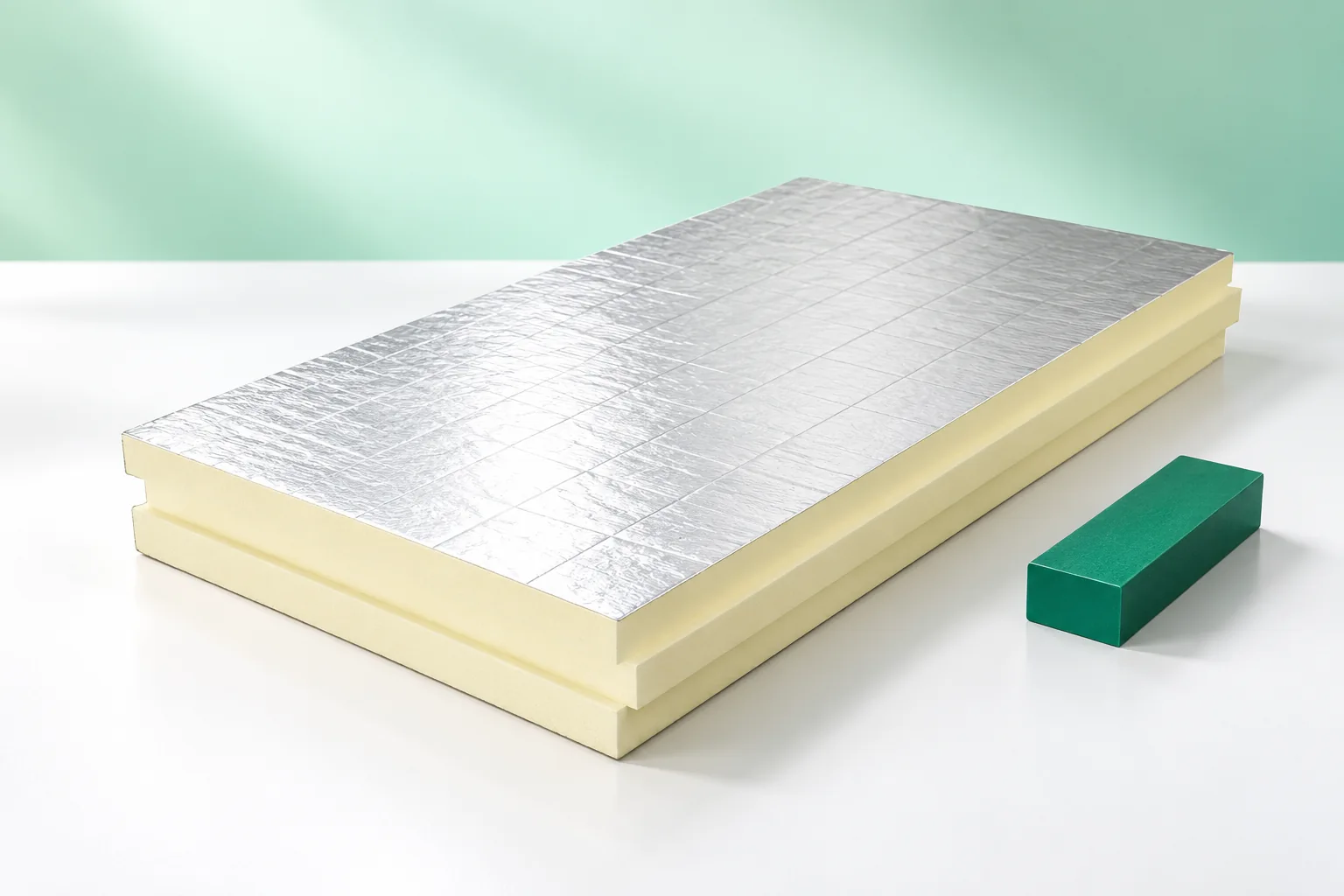
For some PIR boards with facings, the declared lambda is 0.022 W/(m·K). This is a material parameter that should be checked in the datasheet for the specific variant. Lower conductivity means that a thinner layer is needed to achieve the same thermal resistance. This matters at eaves, patio door thresholds and other places with limited height.
An example layer of 120 mm at this lambda has a resistance of approximately 5.45 m²·K/W. The same resistance requires approximately 191 mm of material with a lambda of 0.035. This is a comparison of homogeneous layers, without thermal bridges and the other parts of the roof. It does not mean that 120 mm of PIR will always meet the requirements for a building. The result for the whole building element must be calculated for its actual construction.
When is this difference particularly useful?
During renovation, the existing flashings, the height of the parapet or the space under the covering can be limiting factors. Thinner insulation can make it easier to preserve some of the details. In an above-rafter system, it also allows a continuous layer to be installed over the timber. The junction at the wall plate, chimney and window still has to be resolved, because leakage can negate the benefit of a good material.
Rigid boards require even support and precise fitting. They will not automatically fill the curved space between structural elements. Therefore, the advantage of low thickness must go hand in hand with a feasible installation arrangement. With a very irregular substrate, the work involved in fitting the boards may be more important than the difference in lambda itself.
When is it worth staying with EPS?
EPS is available in many variants. They differ in lambda, strength and intended use, so the material name alone is not sufficient for selection. On a roof, a product approved for such an application must be selected. A façade board does not become the right insulation under a loaded covering simply because it has a favourable thermal parameter or a similar colour.
If the layer height is not a problem, it is worth comparing the cost of a greater thickness of EPS with thinner PIR. The comparison should relate to similar thermal resistance and the required work under load. Fixings and flashings must also be included in the calculation.
Why is XPS considered for contact with water?
Selected XPS boards are intended for applications requiring low water absorption and adequate compressive resistance. They are used, among other things, in designed inverted roofs. There the insulation lies above the waterproofing and works under different conditions from insulation covered from above by a sealed roof layer. The intended use of the specific product must be checked.
PIR with low water absorption is not automatically a substitute for XPS in every such assembly. The facings, edges, water load and durability conditions matter. XPS also does not act as a sealed waterproof layer. The position of the insulation, drainage and method of fixing should follow from the design, not from general information about the material’s closed cells.

What makes the case for mineral wool?
Mineral wool is sometimes a good choice when the main task is to meet fire or acoustic requirements. The properties must be read for the specific product and the complete solution. Resilient grades also make it easier to fill the space between elements. On loaded roofs, suitable boards are used, not any soft material intended for a loft.
PIR is not a non-combustible material and its classification should not be attributed to the entire assembly. A metal facing also does not remove the need to assess the fire performance of the core and the joints. If the design requires a specific fire resistance, a tested assembly must be selected. Likewise, the insulation thickness alone does not indicate how well the roof will limit the noise of rain or machinery.
How should loads and moisture be compared?
In the insulation data sheet, check the compression parameters and the requirements for long-term performance. The stress at 10% deformation is not the permissible service load of the roof. The weight of installations may act as point loads through small bases. The design must specify how forces are distributed to the insulation and the substrate and whether additional load-spreading elements are needed.
The diffusion resistance of the entire product, including its facings, is also important. An aluminium laminate changes the layer’s behaviour with respect to water vapour. Mineral wool therefore must not be replaced with PIR at will without analysing the other layers. Airtightness on the interior side, protection against water and the drying capability intended for the given roof cross-section must be maintained.
How can a decision be made without comparing names alone?
First establish the required thermal result, the available height, the loads and the fire requirements. Then select realistic grades of each material. Compare their thicknesses, facings, fixing and the full cost of execution. Only then can it be seen whether the space saving achieved with PIR actually simplifies the design or whether another solution gives a better balance in that particular place.
Also check whether the offer concerns an insulating PIR board or a sandwich panel with sheet metal on both sides. These are different products with different tasks. An insulating board alone does not replace a load-bearing covering. A comparison only makes sense once each proposal covers an assembly capable of meeting the same requirements in the same building.
7 branches. Materials closer to your project.