PIR insulation
IKO enertherm ALU TG: joints within the field and at the perimeter of the insulation
At a glance
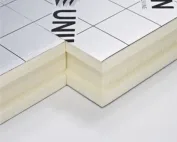
The ALU TG tongue-and-groove joint organises the connection of adjacent boards within the field. At the perimeter and around openings, cuts may occur that remove part of the factory geometry. The system should allow for such terminations. It cannot be assumed that the TG designation resolves the sealing of all cut edges. The cross-section under consideration comprises thermal insulation joined with a factory tongue and groove. The function of IKO enertherm ALU TG must be described together with the layers adjoining its surface. An important point of connection is the edge of a cut piece without a preserved factory tongue. The basis for coordination is a row plan indicating the edges remaining after cutting. Before selecting materials, the width of the last strip and the position of the joint terminations must be established so that the sequence of layers has a real reference.
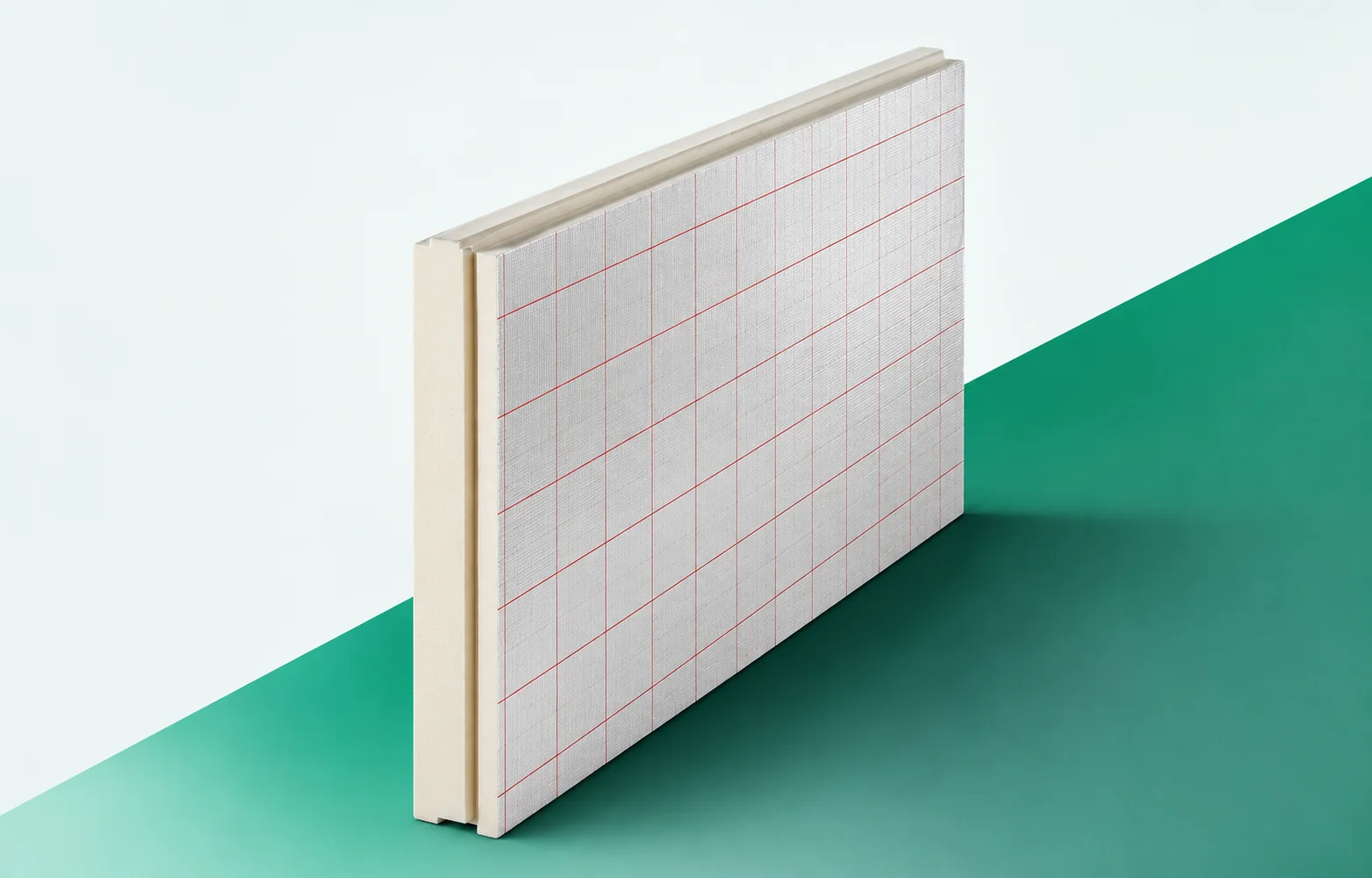
Function of the board in cross-section
A correct layout should allow full boards and cut pieces to be joined without gaps in the layer. The functions of the other layers must be defined separately.
The correct product and the scope of its data
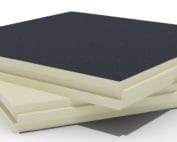
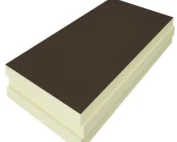
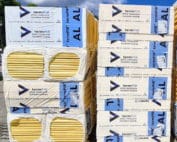
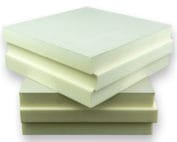
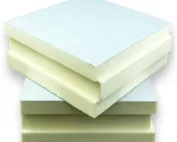
In IKO enertherm ALU TG, the rigid PIR foam core is enclosed by aluminium laminate facings, and the edge has a factory-made tongue and groove. For the family, a lambda of 0.022 W/(m·K) and a compressive strength of at least 175 kPa are stated; the reaction to fire is F, while B-s2,d0 relates to a specific end use. The tongue and groove alone does not act as a structural connection or waterproofing, and cutting removes the factory-made shape from the edge. The board is therefore considered here as thermal insulation within a system with adjacent layers, not as an interchangeable sheet.
Scope of the example comparison
For cut pieces of IKO enertherm ALU TG, part of the perimeter loses the factory-made tongue and groove, although the board thickness remains the same. An example of 100 mm at a lambda of 0.022 still gives a calculated d/λ of approximately 4.55 m²K/W. Purely arithmetically, a lambda of 0.040 would require approximately 181.8 mm; this is a comparative assumption, not a declaration of another material or of the product’s RD. The installer must separately ensure that the joints fit on a level substrate, without forcing them in. The facings, fixing and terminations require their own assessment independently of the thermal result.
The calculation involving IKO enertherm ALU TG describes the stated quantity, not automatically the class of the entire system. The relevant assumption is the tongue-and-groove profile in the ALU TG variant. The result must be compared with the limitation defined as the absence of the factory-made profile on the edges after cutting. With reference to this section, the points where the factory-made profile is lost must be indicated on the drawing. A row plan marking the edges remaining after cutting, from which the position of each layer follows, is helpful. Only then can the finish laid after acceptance of the joints be considered without implicitly transferring the rules from another combination of materials.
How to assess the proposed change
The variant based on the decision to change the width of the first row for a more favourable final cut must be considered through the entire cross-section. In the second step, the following approach must be considered: retaining the full first row and resolving the perimeter separately. With IKO enertherm ALU TG, both proposals must preserve the requirements at the location described as the cut edge without a preserved factory tongue. Any cut must not be treated as an element with a complete factory joint, because such a simplification changes the basis of comparison. The final scope should be confirmed by the coordinator for cutting and laying ALU TG. For the selected solution, a cutting plan with the laying direction and end details is required, consistent with the materials located directly below and above the insulation.
Surface and finish of the joint
The surface of IKO enertherm ALU TG is an aluminium laminate of the ALU TG variant. Its type must be taken into account when selecting the layer with which it will work. In the documentation, the tongue-and-groove profile with intact and matched edges must also be identified, instead of replacing the actual geometry with a general symbol. Acceptance should be based on the description of the fit of the tongue into the groove and the sealing of the perimeter. For this reason, the finish laid after acceptance of the joints should only be installed after the agreed inspection. In the drawing, it is worth highlighting the cut edge without a preserved factory tongue, because that is where the course of the joint changes.
The sequence of work follows from the layout
Before laying IKO enertherm ALU TG, an even substrate must be ensured without forcing the joint into position by force. The schedule should include inspection of the element described as the cut edge without a preserved factory tongue. For acceptance, a row plan must be prepared indicating the edges remaining after cutting, with any execution-related changes marked. After this inspection, work can proceed to the scope that is the finish laid after acceptance of the joints. The sequence should be coordinated by the coordinator for cutting and laying ALU TG, especially when different layers are installed by different teams. This allows the tasks of the polyurethane insulation to be separated from the work ensuring the other functions of the cross-section.
Specification ready for pricing
An enquiry for IKO enertherm ALU TG should clearly indicate thermal insulation joined by a factory tongue and groove. The description should be accompanied by a cutting plan with the laying direction and end details so that the supplier knows the adopted variant. A separate item may be the work required to make the joints of full boards and cut pieces without gaps in the layer. It is worth requesting a specification of the changes caused by any replacement of the facing or geometry. Every such proposal should again take into account the absence of the factory profile on the edges after cutting. In such an order, the polyurethane boards are part of a specific system, not a category of freely interchangeable sheets.
7 branches. Materials closer to your project.