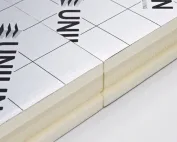
Polystyrene and thermal insulation
Choosing a vapour control layer beneath EPS roof insulation
At a glance
The vapour control layer under polystyrene is selected to suit the whole roof and the conditions in the rooms. What counts is the resistance to water vapour diffusion, but also the airtightness of the joints. The same membrane does not have to perform equally well above a dry warehouse and a damp back room. The design must specify the particular function of the layer and how its edges and penetrations are to be formed. The layer referred to as a vapour control layer limits the transmission of water vapour by diffusion. Its effectiveness is described by parameters, not by the trade name alone. In many solutions it also helps to provide airtightness. These are two related but different tasks. A material with high diffusion resistance will not fulfil the second of these if the laps have been left open.
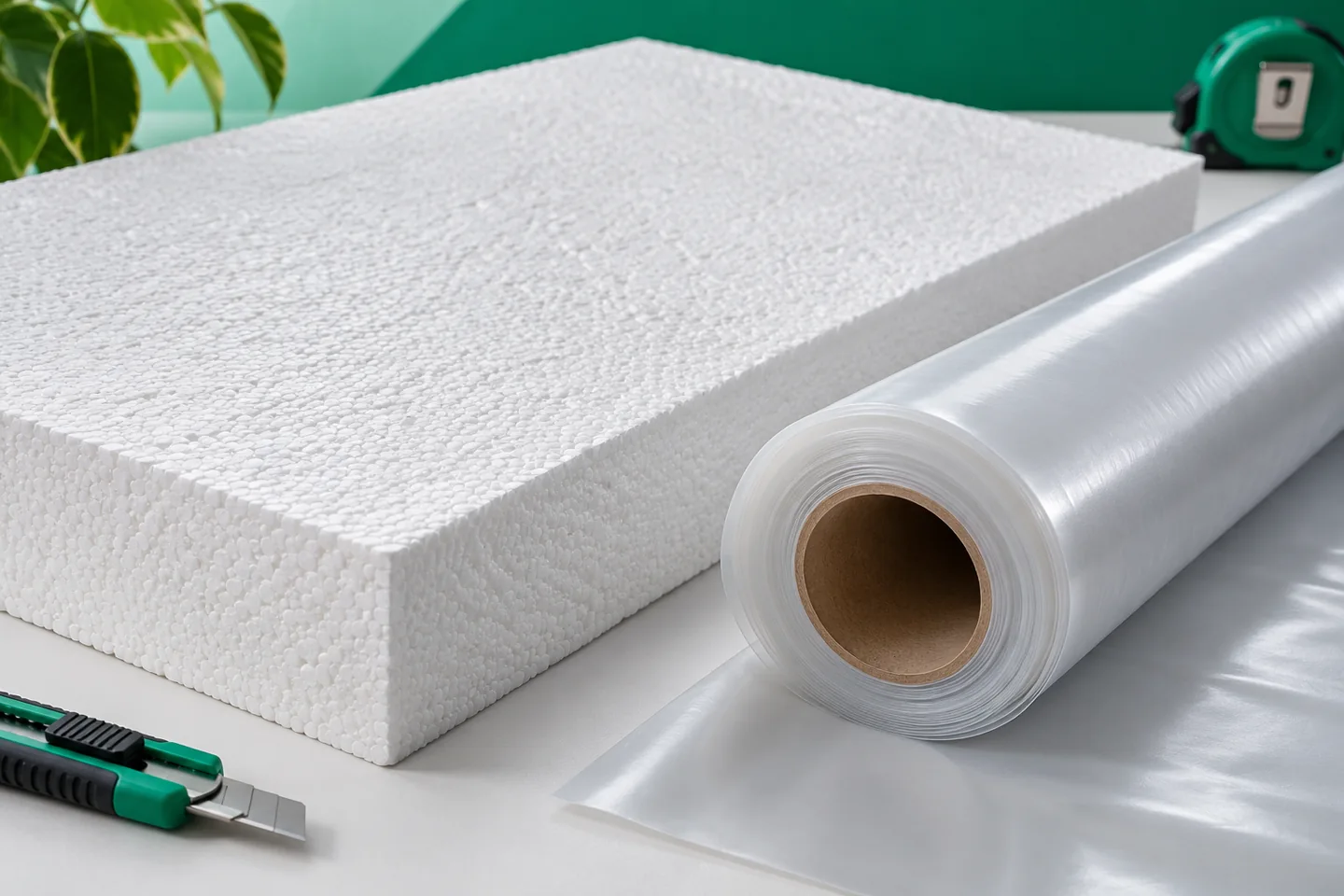
What is the vapour control layer supposed to do?
In a traditional roof, this layer is usually located on the warmer side of the thermal insulation. The exact position and type result from the design. The structure and the function of the other materials must be taken into account. It is not always necessary to add a separate foil if another assessed layer performs the appropriate role. However, this function should not be attributed to an old covering without checking its condition.
How should the sd value be read?
The sd value gives the diffusion-equivalent air layer thickness. The greater it is, the greater the resistance to vapour diffusion under the given conditions. For a homogeneous material the relationship takes the form sd = μ × d. The symbol μ denotes the dimensionless diffusion resistance factor, and d is the thickness in metres. These designations should not be confused with lambda.
For example, a layer with μ equal to 50 and a thickness of 0.20 m has an sd equal to 10 m. This is solely an example calculation, not an indication of a universal value for EPS. The boards have their own data, sometimes stated as a range. The resistance of the polystyrene itself does not mean that laying the boards tightly together will replace a vapour control layer. Gaps and penetrations remain a separate issue.
On which conditions does the selection depend?
The temperature and humidity of the interior, the external climate and the construction of the entire building envelope are important. An office requires a different assessment from a room with high vapour emission. Ventilation and the way the space is used also matter. The assumption of a dry interior should not be applied without reflection if a laundry or an intensively used sanitary area is later planned under the roof.
The covering from above can strongly restrict drying out. The resistances of all layers and the initial moisture must therefore be considered. The highest sd is not automatically the best answer to every problem. The design should specify the supply and the possibility of removing moisture. In the case of an unusual arrangement or demanding conditions, a more detailed analysis than a simple layer diagram may be necessary.
How do you match the material to the substrate?
On a concrete ceiling and on trapezoidal sheet metal, the layer works under different conditions. The requirements for support, resistance to damage and bonding differ. With concrete, the condition of the surface and the moisture must be assessed. On sheet metal, the laps, edges and places where the material does not have full support are important. The installation technology should take this into account.
Various products are available, including membranes and bituminous materials. Their compatibility with the substrate, the EPS and the method of fixing must follow from the documentation. The primer or adhesive must not damage the expanded polystyrene at the points of contact. It is not worth selecting all the components separately purely by price. The manufacturer of the complete solution can specify the required set and the application conditions.
Where does continuity most often get lost?
The connections at parapets, walls, roof hatches and pipes are critical. The layer must be brought up to the correct element and connected tightly. Simply folding up loose foil is not a durable seal. The specified tapes, adhesives or technological connections are needed. The detail should take into account the movement of the elements and the available space during installation.
Penetrations from fixings and installations must be considered within the selected system. This does not mean there is freedom to make additional holes. Before laying the EPS, it is worth inspecting the laps and documenting the places that will be covered. Repairing a leak at this stage is simpler than opening a finished roof after condensation or a leak has appeared.
What data should be included in the design?
The description should specify the required diffusion parameter, the substrate, the method of joints and sealing of details. The sequence of works and protection against damage are also needed. If the project uses an existing layer, the conditions for retaining and repairing it must be described. The contractor should not decide on their own the function of an accidentally uncovered bituminous felt solely on the basis of its appearance.
EPS manufacturers include Arsanit, Paneltech, Swisspor and Genderka. Their boards have different performance characteristics, but a brand name alone does not determine the choice of vapour control layer. The EPS, roof covering, substrate and indoor conditions must be assessed together. The layer performs its intended function only when the appropriate material is installed with durable continuity as designed.
7 branches. Materials closer to your project.