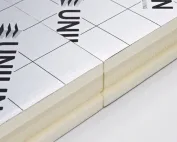
PIR insulation
Therma TF70 in floor assemblies: screed, insulation and heating
At a glance
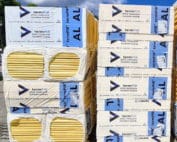
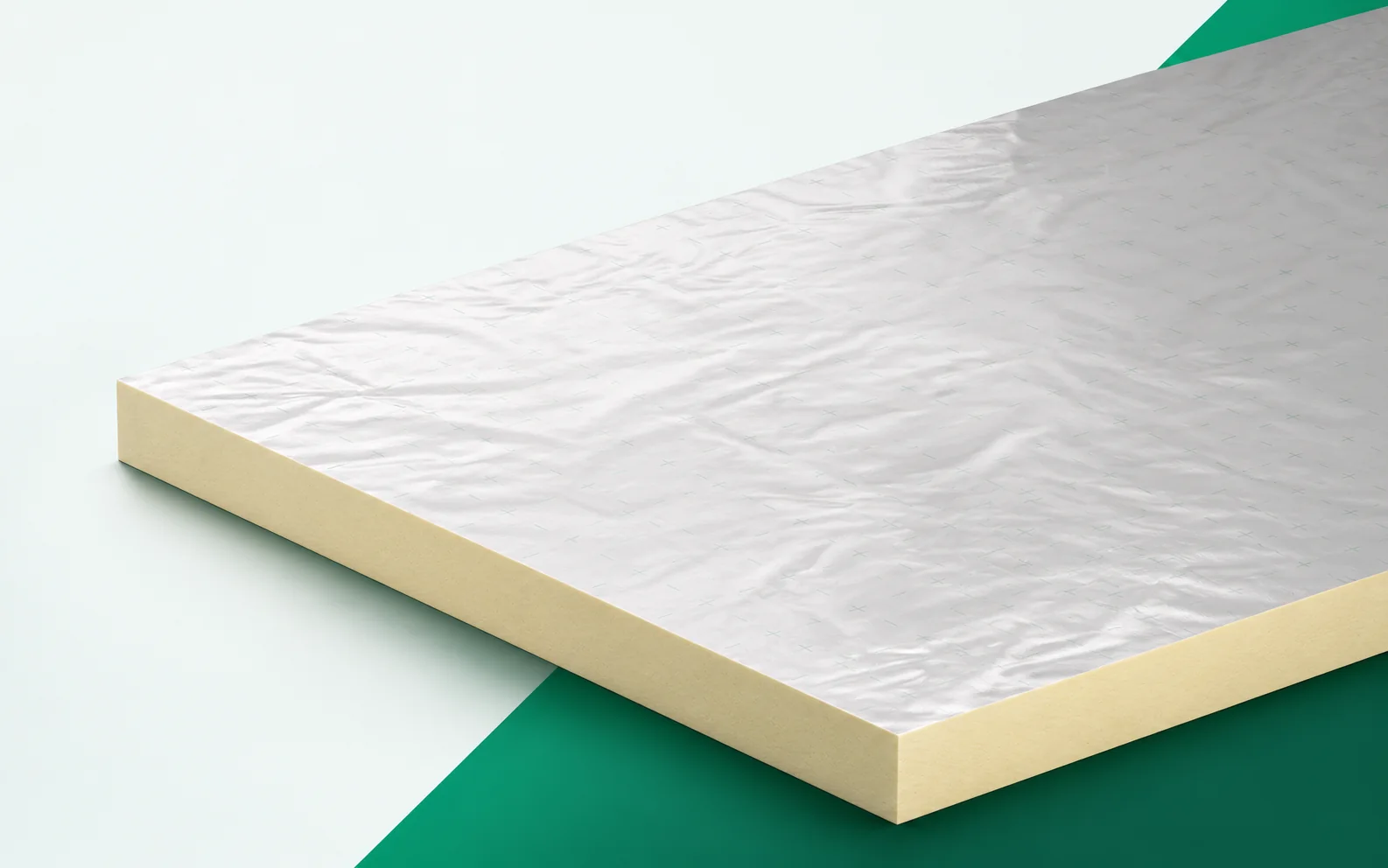
Kingspan Therma TF70 is a PIR board for heated and unheated floors, with a multi-layer facing containing aluminium on both sides. Here the thermal insulation works together with the substrate, screed, finish and protective layers. Before a thickness is selected, the overall build-up height at doors, stairs and adjacent rooms must be checked. The rigidity of the board does not replace even support or a load-distributing layer. The guide covers service grooves, junctions at walls, thermal parameters and how to read the declared compressive stress. It also helps to define the scope of works from substrate preparation to handing over the insulation for the subsequent layers.
Role of the board in the system
A floor cross-section with TF70, together with door and stair thresholds and the thickness of the planned finish. Reducing one layer without checking the whole can change the required thermal resistance or the finished floor level. The available height applies to the entire package.
Interaction of adjacent layers
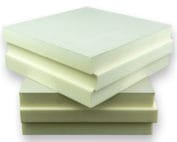
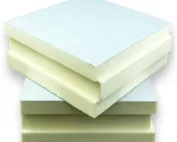
TF70 measures 1200 × 600 mm and has straight edges. Support must also be provided around the perimeter of the room and at installations. In the description of substrate preparation, include existing unevenness and the locations where cables and pipes run.
Before laying TF70, resolve grooves and level the substrate. A rigid board does not justify leaving an arbitrary void beneath future loads. The layout of joints and cut pieces should follow the route of the installations so that the layer is evenly supported.
In the floor, TF70 is responsible for thermal insulation, while the screed and the other layers have their own functions. The rigid board does not replace a load-distributing layer. The connection at the wall and the installation penetrations must be designed separately. The foil on the board does not close the entire perimeter. All these elements must appear in the cross-section handed over for execution.
Behaviour of the completed building element
In the TF70 cross-section, indicate the intended protective and separating layers together with the connection at the wall and at pipe penetrations. The laminate on an individual board does not close these gaps in the floor.
At service penetrations and around the room perimeter, combine protection and separating layers in accordance with the floor documentation. The TF70 surface cannot be assigned the function of a complete waterproofing layer. The sequence of work should leave access for making continuous connections before further layers are laid.
A shared thermal objective
For TF70 with a lambda of 0.022 W/(m·K), the catalogue states an RD of 3.60 m²K/W for 80 mm and 4.50 m²K/W for 100 mm. In the calculation, use the value corresponding to the thickness actually selected.
Assess a ground-bearing floor with TF70 using the appropriate thermal method, taking into account the geometry and the connection to the perimeter of the heated building. Heat flow to the ground is not reduced to the reciprocal of the slab’s resistance. When comparing variants, retain the appropriate RD and the same function of the entire floor.
Material parameters and installation sequence
The TF70 documentation states reaction to fire E and compression of at least 120 kPa at 10% deformation. For a heavy piece of furniture or equipment, however, the entire floor cross-section is what matters. The service load is assessed together with the screed and other layers that are to distribute it.
The CS120 result for TF70 is achieved at a deformation that is not automatically permissible in the finished floor. A heavy piece of furniture or equipment requires verification of the dimensions of the supports and the distribution of pressure through the screed. Also take into account the durability requirements of the finishing layer.
What changing the product changes
The TF70 quotation should be based on the agreed finished floor level and insulation thickness. It should cover substrate levelling, cutting, protection of the material and edge joints. These activities determine the condition in which the work is handed over for the subsequent layers.
When comparing TF70 offers, check the quantity of full boards, the scope of substrate preparation and the responsibility for protection after installation. A similar price for the insulation may conceal a different scope of these works. Acceptance should confirm a uniformly prepared floor of the required height.
7 branches. Materials closer to your project.