Installation and construction
How to plan cutting sandwich panels without damaging the facings?
Key points in brief
A good cut begins before the tool is started. You need to know why the opening is being made, how the element will be supported and how the edge will be closed. In a sandwich panel, two steel sheets and the core work together. An accidental cut can therefore change the load-bearing capacity, airtightness and durability, even when the line looks straight. Shortening a panel to the agreed length and making an opening for a window are different tasks. An opening removes part of the cross-section and changes the flow of forces. Its size, position relative to the supports and distance from the edge must be assessed for the specific system. There is no single safe size for all products.
Distinguish shortening the end from cutting an opening
In a service workshop, a new extraction grille may only appear when the machine is being set up. It is worth passing its dimensions to the designer in advance. Sometimes additional structure or a change of position will be needed. Making the opening and then seeking confirmation reverses the correct order of work.
For serial cuts, check the first finished piece before repeating the operation. A mistake in side or dimension repeated across the whole batch quickly increases losses. It is also worth provisionally marking the intended use of the cut-off pieces in the workshop documentation. The remainder does not automatically become a full-value panel for another location.
Choose a tool intended for cold working
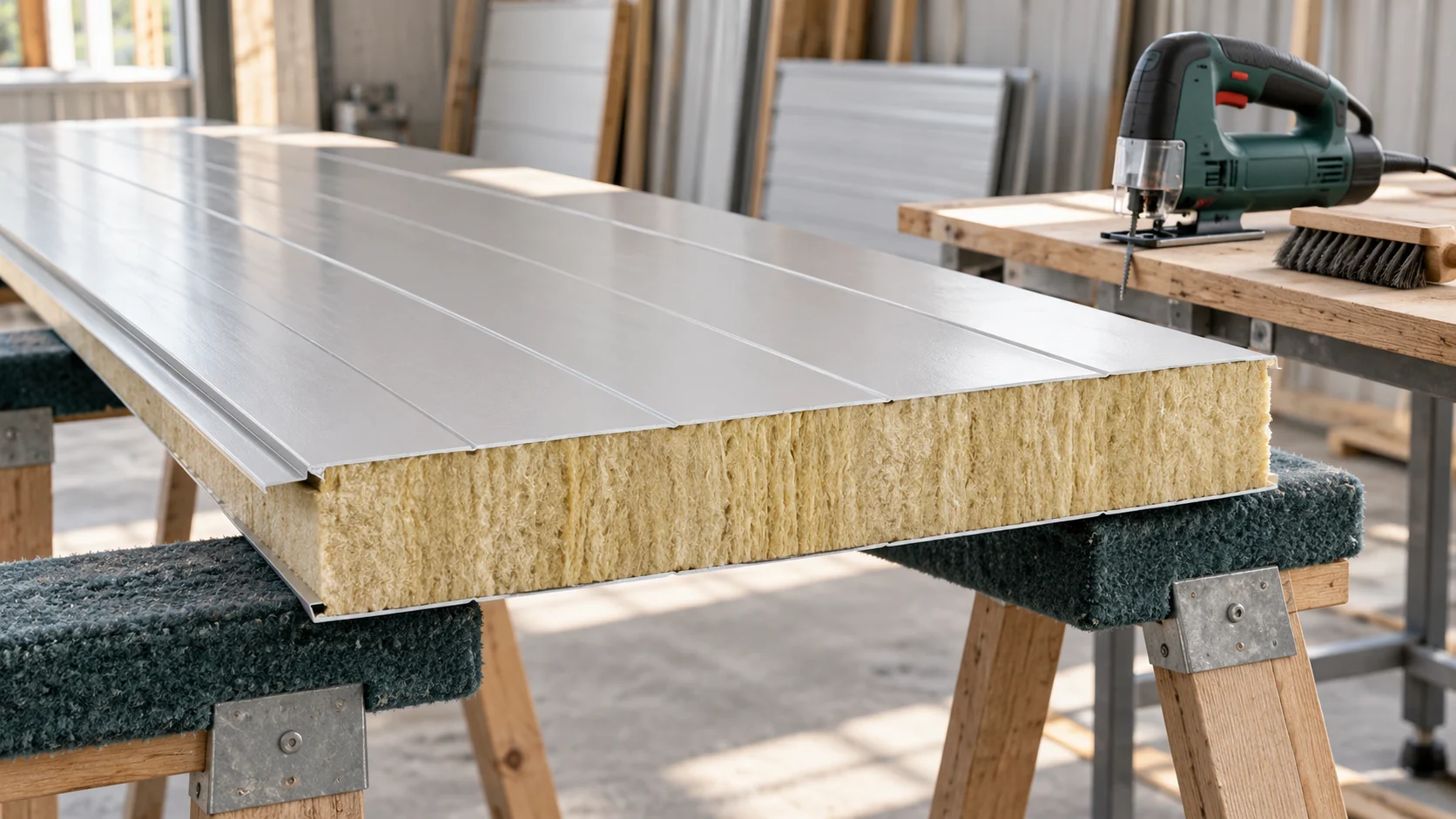
The panel instructions indicate tools that allow cutting without damaging overheating of the coatings. These may be suitably selected circular saws, sabre saws or jigsaws. The type of blade and the cutting range must match the panel thickness and the sheet metal. A tool for a thin single facing will not always cope with the whole element.
An angle grinder with a grinding disc is not the right shortcut for this work. High temperature and sparks can destroy the steel protection and damage adjacent surfaces. Preserving the coating is just as important as a straight line. Thermal damage does not have to be clearly visible immediately.
Support both sides of the planned cut
The panel should rest stably on prepared supports with surface protection. The cut-off piece must not fall and tear the last part of the sheet metal. Jamming of the blade must also be prevented. The layout of the workstation is selected according to length, weight and the way the tool is guided.
Do not use the finished façade as a makeshift table. Swarf and the blade can damage adjacent elements. Protect the surroundings and ensure access to both sides. For panels with mineral wool, allow for dust and fibres. Protective equipment and the dust extraction method are selected according to the material, the tool and their safe-use recommendations.
Mark the line taking the final detail into account
The measurement should refer to the actual structure and the intended finishing. Copying a dimension from a general layout drawing is not enough. Check the external face, the position of the interlock and the installation direction. An incorrect cut on an edge section can prevent a tight connection with the next panel.
At an opening, a frame and a solution closing the core must be prepared. In the case of a partition with a required fire resistance, the detail must preserve its function. A sealant used for protection against water does not automatically replace a fire-rated solution. All layers are terminated in an agreed manner.

Remove swarf before it can settle on the coating
Small metal particles can begin to corrode and leave marks. They must be collected from both sides of the panel and from the flashings and recesses. Use a method that does not scratch the paint. Dragging hard contaminants across the sheet metal can create further damage.
After cutting, inspect the line and its surroundings. Minor coating damage is protected in accordance with the recommendations of the given system. Greater deformation or delamination requires a separate assessment. Do not hide them immediately under a flashing. First, it must be confirmed that the element is still suitable for its task in the wall or roof.
Close the edge and keep a record of the change
The exposed core should be protected with the intended detail. Water must not have an easy path into the interior of the panel. At the same time, the flashing must allow proper water drainage in accordance with the system solution. Sealing everything with an arbitrary compound is not equivalent to a finished detail.
Mark the openings made and the reinforcements used in the documentation. This is useful for later replacement of equipment or leak inspection. If there are many cut pieces, it is worth considering preparing the dimensions in advance in the order. This reduces work on site, but still requires checking the structure and the position of all elements.
Short answers
Is a jigsaw suitable for every panel?
Not automatically. It must have the appropriate range, blade and application in accordance with the instructions for the panel and the tool. Support and the ability to guide through the full thickness are also important.
Is it enough to fit a flashing after cutting?
First, swarf is removed, the condition of the coatings is assessed and the edge is checked. Only then is the actual closing and sealing carried out. The treatment does not repair a damaged core or detached steel sheet.
7 branches. Materials closer to your project.