Costs and purchasing
Where to look for cheaper sandwich panels and how to assess the savings?
Key points in brief
The lowest price shown in an advert is often the starting point of the search, but it is not yet the answer to the question of a cheap purchase. The panel should suit the project, and its length and condition affect the amount of usable material. The most favourable place to buy therefore depends on the size of the order, the requirements and the options for using the batch. Made-to-order production can provide the required lengths and a consistent configuration. A distributor’s warehouse can be useful for a small quantity or a shorter lead time. An outlet allows offcuts and batches with described deviations to be considered. None of these channels is automatically the cheapest in every case.
Compare different channels using the same data
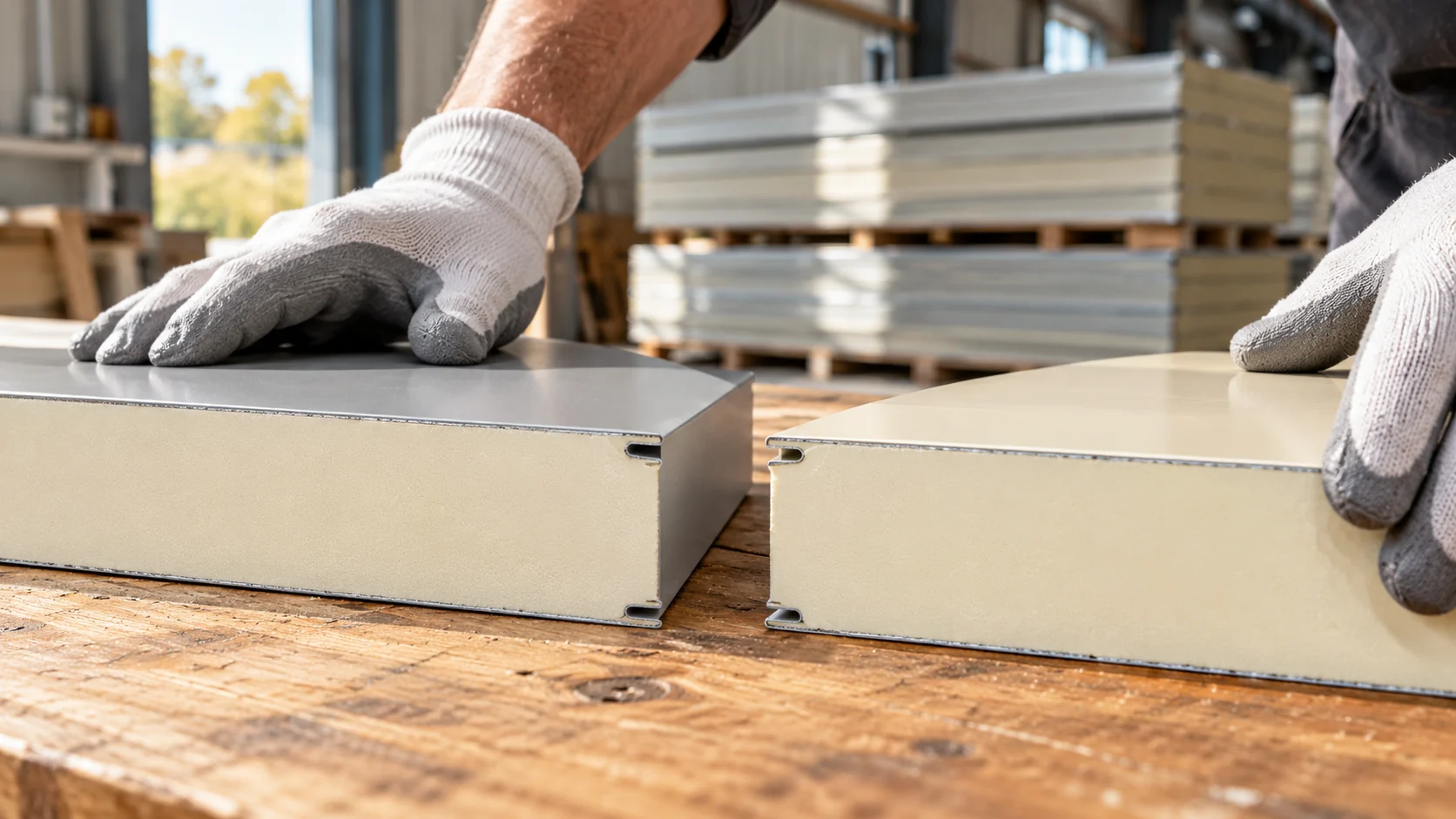
Include the same schedule with every enquiry. State the wall or roof type, core, thickness, facings and colour. If you allow alternatives, write which features may change. This way, a lower price will not result solely from thinner steel sheet, a different coating or poorer thermal fit that you do not notice at first.
First determine the properties that cannot be changed
The project may require a specific thermal insulation, load-bearing capacity or fire classification. These conditions should not be reduced just to fit into a batch found by chance. Reaction to fire and fire resistance are different properties. The name of the core does not prove that the complete partition achieves the required class.
It is worth leaving flexibility for features that can actually be changed. In a storage back area, a different shade of the internal facing may be acceptable. On a visible façade of a service unit, colour differences may be disturbing. Dividing into technical requirements and acceptable appearance helps to discuss a discount without weakening the building’s function.
Convert lengths into actual coverage
The price per m² does not show whether the entire wall can be laid from the sections. Draw the modules, openings and support points. A short panel cannot always be extended with a simple joint. An additional connection requires a designed support, sealing and flashing, and may also change the façade’s aesthetics.
In this example, 75 m² at €25.00 per m² excluding VAT costs €1,875.00. If another batch covers the same area using only 68 m² at €26.85, the bill is €1,825.80. The €49.20 difference is for the panels alone. These are assumed rates; accessories and freight could reverse the result.
Second grade requires a description, not a promise
Determine whether the reduction results from a scratch, dimensional deviation, colour difference, edge damage or another feature. An appearance defect and a problem with the joint have different consequences. Not every unevenness can be hidden under a flashing, and covering damage does not automatically restore the panel’s parameters.
Confirmation is needed of what a given batch can be used for and which properties remain declared. Inspect representative pieces and the areas indicated as defective. If missing data prevents establishing suitability for the project, the discount alone does not remove that uncertainty. Price should be assessed together with information about the material, not instead of it.

Add the costs that come back later to the purchase price
Transport of a long pack, unloading, cutting and additional processing can consume the savings from a low rate. Check the cost of a small supplementary delivery. If one panel is missing, a second delivery may be disproportionate to the value of the missing piece. Completeness of the list and an agreed allowance resulting from the cutting plan are therefore important.
For a heated building, also consider subsequent use. A material with different thermal parameters may change the heating demand. However, energy savings cannot be promised on the basis of core thickness alone. A balance of the building envelope, airtightness and how the building is used is needed.
Choose an offer that can be clearly verified
A good comparison includes quantities, billing units, parameters and the scope of extras. It also requires confirmation of the date and availability of a specific batch. A product photo in a catalogue is not proof of current stock. When reserving, establish how long it is valid for and whether it covers exactly the specified lengths.
Record net or gross prices consistently throughout the table. Add transport, packaging and unloading if they are separate items. For an offer including installation, check who bears the cost of cuts and waste removal. The cheapest useful purchase is one that allows the planned building envelope to be completed without unforeseen material changes and additional journeys.
Short answers
Does buying directly from production always pay off?
No. It can help with a larger, consistent order, but production minimums, the date and transport matter. For a small quantity, a better-matched stock batch may be more advantageous.
Is it worth buying excess only because of a discount?
Only if it has a planned use or a justified allowance. Unused lengths cost money, take up space and require proper storage.
7 branches. Materials closer to your project.