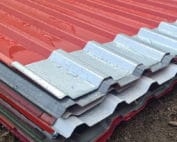
Roofs and steel sheets
How do you choose the thickness of trapezoidal steel sheet for a roof and the way the building is used?
Key points in brief
The thickness of the trapezoidal sheet is not chosen solely based on the roof area. The profile, support spacing, loads and steel grade are important. In many offers you will find values of 0.5, 0.6 and 0.7 mm. This is a starting point for comparison. The data for the specific sheet and the layout of the entire roof assembly determine which variant will be suitable. In the specification, a distinction must be made between the thickness of the metal substrate and the thickness of the protective coatings. The paint coating does not replace the steel. Increasing its thickness is not a way to achieve the load-bearing capacity of a thicker sheet. The offer should make clear to which layer the given number refers.
What does the value given in millimetres actually mean?
Nominal thickness is subject to specified tolerances. A single measurement on a finished, coated sheet does not always allow conformity to be assessed straight away. The method of measurement and the product documentation are what matter. Do not compare a calliper reading with the declaration without establishing what has been measured.
Why does the same steel dimension not give the same stiffness?
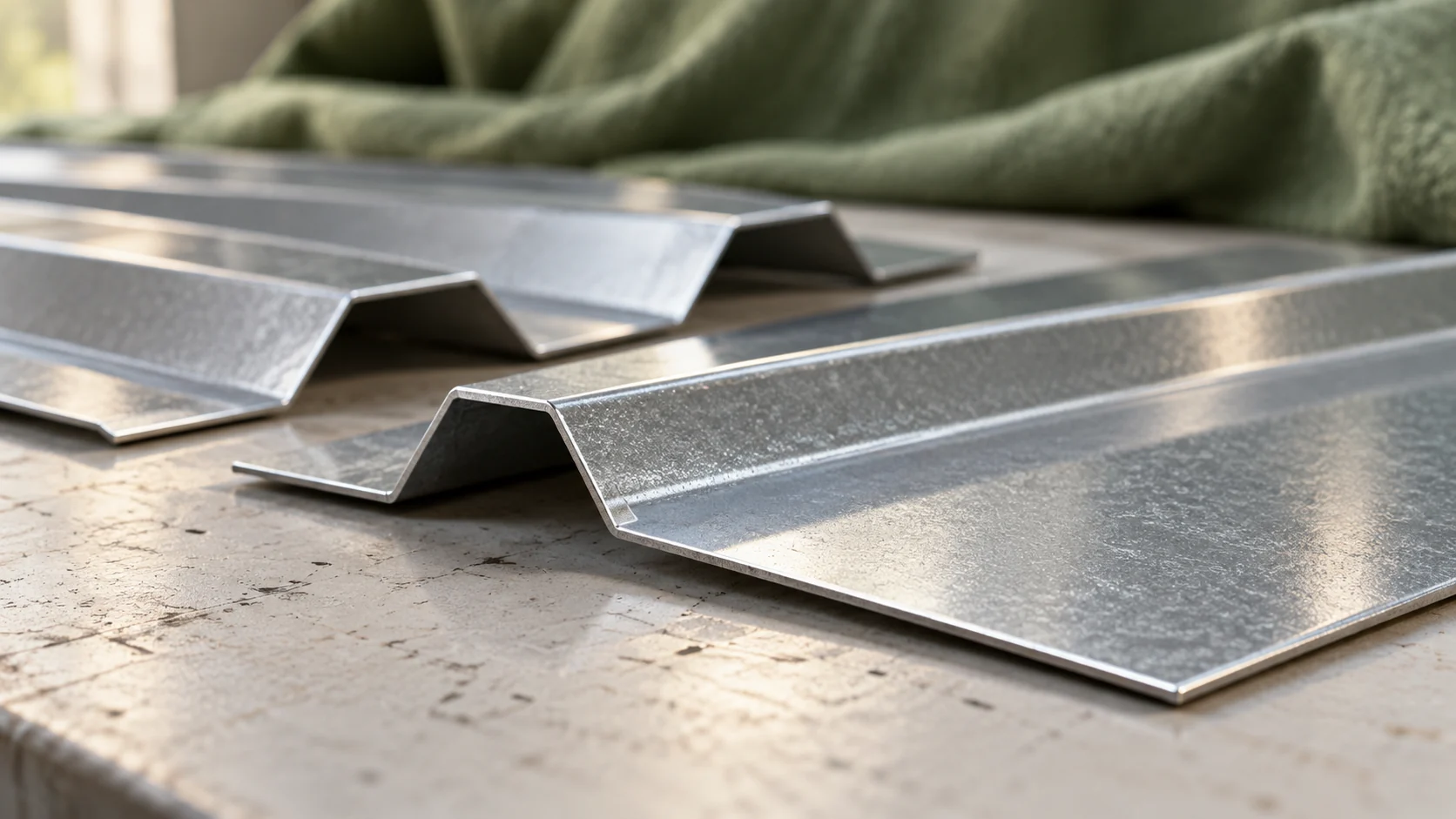
A flat sheet and a sheet with a high trapezoidal profile behave differently. The behaviour of the sheet is determined by the entire cross-section: height, flange width, rib spacing and additional stiffening profiles. That is why the designation T18 or T35 is just as important as the number of millimetres. It still does not describe every detail, however.
Two trapezoidal profiles with the same nominal name may have a different section drawing. Load tables must not be transferred between them. A comparison only makes sense for a specific variant, thickness and steel grade. The thickest sheet on the available list is not automatically the best choice for every roof.
What role do supports play?
The spacing between purlins and the number of spans over which the sheet lies are significant. A single-span arrangement is assessed differently from a continuous one. The support width is also important. A table prepared for one scheme does not give the freedom to apply any other.
The check covers load-bearing capacity and deflection. A roof may fail one condition despite meeting the other. The fixings must also be designed. In an existing workshop, first establish the actual structural arrangement. Only then select the covering to suit it, not the other way round.
Can you choose a sheet without information about snow and wind?
These actions should not be overlooked. Location, roof geometry and the way the building is enclosed all matter. At edges and corners, wind suction may require different fixing than in the middle of the roof slope. An open canopy is not the same case as a sealed industrial hall.
An example workshop in Krotoszyn may have an enclosed section and a covered porch. This is a hypothetical layout that must be described to the designer. The town name alone does not determine the full set of loads. Height, surroundings and the shape of the structure are also important.

What does thicker steel sheet change in everyday use?
It changes the weight of the sheet and its behaviour during lifting and installation. For a specific trapezoidal profile with a height of 35 mm, the mass per square metre of effective coverage may be 4.71 kg with 0.5 mm steel and 6.59 kg with 0.7 mm. These are data for one cross-section in a specific variant, not a conversion factor for all trapezoidal sheets.
Thickness alone does not give general permission to walk on the roof slope. Movement on the roof requires proper support and working rules. It also does not solve rain noise or condensation by itself. Comfort depends on the entire layer build-up and how the space under the roof is used.
Is the coating as important as the steel?
It serves a different function. It protects the surface under specific conditions and gives it its appearance. When selecting it, the environment, moisture exposure and cleanability are taken into account. Both sides of the sheet must be checked. The underside above a humid room may operate under different conditions than the external surface.
Do not judge protection by colour alone. The same shade may occur in different coating systems. Cutting and removal of swarf also matter. Damage from incorrect processing is not repaired by choosing a greater nominal steel thickness alone.
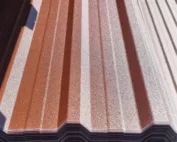
It is worth keeping a sample of the finish for comparison with the delivery. It facilitates assessment of shade and texture, but does not by itself confirm the thickness or grade of the steel.
What should go into the order?
Provide the exact profile, nominal steel thickness, coating and colour. Add lengths, number of sheets and direction of use. Confirm the coverage width and the need for an anti-condensation layer. For technical arrangements, include the support spacing and the scope of the fixing design.
If the seller proposes a change of thickness, ask for the entire variant to be checked. A substitution may change cost, weight and conditions of use. The decision should be based on the properties of the finished product. An assurance that the difference is only one tenth of a millimetre is not enough.
Short answers
Is 0.5 mm enough for every small roof?
No. A small area does not determine support spacing, loads or the performance of fixings. A specific profile must be selected.
Will a thicker trapezoidal sheet improve thermal insulation?
It will not replace insulation. The choice of steel thickness relates primarily to the mechanical performance of the sheet. Thermal performance is assessed for the entire building envelope.
7 branches. Materials closer to your project.