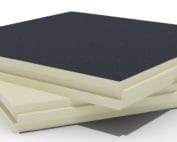
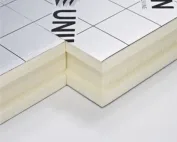
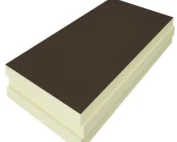
PIR insulation
How many centimetres of PIR give a similar thermal resistance to polystyrene?
Key points in brief
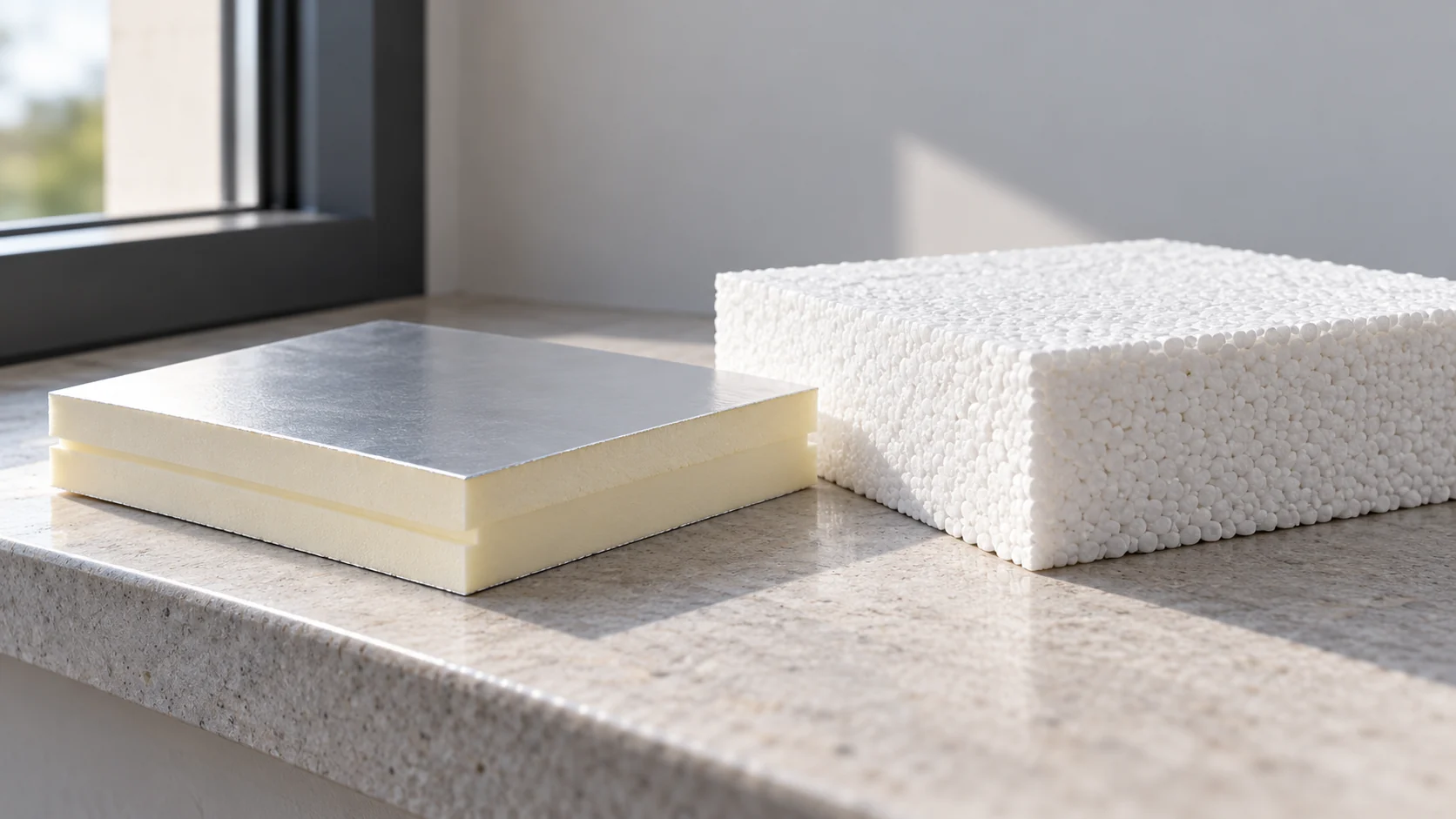
Thinner PIR can give a similar thermal resistance to thicker polystyrene, but there is no single conversion factor for all boards. You need to know the lambda of both materials and check their application. With a small window reveal, saving a few centimetres can be valuable, but it should not mean replacing the whole system without assessing its other properties. Thickness tells you how much space the layer will take up. Its ability to limit heat flow is given by the resistance, denoted R. In simplified terms, you divide the thickness in metres by the lambda. A lower lambda allows the same resistance to be achieved with a smaller thickness.
Compare thermal resistance, not thickness alone
The comparison must relate to materials intended for the building element under consideration. A PIR board for the floor, a board in foil and a board with fleece under render may have different declarations. Picking the best lambda from one variant and the price from another gives a result that cannot actually be ordered. It is worth recording the designation of the variant being compared.
Example with 15 cm of polystyrene
Assume polystyrene 150 mm thick with a lambda of 0.036 W/(m·K). Its resistance in a simple calculation is approximately 4.17 m²K/W. For the assumed PIR with a lambda of 0.022, a similar resistance requires approximately 92 mm. The result is a theoretical thickness, not an indication of a product available in that dimension.
Once the actual thickness has been selected, the declared resistance of the specific board is checked. Compliance with the layer build-up and the installation method are also added. Do not order 90 mm solely because the number is close to 92 mm; the difference may matter if the project works to an assumed limit.
PIR under render may give a different conversion factor
If a lambda of 0.026 W/(m·K) is used in the same comparison, the required thickness will be approximately 108 mm. Such a value may correspond to a specific group of thicknesses of façade board with fleece. After moving to a different thickness, however, the declaration must be checked again, because the lambda may change.
In this example the difference between the two types of PIR is approximately 17 mm. This shows why the slogan “PIR replaces polystyrene in a fixed proportion” is too imprecise. In practice, the variant available in the specific system is selected and only then is the calculation completed for it.
Better polystyrene reduces the difference
For 150 mm of EPS with an assumed lambda of 0.031, the thermal resistance will be approximately 4.84 m²K/W. Matching this with PIR at a lambda of 0.022 requires approximately 106 mm in the calculation. This is a greater thickness than in the previous example, although the layer of EPS being compared is still 15 cm.
The lambdas given are assumptions to demonstrate the method, not a description of every variant on the market. In quotations it is worth comparing the declared resistances of products at selected thicknesses. Such a comparison reduces errors associated with rounding and with the difference between calculated and declared values.

Similar R does not mean an identical wall
The entire building envelope also includes the wall, plasters, fixings and junctions with other elements. Changing the insulation can affect vapour flow, the method of fixing, details at windows and fire behaviour. The U-value of the wall is not simply the inverse of the resistance of the board alone.
With an existing façade, compatibility of the new layers with the substrate is important. A material specified in the system cannot be freely replaced with another, even one with equal R. First the approved configuration must be confirmed, then the entire building envelope and the scope of work on flashings must be checked.
Check the space saving on the specific detail
The greatest benefit of thinner insulation may become apparent at a narrow reveal, an entrance under a canopy or a limited passage width. However, the full finish must be taken into account. The thickness of adhesive, reinforcing layer, plaster or gypsum board does not disappear when the core changes.
It is worth drawing both variants at the same scale. Check the projection of the window sill, the junction with the plinth and the space for fittings. If the thinner material allows a correct detail to be maintained, the benefit is concrete. If it simplifies nothing, the cost of the whole solution may weigh more heavily in the choice.
Do not price the substitution by cubic metre alone
The budget comparison should relate to a square metre of completed building envelope with a similar thermal target. Include seals, fixings, finish and labour. Different board formats can also produce different offcuts for the same number of windows.
Similar resistance does not guarantee similar energy consumption throughout the house. Bills are affected by the other building envelope elements, ventilation, services and the heating method. The gain from replacing one layer should be assessed in the building balance, without promising a fixed percentage saving for every user.
Short answers
Is it enough to multiply the thickness of the EPS by 0.6?
Not always. That ratio applies only to a specific pair of lambda values. For other material variants the result will differ, and once the thickness is chosen the declared thermal resistance must be checked.
Are two materials with equal R interchangeable in a façade?
Not automatically. They must suit the system, the substrate, the fixing and the fire requirements. Moisture behaviour and the details of the whole wall must also be checked.
7 branches. Materials closer to your project.