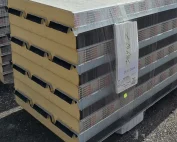
Buildings and applications
How do you choose panels for a cold room and freezer in a small facility?
Key points in brief
In a cold room, air temperature is not the only consideration. Door opening frequency, moisture, cleaning method and the type of goods stored also matter. A freezer places different demands on the enclosure. Panel thickness is selected as part of the overall system, together with the floor, ceiling, doors and refrigeration unit. State the storage temperature, chamber dimensions and ambient temperature. Record the quantity and temperature of goods brought in, operating hours and the number of door openings. A small chamber in a shop’s back room behaves differently from a warehouse where trolleys enter throughout the day. The enclosure cannot be selected on floor area alone.
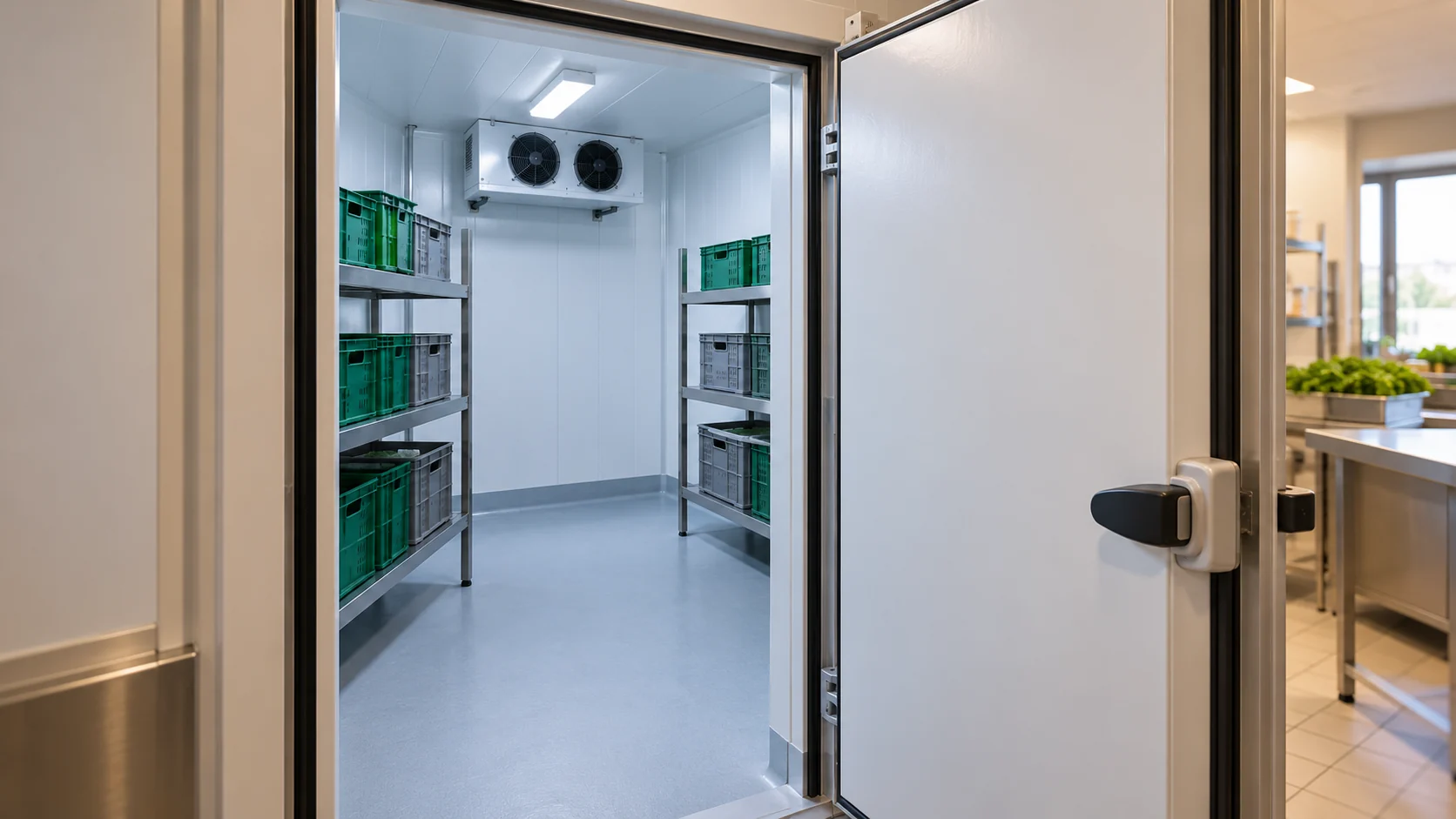
Describe the process before choosing the thickness
Cooling freshly delivered products places a different load on the system than maintaining the temperature of an already chilled batch. A thicker wall reduces heat transfer but does not replace calculation of heat gains from goods and air exchange. This data should be provided to the designer of the cold room and the refrigeration system. This helps avoid apparent savings on a single component.
Choose the variant intended for refrigeration
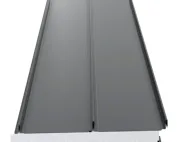
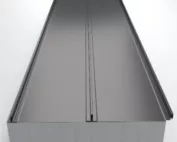
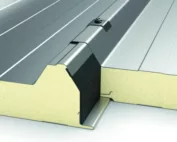
Cold-room panels have joint solutions designed for specific temperature and tightness conditions. An ordinary wall panel with the same core does not necessarily offer identical details. The difference also concerns joint sealing, floor connections and service penetrations. The name PIR alone describes the type of core, not a finished cold room.
Within one proven cold-room panel family, thicknesses of 120, 160, 180 and 200 mm are available. This is not a universal selection for specific temperatures. Even the thickest of these requires verification of the joints and the method of support. The properties of the entire building envelope depend on the product and workmanship. Fire class or U-value from another system should not be transferred.
A thicker panel is one component of the balance
For the specified panel family, the Uc value is 0.18 W/(m²·K) at 120 mm and 0.11 W/(m²·K) at 200 mm respectively. These are data for these specific panels, not for every PIR panel. The difference can be used for an initial comparison of losses through the full area. It does not describe the effect of doors, thermal bridges and leaks.
For an assumed 40 m² of envelope and a constant temperature difference of 30 K, we obtain 216 W and 132 W of transmission in a simplified U × A × ΔT calculation. The difference is 84 W. This is not the capacity of a selected cooler nor an energy bill. The unit’s operation also depends on efficiency, opening of the cold room and heat gains over the entire period of use.
Airtightness protects the insulation and limits frost
Warm, humid air tends to penetrate into the cold interior. A leak at a joint can cause local condensation or freezing of moisture. The continuity of the designed seal must therefore be maintained, particularly on the warmer side. The solution depends on the cold-room conditions and the panel system. Accidental silicone on a visible gap does not prove that the entire joint is correctly sealed.
Pay particular attention to the corners, the wall-to-ceiling junction and the door perimeter. Pipes, cables and drains should pass through prepared details. After commissioning, it is worth observing whether moisture appears around them. Repeated frost is a signal to find the cause, not merely to remove it.

The floor and doors have their own tasks
A casing of thick panels will not remedy an uninsulated floor. In a freezer, the design must take account of the substrate, insulation, moisture and protection against frost penetration to the extent appropriate to the given project. Movement of trolleys requires verification of loads and threshold details. Decisions should not rest on the strength of the insulation alone at high test deformation.
Doors are selected according to temperature, intensity of traffic and the manner of emergency opening from inside. Gaskets and heating of selected elements, if provided by the system, affect operational reliability. Shorter opening limits the ingress of warm air. Sometimes a more convenient circulation layout brings greater benefit than merely thickening the wall.
The surface should suit cleaning and the goods
In a food preparation area, the ability to maintain cleanliness is important. Select the surface according to humidity and the cleaning agents used, taking account of temperature and contact time. Not every white coating has the same properties. The documentation should confirm suitability for the specific environment and manner of use.
Plan access for cleaning corners, equipment and the drain. Shelving must not damage the cladding or obscure places requiring inspection. At acceptance, check the continuity of seals and the condition of the coating, and then the operation of the doors after the chamber has cooled. A temperature measurement at one point does not yet confirm tightness and the correct operation of all details.
Short answers
Can a freezer be built from any thick wall panel?
This should not be assumed. Confirmation is needed of the panel’s scope of application and of the floor, joint, ceiling and door solution for the chamber’s operating conditions.
Will greater thickness always reduce the bill by a similar percentage?
No. The overall chamber balance determines the result. When a large proportion of heat enters through frequently opened doors, changing the wall alone may yield limited benefit.
7 branches. Materials closer to your project.